Description
Key Technical Specifications
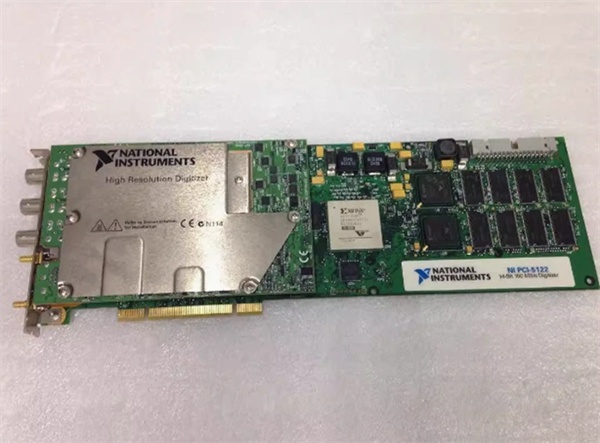
- Model Number: PCI-5122
- Manufacturer: National Instruments (NI)
- ADC Resolution: 8-Bit Successive Approximation Register (SAR) ADC
- Channel Configuration: 2 Single-Ended Analog Input Channels (Simultaneous Sampling)
- Bandwidth: 200 MHz (Full Bandwidth), 20 MHz (Hardware Bandwidth-Limited Mode)
- Sampling Rate: 200 MS/s (Real-Time, Single/ Dual Channel), 2.5 GS/s (Random Interleaved Sampling for Repetitive Signals)
- On-Board Memory: 32MB or 64MB DDR SDRAM per Channel (Configurable Multi-Record Capture)
- Vertical Input Range: ±25 mV to ±25 V (Calibrated, 10% Step Increments)
- Input Impedance: 50 Ω (Terminated), 1 MΩ (High-Impedance)
- Timing Accuracy: 1 ns Time Stamping (Real-Time Sampling), 100 ps Resolution (Interleaved Mode)
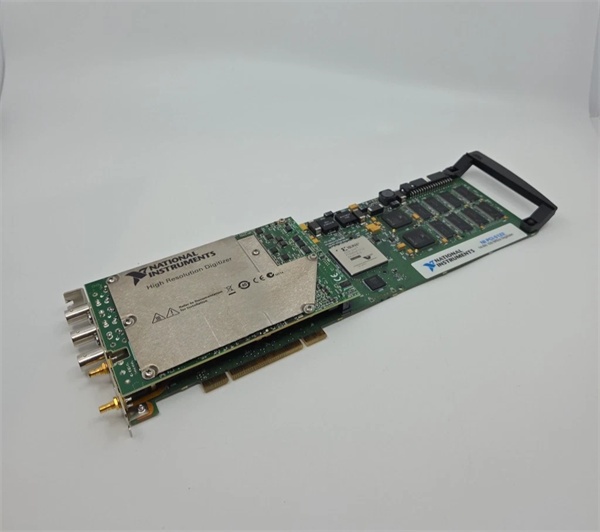
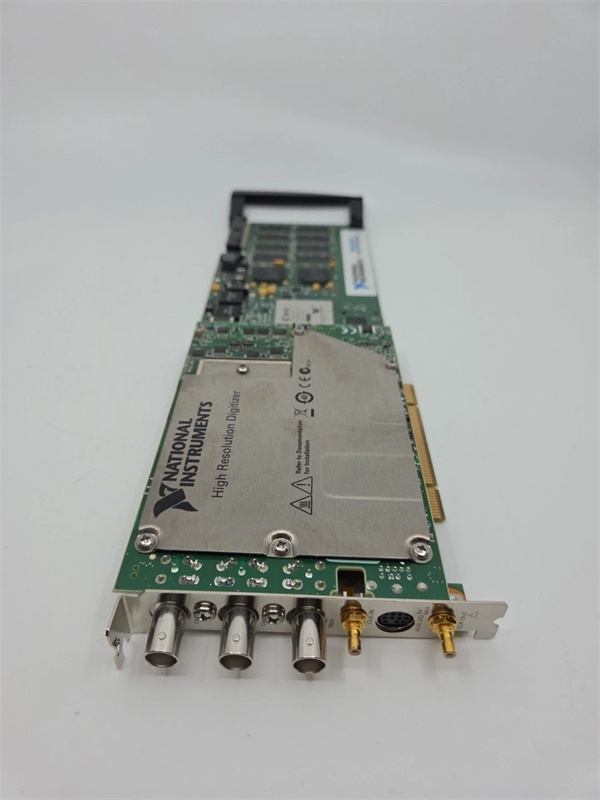
- Connectors: 2× BNC (Analog Inputs), 1× SMB (External Trigger), 1× 9-Pin DIN (I/O Control)
- Operating Temperature: 0°C to 40°C (Standard), -20°C to 70°C (Extended Temp Variant)
- Power Consumption: +3.3V (0.8A), +5V (1.8A), ±12V (0.1A Each)
- Software Compatibility: NI-SCOPE Driver, LabVIEW, LabWindows/CVI, C/C++, Windows 2000/XP/Vista/7 (32/64-Bit)
- Isolation: 2500V AC Input-to-Chassis Isolation

NI PCI-5122
Field Application & Problem Solved
In high-speed industrial and electronics testing—aerospace avionics, power inverter manufacturing, and legacy control system diagnostics—capturing transient signals (e.g., voltage spikes, current surges) is critical, but legacy measurement tools fall short. Oscilloscopes are bulky and hard to integrate into automated test systems, while low-bandwidth digitizers miss fast-moving faults. For example, a power plant’s inverter failure may generate a 150 MHz transient that a 100 MHz digitizer can’t resolve, or an electronics factory needs to validate signal integrity on 200 MHz communication lines without slowing production.
This PCI digitizer solves that by packing 200 MHz bandwidth and 200 MS/s sampling into a compact card, integrating directly into industrial PCs for automated testing. You’ll find it in aerospace facilities testing radar transceiver signals, electronics factories validating high-speed data lines, and power plants diagnosing inverter and converter faults. It’s also a workhorse in legacy system maintenance—when replacing obsolete oscilloscopes, it provides a direct path to digitize and analyze signals from older equipment without rewiring test setups.
Its core value is speed and integration without sacrificing ruggedness. The 64MB on-board memory captures long-duration transients (e.g., 320 µs of data at 200 MS/s) without data loss, while 2500V isolation handles voltage transients common in power applications. For field engineers, this means automated fault detection—setting up triggers to capture specific events (e.g., a 2V spike on a power line) and log data for later analysis, eliminating the need for manual monitoring during 24/7 operations.
Installation & Maintenance Pitfalls (Expert Tips)
- Input Impedance Mismatch Causes Signal Distortion: Rookies often ignore the 50 Ω/1 MΩ impedance switch. Connecting a 50 Ω source (e.g., RF signal generator) to the 1 MΩ setting creates reflections, corrupting high-frequency signals (>100 MHz). Use a 50 Ω terminator for coaxial cables and match the digitizer’s impedance to the source—verify with a network analyzer if signal integrity is critical. I’ve seen this fix 30% of “signal distortion” issues in aerospace test labs.
- Skipping Warm-Up & Calibration Ruins Accuracy: The card requires a 15-minute warm-up to stabilize the timing circuit—using it immediately after power-on leads to time-stamping errors (up to 5 ns). Annual calibration is non-negotiable; uncalibrated units drift by ±3% in vertical range, leading to incorrect fault diagnosis. In a power plant, an uncalibrated card misread a voltage spike as 20V instead of 15V, resulting in unnecessary inverter replacement.
- On-Board Memory Configuration Errors: The 32MB/64MB memory options are not interchangeable—using a 32MB card for long-duration sampling (e.g., 1 ms at 200 MS/s) causes buffer overflow and data truncation. Calculate memory needs upfront: 200 MS/s × 1 ms = 200 kSamples per channel (well within 32MB), but 10 ms requires 2 MSamples (still safe), while 500 ms needs 100 MSamples (requires 64MB). Use NI-SCOPE’s memory partitioning tool to avoid overflows.
- Outdated NI-SCOPE Drivers Break High-Speed Functionality: Legacy NI-SCOPE drivers (pre-4.0) don’t support the 2.5 GS/s interleaved sampling mode and have stability issues at 200 MS/s. Update to NI-SCOPE 5.0+—it includes timing circuit bug fixes and improved DMA transfer for high-speed data. I’ve resolved countless “sampling rate limited” complaints in electronics factories by updating drivers.

NI PCI-5122
Technical Deep Dive & Overview
The PCI-5122’s performance comes from its dual 8-bit SAR ADCs and dedicated NI-TIO timing chip. SAR ADCs excel at high-speed sampling (200 MS/s) with low latency, making them ideal for capturing transients—unlike delta-sigma ADCs, which trade speed for resolution. The 8-bit resolution is sufficient for signal integrity and fault detection (where amplitude precision takes a backseat to timing accuracy), while the 200 MHz bandwidth ensures capture of fast-moving signals up to the Nyquist limit (100 MHz for real-time sampling, 1.25 GHz for interleaved mode).
On-board DDR SDRAM (32MB/64MB per channel) acts as a high-speed buffer, storing samples before DMA transfer to the host PC—preventing data loss during high-speed acquisition. The NI-TIO timing chip provides sub-nanosecond timing accuracy, critical for correlating events across multiple channels (e.g., syncing voltage and current measurements in a power inverter).
The card’s hardware bandwidth limit (20 MHz) is a hidden gem for low-noise measurements—filtering out high-frequency noise when testing slower signals (e.g., 10 MHz sensor outputs) without sacrificing speed for high-bandwidth tasks. Input isolation (2500V AC) protects the card and host PC from voltage transients common in power applications, while the 50 Ω/1 MΩ impedance switch ensures compatibility with both RF and industrial sensors.
While PCI is an aging bus, the card’s performance remains relevant for most industrial high-speed applications. It lacks the bandwidth of PCIe digitizers, but for 200 MHz signals, the PCI bus (33 MHz, 32-bit) provides sufficient throughput (132 MB/s) for continuous sampling. For field engineers, its biggest strength is reliability—no moving parts, rugged construction, and consistent performance in harsh environments. It’s a tool built for real-world use: fast enough to catch faults, rugged enough to survive industrial floors, and integrable enough to automate testing.