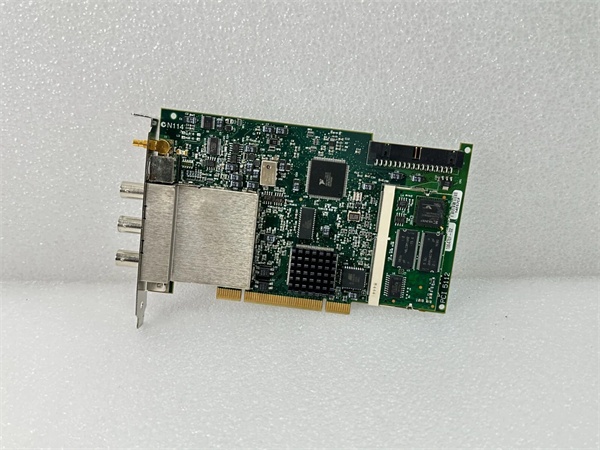
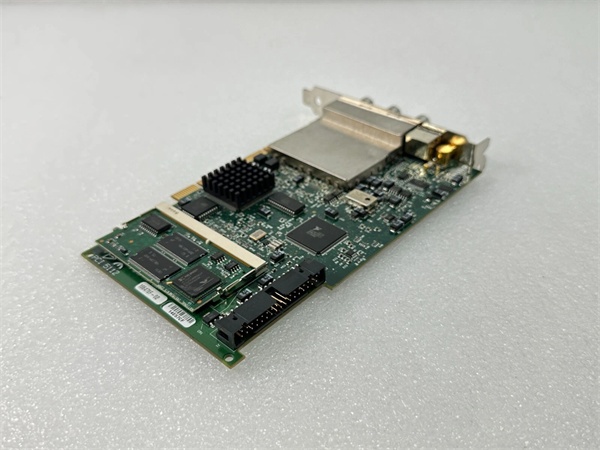
Description
Key Technical Specifications
| Technical Indicator | Details |
|---|---|
| Manufacturer | National Instruments (NI) |
| ADC Resolution | 8-bit analog-to-digital converter |
| Channel Configuration | 2 single-ended analog input channels, supporting simultaneous sampling |
| Bandwidth | Maximum 100 MHz; typical 20 MHz when the 20 MHz hardware bandwidth limit is enabled |
| Sampling Rate | 100 MS/s in real-time sampling mode; up to 2.5 GS/s in random interleaved sampling (RIS) mode |
| On-board Memory | Two options: 16 MB per channel or 32 MB per channel, the 32MB version supports multi-record capture mode |
| Vertical Range | Calibrated range of ±25 mV to ±25 V, adjustable in 10% step increments |
| Timing Accuracy | Equipped with NI-TIO timing chip, time stamping accuracy of 2 ns for real-time sampling and 100 ps for random interleaved sampling |
| Power Requirements | 0.5 A at +3.3 VDC, 1.5 A at +5 VDC, 80 mA at +12 VDC, 120 mA at -12 VDC |
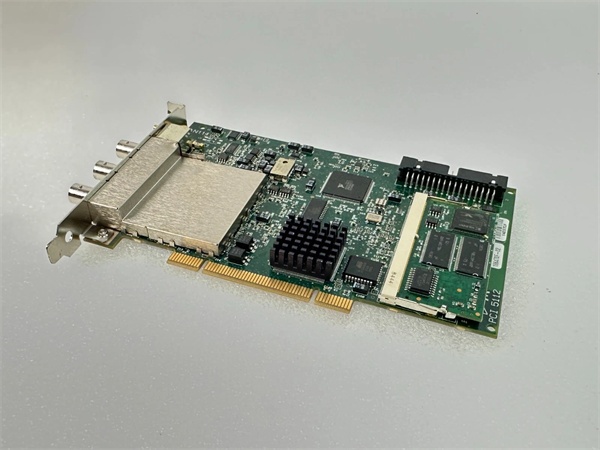
| Connectors | 2 BNC female connectors, 1 SMB female connector, 1 9-pin DIN I/O connector |
| Operating & Storage Environment | Operating temperature: 0°C – 40°C; Storage temperature: -20°C – 70°C; Non-condensing humidity: 10% – 90% RH |
| Calibration & Warm-up | Recommended warm-up time of 15 minutes; calibration interval of at least once a year |
| DC Accuracy | ±2.5% for range settings, ±0.5% for offset settings |
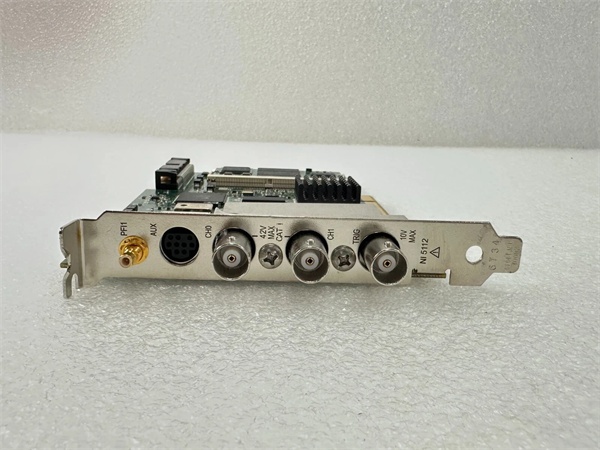
NI PCI-5112
Field Application & Problem Solved
In high-speed signal testing scenarios, traditional GPIB-based measurement instruments often have the disadvantages of slow data transmission speed and long measurement cycles, which make it difficult to capture transient high-speed signals. In addition, some low-cost digitizers on the market have problems such as small on-board memory, which cannot store long-term continuous signal data, and poor timing accuracy, which leads to large errors in signal time-stamping. These problems bring great obstacles to electronic product debugging and scientific research data collection.
The NI PCI-5112 solves these pain points well by virtue of its advantages of PCI bus and high-performance hardware configuration. For example, in the production line of mobile phone charging chips, the card can capture the transient current and voltage signals during the chip’s fast charging process at a 100MS/s real-time sampling rate, and quickly judge whether the chip’s signal output is stable so as to screen out unqualified products. In university physics laboratories, when researching high-frequency electromagnetic signals, researchers use its 2.5GS/s interleaved sampling rate to analyze the waveform characteristics of repetitive electromagnetic signals, and the 16MB/channel on-board memory can store a large amount of sampling data for subsequent in-depth analysis.
Moreover, its 20MHz hardware bandwidth limiting function can filter out high-frequency noise when testing low-frequency signals such as audio circuits, improving the accuracy of signal analysis. Compared with GPIB-based instruments, its PCI bus interface enables faster waveform acquisition and processing, which shortens the overall test time and improves the efficiency of experimental and production testing.
Installation & Maintenance Pitfalls (Expert Tips)
- Memory Version Mismatch: The product has two memory versions. If the 16MB/channel version is used in scenarios that require long-term continuous sampling (such as monitoring the operation signals of industrial equipment for a long time), it may lead to insufficient memory and data loss. It is necessary to select the appropriate version according to the sampling duration and frequency. For long-term sampling scenarios, it is recommended to choose the 32MB/channel version with multi-record capture mode.
- Neglecting Warm-up and Calibration: The card requires a 15-minute warm-up time before use. If it is used immediately after power-on, the timing accuracy and signal sampling accuracy will be affected. In addition, if the annual calibration is not performed as required, the DC accuracy and range accuracy will drift, resulting in large errors in test results. It is suggested to formulate a regular calibration plan and record the calibration data to ensure the stability of the equipment.
- Incorrect Driver Installation: The NI PCI-5112 relies on the NI-SCOPE driver to work. Using an incompatible or outdated driver version may cause problems such as failure to recognize the device or inability to set the sampling rate normally. It is recommended to download the driver version matching the operating system from NI’s official website instead of randomly installing third-party drivers to avoid functional abnormalities.
- Ignoring Voltage Range Limitations: The maximum working voltage of the card is 42V (Measurement Category I), and the calibrated vertical range is ±25mV to ±25V. If the input signal exceeds this range during use, the ADC module may be damaged. When testing unknown signals, a voltage divider should be used to reduce the signal amplitude to the safe range first, and then connected to the card for sampling.

NI PCI-5112
Technical Deep Dive & Overview
The core competitiveness of the NI PCI-5112 lies in its balanced high-speed sampling performance and flexible application capabilities. The NI-TIO timing chip it is equipped with is the core component to achieve high-precision time stamping. This chip can realize time stamping of data records in various acquisition modes, and even can timestamp triggered events for up to 130 days with 2ns precision in real-time sampling mode, which is of great significance for scenarios that need to track the occurrence time of abnormal signals, such as industrial control system fault diagnosis.
Its random interleaved sampling technology is another major highlight. Although the real-time sampling rate is 100MS/s, it can achieve a sampling rate of up to 2.5GS/s for repetitive signals through interleaved sampling. This makes it possible to analyze high-frequency repetitive signals without purchasing more expensive high-speed digitizers, which reduces the cost of testing equipment for small and medium-sized enterprises and scientific research institutions.
However, the product also has obvious limitations. Its 8-bit ADC resolution is lower than that of high-precision digitizers with 12-bit or 16-bit resolution, so it is not suitable for scenarios that require high signal quantization accuracy, such as low-noise sensor signal sampling. In addition, as a PCI bus device, it is gradually being replaced by PCIe bus digitizers with higher bandwidth in new equipment. But for legacy test systems based on PCI slots and scenarios that do not pursue ultra-high precision, such as rough testing of consumer electronics, the NI PCI-5112 still has high cost performance and practical value due to its stable performance and mature driver support.