Description
Key Technical Specifications
Model Number: MVME55006E-0163R
Manufacturer: Motorola (now Emerson/Artesyn Embedded Technologies)
Product Family: MVME5500 Series (6E Rugged Variant)
Form Factor: 6U VME (233.4 mm × 160 mm / 9.2″ × 6.3″)
Processor: Motorola/Freescale MPC7457 PowerPC RISC microprocessor at 1 GHz
Cache: 256 KB on-chip L2 cache, 2 MB L3 cache
Coprocessor: 128-bit AltiVec™ vector processing unit
Memory: 512 MB onboard 133 MHz SDRAM ECC (Error-Correcting Code), expandable to 1 GB via memory mezzanine
Storage: Dual banks of soldered Flash memory (32 MB and 8 MB)
VMEbus Interface: VME64x with Universe II VME interface
PCI Buses: Dual independent 64-bit PCI buses
PMC Expansion: Two PMC sites with 33/66 MHz capability; 64-bit PCI expansion mezzanine supports up to 4 additional PMCs
Ethernet: Gigabit Ethernet (1000Base-T) plus additional 10/100BaseTX Ethernet
Serial Ports: Two RS-232/422/485 serial interfaces
Handle Type: IEEE handles (6E designation indicates enhanced/rugged variant)
Power Supply: 5V DC ±5%, ±12V DC ±10%
Operating Temperature: -40°C to +85°C (industrial/military rugged)
Storage Temperature: -40°C to +85°C
Vibration/Shock: Enhanced for military/industrial environments (MIL-STD compliance implied by 6E designation)
Firmware: MOTLoad with POST, initialization, debugging, OS boot
Operating System Support: VxWorks, Linux, QNX
Migration Path: From MVME2300, MVME2400, MVME2600, MVME2700, MVME5100 series
Field Application & Problem Solved
In the field, the biggest challenge with standard VME boards is environmental survival. Commercial-grade boards rated for 0°C to +70°C fail in outdoor enclosures, desert heat, arctic cold, or high-vibration military vehicles. The MVME55006E-0163R solves this as a ruggedized “6E” variant of the MVME5500 series, delivering full 1 GHz PowerPC performance with -40°C to +85°C operation and enhanced shock/vibration tolerance .
You will typically find this board in military ground vehicles (tanks, APCs, command vehicles), aerospace applications (unmanned aerial vehicles, mission computers), outdoor industrial automation (oil & gas, mining, railway signaling), and marine environments (shipboard control, offshore platforms). The “6E” designation indicates enhanced environmental specifications beyond standard commercial grade—though Motorola’s exact 6E specification sheet is proprietary, industry usage implies extended temperature, conformal coating, and enhanced vibration tolerance.
Its core value is performance without compromise in harsh environments. While ruggedized embedded computers often sacrifice performance for reliability, the MVME55006E-0163R delivers the same 1 GHz MPC7457 processor, 512 MB ECC SDRAM, dual PMC slots, and Gigabit Ethernet as the standard MVME5500 , but survives where standard boards would fail. The IEEE handles (vs. Scanbe handles on commercial variants) provide more secure retention in high-vibration environments. The AltiVec vector coprocessor enables real-time signal processing for radar, sonar, and image analysis in tactical applications. The dual Flash banks support redundant boot images—critical for systems that cannot afford downtime in combat or safety-critical situations.
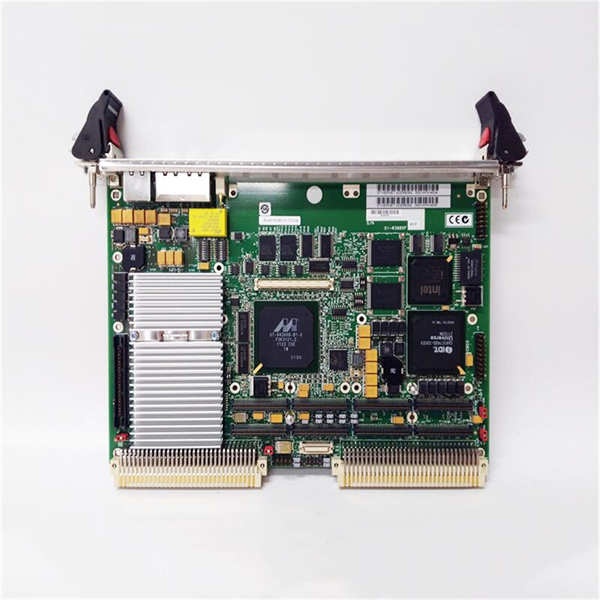
MOTOROLA MVME55006E-0163R
Installation & Maintenance Pitfalls (Expert Tips)
“6E” Designation Indicates Ruggedized—Not Standard Commercial Grade
The most common field mistake is confusing MVME5500-0163 (commercial) with MVME55006E-0163R (ruggedized). The “6E” suffix indicates enhanced environmental specifications. If you install a standard MVME5500 in a -40°C environment, it will fail to boot or exhibit erratic behavior. Verify the full part number includes “6E” for harsh environments. The “R” suffix typically indicates RoHS compliance or a specific revision—check with Emerson/Artesyn for exact meaning in your production lot.
IEEE Handles vs. Scanbe Handles—Vibration Matters
The MVME55006E uses IEEE handles , while commercial variants use Scanbe handles. IEEE handles provide more positive retention in high-vibration environments but require different ejector tools. A field pitfall is using standard VME extraction tools designed for Scanbe handles on IEEE handles—you’ll damage the handle or the board. Use IEEE-compliant ejector/inserter tools. Also, verify your VME chassis card guides are compatible with IEEE handle geometry—some older chassis have tight clearances.
Conformal Coating and Cleaning Procedures
Ruggedized 6E variants typically have conformal coating to protect against moisture and contaminants. A common maintenance mistake is using aggressive solvents (acetone, MEK) for cleaning, which dissolves the coating. Use only isopropyl alcohol or manufacturer-approved cleaning agents. If you must rework solder joints, use low-temperature solder and minimize heat exposure to preserve coating integrity. Document any coating damage during repair and request touch-up coating from the manufacturer.
Thermal Management in Sealed Enclosures
The -40°C to +85°C rating assumes adequate airflow or conduction cooling. A frequent pitfall is installing in a sealed NEMA 4X enclosure with no airflow—the internal temperature exceeds 85°C even with moderate ambient. Calculate your thermal budget: the MPC7457 at 1 GHz dissipates significant heat. Use thermal modeling software or contact Emerson/Artesyn for thermal resistance specifications. For conduction-cooled variants, ensure the card guide thermal interface is clean and properly torqued.
Flash Memory Write Protection in Tactical Applications
The dual Flash banks support redundant boot, but tactical applications require write protection to prevent field corruption. A dangerous pitfall is leaving Flash write-enabled during operation—an electromagnetic pulse (EMP) or power transient can corrupt the boot image. Use hardware write-protect jumpers after final software validation. Maintain a “golden” boot image in the secondary bank that cannot be overwritten from the primary bank. Document your write-protect strategy in the system security plan.
AltiVec Code Validation for Signal Processing
The AltiVec unit accelerates DSP algorithms, but code must be specifically compiled for AltiVec. A common field issue is porting standard PowerPC code and expecting automatic speedup—it won’t happen. Use compiler flags (-maltivec for GCC) and validate vector alignment (16-byte boundaries). In rugged environments, cosmic ray-induced single-event upsets (SEUs) can corrupt AltiVec registers—implement periodic register refresh or error checking for long-duration missions.
VME Backplane Compatibility in Mixed Environments
The MVME55006E uses VME64x , but military systems often have legacy VME64 backplanes. While backward compatible, some 6E features (like enhanced VME block transfers) may not function on older backplanes. Test VME DMA performance after installation—if you see degraded throughput, the backplane may not support MBLT (Multiplexed Block Transfer) protocols. For mixed commercial/military environments, verify all boards support the same VME protocol subset.
Technical Deep Dive & Overview
The Motorola MVME55006E-0163R represents the ruggedized evolution of the MVME5500 series, specifically engineered for military, aerospace, and harsh industrial environments where standard commercial-grade VME boards cannot survive. It combines high-performance PowerPC processing with enhanced environmental specifications in a single 6U VME slot.
The architecture centers on the MPC7457 PowerPC at 1 GHz , a superscalar RISC processor with integrated 128-bit AltiVec vector unit for SIMD operations. The 256 KB L2 cache and 2 MB L3 cache minimize memory latency, while the 133 MHz ECC SDRAM provides 512 MB base memory expandable to 1 GB. Error-correcting code is essential for radiation tolerance and data integrity in unattended operations.
The dual independent 64-bit PCI buses support two PMC sites for application-specific I/O, with a 64-bit PCI expansion mezzanine enabling up to four additional PMCs. This modularity allows customization without base board redesign—critical for military programs with long development cycles.
The VME64x interface provides high-bandwidth VME connectivity with backward compatibility to legacy VME systems. The Universe II VME bridge handles protocol translation and DMA operations, offloading the processor for efficient data movement.
Peripheral integration includes Gigabit Ethernet for high-speed network-centric operations, 10/100 Ethernet for legacy compatibility, dual serial ports for console and device communication, and dual Flash banks for redundant boot storage. The MOTLoad firmware provides board initialization, diagnostics, and OS boot.
The “6E” designation indicates enhanced environmental specifications: extended temperature (-40°C to +85°C) , enhanced vibration/shock tolerance, and potentially conformal coating. The IEEE handles provide secure retention in high-vibration environments compared to standard Scanbe handles.
From a system architecture perspective, the MVME55006E-0163R functions as a rugged computational node in VME-based embedded systems. It can operate as VME bus master, slave, or system controller, supporting multiprocessor configurations. The deterministic VME bus timing, combined with AltiVec processing and rugged construction, makes this suitable for real-time signal processing, mission computing, and control applications in harsh environments where failure is not an option.
The board’s rugged design—extended temperature operation, enhanced vibration tolerance, ECC memory, and redundant boot—reflects its target markets: military ground vehicles, aerospace platforms, and industrial infrastructure requiring 99.999% availability in extreme conditions. The MVME55006E specifically addresses the gap between standard commercial VME and fully custom military-grade systems, providing COTS (Commercial Off-The-Shelf) hardware with enhanced reliability for demanding applications.