Description
Key Technical Specifications
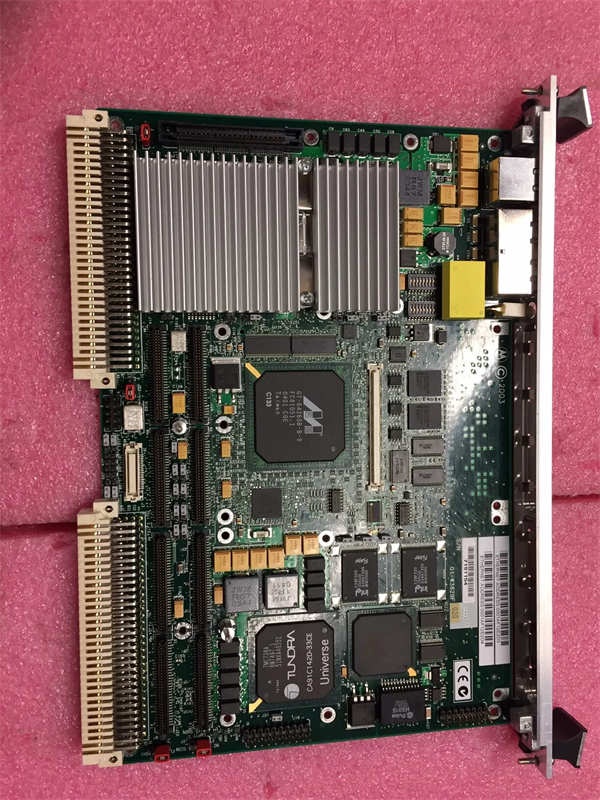
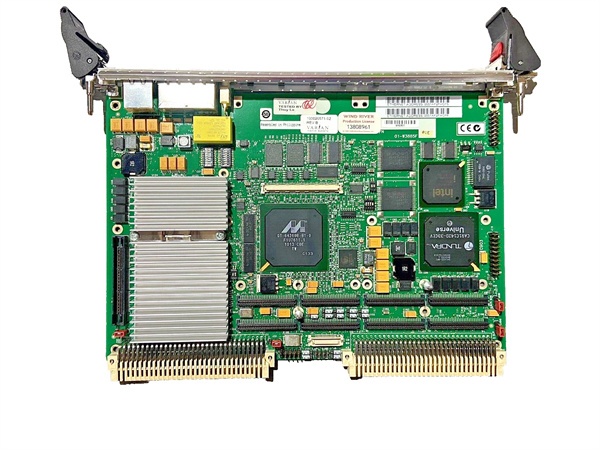
Model Number: MVME5500-0161
Manufacturer: Motorola (now NXP/Emerson/Artesyn through acquisitions)
Product Family: MVME5500 Series VMEbus Processors (flagship line)
Form Factor: 6U VME (233.4 mm × 160 mm / 9.2″ × 6.3″)
Processor: Motorola/Freescale MPC7455 PowerPC RISC microprocessor at 1 GHz
Cache: 256 KB on-chip L2 cache, 2 MB L3 cache ; 32 KB L1 instruction/data cache
Coprocessor: AltiVec™ vector processing unit for high-performance computational applications
Memory: 512 MB onboard 133 MHz SDRAM ECC (Error-Correcting Code), expandable to 1 GB via memory mezzanine card
Storage: Dual banks of soldered Flash memory (32 MB and 8 MB) ; CompactFlash expansion supported
VMEbus Interface: VME64x with Universe II VME interface, 2eSST protocol support, 320 MB/s transfer rate
PCI Buses: Dual independent 64-bit PCI buses, 33/66 MHz operation
PMC Expansion: Two PMC sites (one per PCI bus), 33/66 MHz capable; 64-bit PCI expansion mezzanine supports up to 4 additional PMCs
Ethernet: Gigabit Ethernet (1000Base-T) plus additional 10/100BaseTX Ethernet
Serial Ports: Two RS-232/422/485 serial interfaces
System Controller: Marvell system controller with 133 MHz host bus and 133 MHz SDRAM memory bus
Power Supply: 5V DC ±5%, ±12V DC ±10% ; typical 30W consumption
Operating Temperature: -40°C to +85°C (industrial/military) ; 0°C to +70°C (commercial)
Storage Temperature: -40°C to +85°C
Humidity: 5% to 95% non-condensing
Vibration: 0.03 inch peak-to-peak, 10-500 Hz
Shock: 15G, 11 ms half-sine wave
Firmware: MOTLoad (Motorola Load) with POST, initialization, low-level setup, debugging, OS boot
Operating System Support: VxWorks, Linux, QNX, Windows CE
Weight: 0.68-0.7 kg
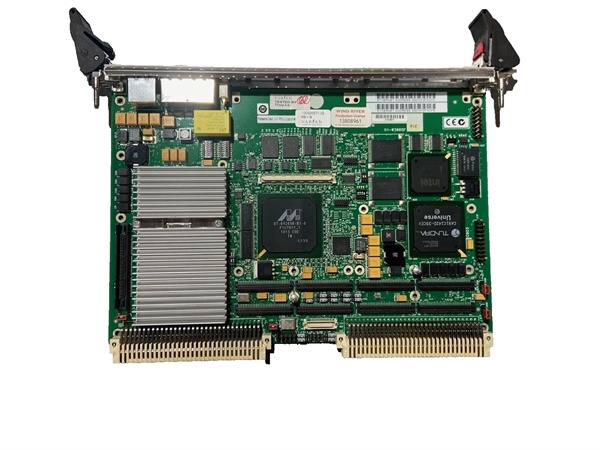
Motorola MVME5500-0161
Field Application & Problem Solved
In the field, the biggest challenge with legacy VME systems is performance obsolescence. You have 15-20 year old industrial and military systems that are mechanically sound but computationally starved—the original 200-366 MHz processors can’t handle modern data rates, image processing, or network throughput requirements. The MVME5500-0161 solves this by providing a 5x performance upgrade path within the same VME form factor, allowing you to drop this board into existing chassis and immediately gain 1 GHz processing, Gigabit Ethernet, and high-speed PCI connectivity without redesigning your I/O subsystem.
You will typically find this board in high-performance military and aerospace applications (radar signal processing, image analysis, mission computing), industrial automation (high-speed data acquisition, machine vision, motion control), telecommunications (network infrastructure, protocol processing), and medical imaging (CT/MRI reconstruction, real-time visualization). It’s specifically designed for data-intensive applications where the AltiVec vector coprocessor can accelerate digital signal processing, graphics transformations, and mathematical algorithms by operating on multiple data elements simultaneously.
Its core value is preserving VME infrastructure while delivering modern performance. The MVME5500 series provides a migration path from older MVME2300, MVME2400, MVME2600, MVME2700, and MVME5100 boards , allowing customers to upgrade processor performance, memory capacity, and network speed while keeping their existing VME I/O cards, chassis, and software investment. The dual 64-bit PCI buses eliminate the I/O bottleneck common in older single-bus designs—one PCI bus can handle high-speed data acquisition while the other manages network and storage. The Gigabit Ethernet enables high-speed network-centric operations that 10/100 Ethernet can’t support. The ECC memory detects and corrects single-bit errors, essential for unattended operation in harsh environments where cosmic rays or electrical noise could corrupt data.
Installation & Maintenance Pitfalls (Expert Tips)
0161 vs. 0163 Suffix Indicates Configuration Variant
The MVME5500-0161 and MVME5500-0163 are hardware-identical boards with different factory configurations . The suffix difference typically relates to memory size, Flash configuration, or specific feature enablement at the factory. A common field mistake is assuming these are interchangeable without verifying the specific configuration. If your application requires the exact memory map or Flash layout of the -0163, substituting an -0161 may cause boot failures or software incompatibility. Always verify the full part number in your system documentation before ordering spares. The -0161 typically has 512 MB base memory; the -0163 may have 1 GB or different Flash partitioning .
Migration from Older MVME Boards Requires Software Validation
The MVME5500-0161 is pin-compatible with MVME5100 and earlier series , but the processor architecture differs significantly. The MPC7455 has AltiVec, different cache organization, and faster timing than older MPC750 or 68060 processors. A common field mistake is assuming software compiled for MVME2400 will run without modification. Recompile your application with optimizations for MPC7455/AltiVec, and validate timing-critical code—loops that worked at 366 MHz may fail at 1 GHz due to different instruction timing. The MOTLoad firmware provides compatibility modes, but for maximum performance, recompile natively.
PCI Bus Speed Configuration is Critical
The dual 64-bit PCI buses support 33 or 66 MHz operation, selected via jumpers. A frequent pitfall is installing 66 MHz PMC cards but leaving the bus at 33 MHz, crippling performance. Conversely, forcing 66 MHz with 33 MHz-only cards causes bus errors and system instability. Check your PMC card specifications and set jumpers accordingly. The Universe II VME interface and PMCspan connector are isolated on a dedicated 33 MHz segment , so both PMC sites can run at 66 MHz independently—verify your backplane supports this configuration.
Gigabit Ethernet Requires Proper Cable and Switch Infrastructure
The Gigabit Ethernet port is backward-compatible with 10/100, but to realize the performance benefit, you need Cat5e or Cat6 cabling and Gigabit-capable switches. I’ve seen installations where technicians connected Gigabit ports to 100 Mbps switches, then wondered why network throughput didn’t improve. Also, the Gigabit controller may have different driver requirements than the 10/100 port—ensure your operating system has updated drivers for the Marvell or Motorola Ethernet controller.
AltiVec Code Requires Specific Compiler Flags
The AltiVec vector coprocessor provides massive performance gains for DSP and matrix operations, but only if your code is compiled with AltiVec support. Standard PowerPC code won’t use AltiVec automatically. Use compiler flags (-maltivec for GCC, -qaltivec for XL C) and vector intrinsics or libraries. A common field issue is expecting AltiVec speedup without recompiling. Also, AltiVec operates on 128-bit vectors—ensure your data structures are aligned to 16-byte boundaries for optimal performance.
Memory Mezzanine Installation Affects Thermal Management
The 512 MB memory mezzanine card expands total memory to 1 GB but increases power dissipation and blocks airflow. A common mistake is installing the mezzanine in a chassis with marginal cooling, causing thermal throttling or shutdown. Verify your VME chassis has adequate airflow (typically 200+ LFM) when using the memory expansion. The mezzanine sits directly above the processor—ensure no cables obstruct the heatsink. If running at +85°C ambient , consider removing the mezzanine or upgrading chassis cooling.
Flash Boot Bank Selection and Write Protection
The dual Flash banks (32 MB and 8 MB) support redundant boot images. A dangerous pitfall is programming the primary boot image without verifying the backup image works. If the primary image corrupts and the backup is blank or incompatible, the board bricks. Always maintain a known-good backup image in the alternate bank. Use write-protect jumpers to protect critical boot blocks after validation. The “Safe Start” header forces default environment variables—use this if custom settings prevent boot.
VME SCON Selection for Multi-Processor Systems
In chassis with multiple VME boards, the System Controller (SCON) must be uniquely assigned. Only one board per VME backplane should be SCON; others should be SCON disable. Multiple SCON boards cause bus arbitration conflicts and system hangs. Check your chassis documentation—some backplanes have fixed SCON slots. If migrating from MVME5100, note that SCON selection may have moved to different jumpers—verify against the MVME5500 manual before installation.
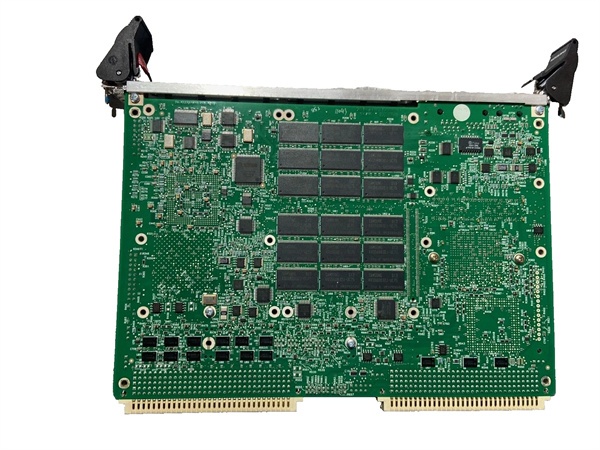
Motorola MVME5500-0161
Technical Deep Dive & Overview
The Motorola MVME5500-0161 is a high-performance 6U VMEbus Single Board Computer representing the flagship of Motorola’s VME product line . It bridges the gap between legacy VME infrastructure and modern computational requirements, delivering workstation-class performance in an embedded rugged form factor.
The architecture centers on the MPC7455 PowerPC processor at 1 GHz , a superscalar RISC design with integrated AltiVec vector processing unit . AltiVec provides SIMD (Single Instruction, Multiple Data) capabilities—operating on 128-bit vectors containing multiple data elements simultaneously. This accelerates DSP, graphics, and scientific computations by 4-10x over scalar processing. The 256 KB L2 cache and 2 MB L3 cache minimize memory latency for performance-critical code.
The Marvell system controller provides high-speed interconnect with 133 MHz front-side bus and 133 MHz SDRAM interface, matching the processor’s bandwidth requirements. ECC SDRAM detects and corrects single-bit errors, essential for reliability in electrically noisy industrial environments or high-altitude aerospace applications where cosmic ray-induced bit flips are more frequent.
The dual independent 64-bit PCI buses represent a significant architectural improvement over single-bus designs. PCI Bus 0 and PCI Bus 1 each have dedicated PMC sites, allowing simultaneous high-speed operations without bus contention. The Universe II VME interface provides high-performance VME64x connectivity with 2eSST (Two-Edge Source Synchronous Transfer) protocol, achieving 320 MB/s transfer rates—critical for real-time data acquisition and inter-board communication.
Peripheral integration includes Gigabit Ethernet for high-speed network-centric operations, 10/100 Ethernet for backward compatibility, dual serial ports for console and device communication, and dual Flash banks for redundant boot storage. The 64-bit PCI expansion mezzanine supports up to four additional PMCs beyond the two onboard sites, enabling extreme I/O expansion.
The MOTLoad firmware provides board initialization, power-on self-test (POST), low-level debugging, and operating system boot. It supports network boot (BOOTP/TFTP), Flash boot, and diagnostic modes. The firmware is field-upgradable via serial or Ethernet, allowing feature enhancements without hardware replacement.
From a system architecture perspective, the MVME5500-0161 functions as a computational node in VME-based embedded systems. It can operate as VME bus master, slave, or system controller, supporting multiprocessor configurations. The deterministic VME bus timing, combined with high-speed PCI and AltiVec processing, makes this suitable for real-time signal processing, image analysis, and closed-loop control applications where latency and throughput are critical.
The board’s rugged design—extended temperature operation (-40°C to +85°C) , shock/vibration tolerance, and ECC memory—reflects its target markets: military/aerospace (where VME remains the standard for mission-critical systems), high-performance industrial automation, and telecommunications infrastructure requiring 99.999% availability. The MVME5500-0161 specifically provides a balanced configuration that matches the -0163 variant in core capabilities while potentially differing in memory size or Flash partitioning to meet specific OEM requirements.