Description
Detailed Product Breakdown
Key Technical Specifications
Model Number: MVME2432
Manufacturer: Motorola (now NXP/Emerson/Abaco Systems through acquisitions)
Product Family: MVME2400 Series VMEbus Processors
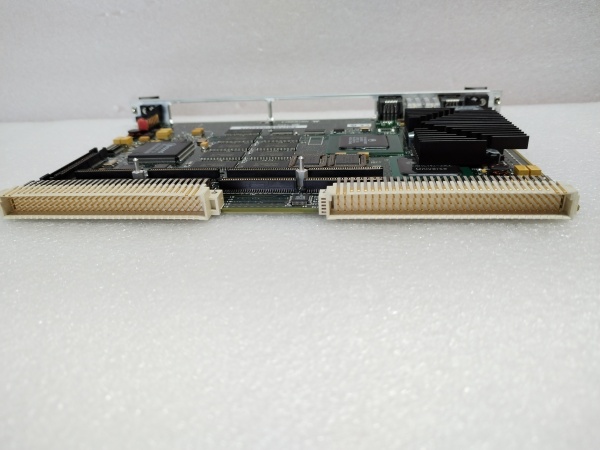
Form Factor: 6U VME (233 mm × 160 mm / 9.2″ × 6.3″)
Processor: Motorola PowerPC 750 (MPC750) 32-bit RISC microprocessor
Clock Speed: 333 MHz (MVME2432-1), 366 MHz (MVME2432-2), 400 MHz (MVME2432-3) ; conflicting sources cite 266 MHz and 350 MHz
Cache: 32 KB L1 instruction cache, 32 KB L1 data cache; 1 MB backside L2 cache
Memory: 32 MB to 128 MB board-mounted ECC SDRAM (Error-Correcting Code) ; MVME2432-1: 32MB, MVME2432-2: 64MB, MVME2432-3: 128MB
Storage: 2 MB to 8 MB Flash memory for firmware (MVME2432-1: 2MB, MVME2432-2: 4MB, MVME2432-3: 8MB) ; 8 KB NVRAM with battery backup
VMEbus Interface: VME64 (A16/A24/A32 addressing, D8/D16/D32 data, DMA support)
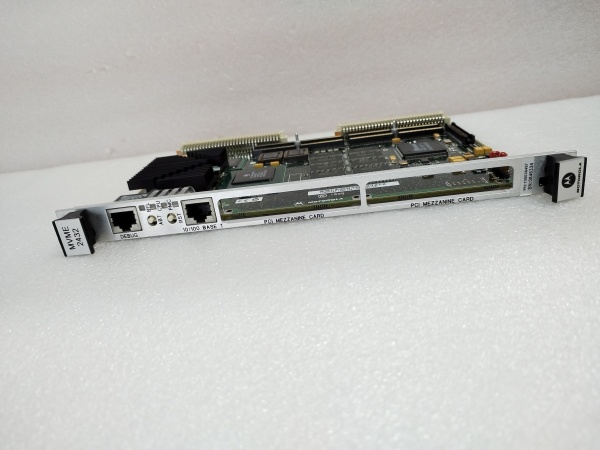
Expansion: Two PCI Mezzanine Card (PMC) slots
Serial Ports: Dual RS-232/422/485 serial interfaces
Ethernet: 10/100Base-TX Ethernet controller
Parallel Interface: Centronics parallel port
Timers: Six 32-bit programmable timers plus watchdog timer
SCSI Interface: Integrated SCSI bus with DMA
Power Supply: +5 Vdc (standard VME power), 15-20W typical consumption
Operating Temperature: 0°C to +70°C (commercial); -40°C to +70°C or +85°C (industrial/military)
Storage Temperature: -40°C to +85°C
Protection: IP20 (control cabinet installation) ; conflicting IP67 claim appears erroneous
Weight: 0.5 kg ; 0.9-2.6 kg (varies by configuration)
Operating System Support: VxWorks, Linux, QNX, other real-time OS
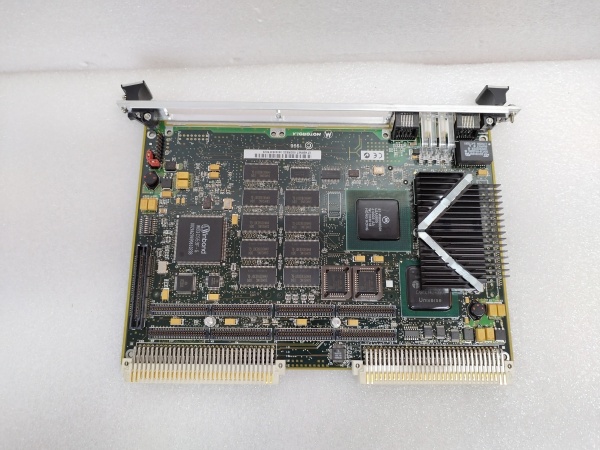
MVME2432
Field Application & Problem Solved
In the field, the biggest challenge with legacy industrial and military systems is computing obsolescence. You have 20-year-old VME-based control systems that work perfectly mechanically, but the processor boards are failing and original manufacturers stopped production. The MVME2432 solves this by providing a drop-in PowerPC-based upgrade path for VMEbus systems, maintaining backward compatibility with existing I/O cards while providing modern processing power and memory capacity.
You will typically find this board in military and aerospace applications (radar signal processing, flight control computers, mission systems), industrial automation (CNC machine tools, robotics, process control), telecommunications (switching equipment, base station controllers), and transportation systems (railway signaling, traffic control). It’s designed for harsh environment operation with extended temperature ranges, shock/vibration tolerance, and ECC memory for data integrity in electrically noisy environments.
Its core value is preserving VMEbus infrastructure investments while upgrading compute performance. The VMEbus standard has been around since 1981 and is still used in military/aerospace because of its ruggedness and extensive I/O ecosystem. Rather than redesigning entire systems for newer bus architectures (PCIe, VPX), the MVME2432 lets you swap the processor board and keep your I/O cards, chassis, and wiring. The dual PMC slots allow adding modern interfaces (Gigabit Ethernet, fiber optic, high-speed A/D) without changing the base platform. The ECC SDRAM detects and corrects single-bit errors—critical for unattended operation in remote or hazardous locations where memory corruption from cosmic rays or EMI could cause system failures.
The MVME2432 specifically addresses the mid-range performance segment between the lower-memory MVME2431 and the higher-capacity MVME2434, with three distinct configurations (-1, -2, -3) that let you match performance to application requirements without over-specifying.
Installation & Maintenance Pitfalls (Expert Tips)
Variant Suffixes Are Not Interchangeable
The MVME2432 comes in three distinct variants: -1 (333 MHz, 32MB SDRAM, 2MB Flash), -2 (366 MHz, 64MB SDRAM, 4MB Flash), and -3 (400 MHz, 128MB SDRAM, 8MB Flash) . A common field mistake is ordering a replacement based on the base model number only, then discovering the software won’t boot because it was compiled for a specific clock speed or memory map. The MVME2432-3 has twice the memory and Flash of the -1 variant—software that assumes 128MB will fail on a 32MB board. Always verify the full part number including suffix before ordering spares. If upgrading from an older MVME2400 series board, check that your software doesn’t have hardcoded timing loops or memory assumptions.
PMC Cards Must Be VME64-Compliant
The two PMC expansion slots accept PCI Mezzanine Cards for added functionality—network interfaces, graphics, storage, custom I/O. However, not all PMC cards work in VME environments. A frequent pitfall is installing a commercial PCI PMC card that works fine on the bench but fails in the VME chassis due to different interrupt handling, power sequencing, or thermal constraints. Use VME-rated PMC cards designed for the MVME2400 series. Check the card’s compatibility list for Motorola/Emerson VME platforms. Also, verify that your VME chassis provides adequate cooling for PMC cards—they’re buried deep in the card cage and can overheat.
VME Bus Termination and Backplane Compatibility
The MVME2432 supports VME64 , but many legacy systems use older VME backplanes without full VME64 support. A common field issue is installing this board in a legacy VME chassis and getting intermittent bus errors or DMA failures. The MVME2432 tries to use VME64 features (64-bit transfers, 2eSST) that the backplane doesn’t support. Check your chassis manual—if it only supports VME32, you may need to configure the MVME2432 for legacy mode via jumpers or software. Also, VME bus termination is critical; missing terminators cause signal reflections that corrupt data. Verify your chassis has proper termination at both ends of the bus.
NVRAM Battery Failure Causes Configuration Loss
The 8 KB NVRAM with battery backup stores critical configuration data—boot parameters, calibration constants, network addresses. The battery has a 10-year life but fails sooner in high-temperature environments. A common failure mode is the system boots to factory defaults or loses its MAC address because the NVRAM battery died. Check the battery voltage during preventive maintenance (should be >2.5V). Replace proactively every 5 years in industrial environments. Document your NVRAM settings so you can restore them if the battery fails unexpectedly.
Heat Sinking and Airflow Are Critical
The PowerPC 750 dissipates significant heat, especially at 366-400 MHz. The MVME2432 has a heat sink and thermal design for forced-air cooling. A common field mistake is installing this board in a VME chassis with blocked airflow, missing fans, or overcrowded card cage. The processor overheats, causing thermal throttling or sudden shutdown. Verify your chassis meets the 15-20W power dissipation per slot. If upgrading from a lower-power board (e.g., 68040-based), your existing cooling may be inadequate. Add chassis fans or upgrade the power supply cooling if necessary.
Firmware and Boot ROM Compatibility
The Flash memory contains firmware and boot code. Different board revisions have different firmware requirements. A pitfall is swapping boards between systems and finding one won’t boot because it has older/newer firmware than expected. The MVME2432 uses Motorola’s BUG (Built-in Utility and General) firmware or later U-Boot for system initialization. Verify your application software is compatible with the firmware revision. Keep a “golden” board with known-good firmware as a backup, and document the firmware revision in your maintenance records.
Operating System Licensing and Drivers
The MVME2432 supports VxWorks, Linux, QNX , but these require board-specific BSPs (Board Support Packages). A common field issue is installing a generic Linux distribution and finding Ethernet, SCSI, or VME DMA doesn’t work. You need the Motorola/Emerson BSP for this specific board. If your original vendor is gone, check with Emerson/Abaco Systems for legacy support. For VxWorks, verify your license covers the processor count and features you’re using. Driver incompatibilities between board revisions can cause subtle bugs—test thoroughly before deploying.
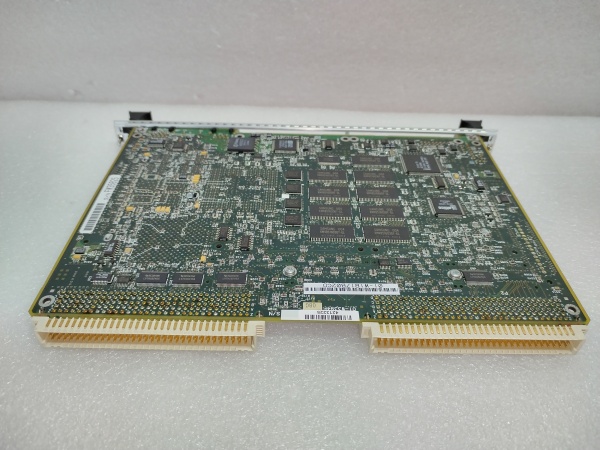
MVME2432
Technical Deep Dive & Overview
The Motorola MVME2432 is a 6U VMEbus Single Board Computer from the MVME2400 series, representing Motorola’s PowerPC-based embedded computing platform for industrial and military applications. It bridges the gap between legacy VME systems and modern processing requirements, providing a PowerPC 750 RISC processor in the standard VME form factor that dominated industrial control from the 1980s through 2000s.
The board architecture centers on the PowerPC 750 (MPC750) microprocessor , a 32-bit RISC design with superscalar execution, integrated floating-point unit, and memory management unit. The 333-400 MHz clock speed provides significantly more performance than earlier 68040-based VME boards while maintaining software compatibility through PowerPC’s big-endian mode. The 1 MB backside L2 cache improves memory bandwidth for real-time applications.
Memory architecture uses ECC SDRAM with error-correcting code that detects and corrects single-bit errors, essential for reliability in unattended or safety-critical systems. The 32-128 MB capacity range (depending on variant) supports large real-time applications and data buffering. Flash memory stores firmware and boot code, while battery-backed NVRAM preserves configuration across power cycles.
The VME64 bus interface provides 32-bit data paths with DMA support for high-speed data transfer to I/O cards. Unlike newer bus architectures, VME uses asynchronous transfer with defined handshake protocols, making it deterministic for real-time control. The MVME2432 can function as VME bus master or slave, supporting multiprocessor configurations.
Dual PMC slots provide expansion through PCI Mezzanine Cards—industry-standard modules for adding specialized I/O, communications, or processing. This modularity allows the base board to remain standard while adapting to specific application requirements.
Peripheral integration includes dual serial ports (RS-232/422/485) for debugging and device communication, 10/100 Ethernet for network connectivity, SCSI for storage, and parallel port for legacy peripherals. The six programmable timers plus watchdog support real-time operating systems and system health monitoring.
From a system architecture perspective, the MVME2432 functions as a general-purpose embedded computer on the VME bus. It boots from Flash or network, runs a real-time operating system (VxWorks, Linux, QNX), and controls I/O through VME address space. The deterministic VME bus timing makes this suitable for closed-loop control, data acquisition, and signal processing applications where PCI/PCIe’s variable latency is unacceptable.
The board’s rugged design—extended temperature operation, shock/vibration tolerance, ECC memory—reflects its target markets: military/aerospace (where VME remains standard for its reliability pedigree), industrial automation (where 20-year system lifecycles are common), and telecommunications infrastructure (where downtime is costly). The three variant configurations (-1, -2, -3) let system integrators match performance and cost to application requirements without changing the base platform.