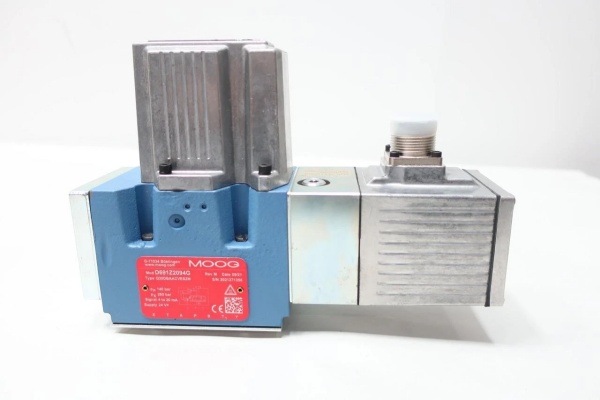
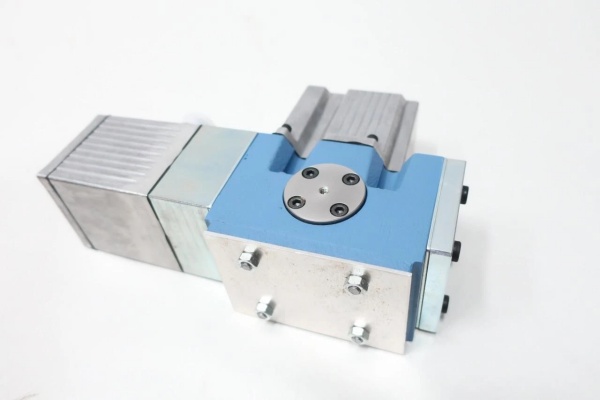
Description
Key Technical Specifications
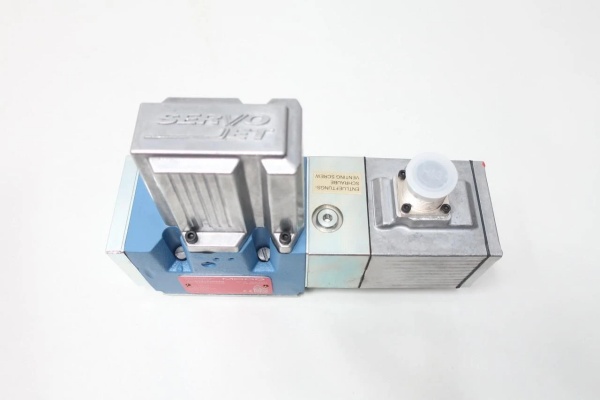
- Model Number: D691-Z2708G
- Manufacturer: Moog Inc. (Industrial Motion Control Group)
- Valve Type: Two-stage PQ servo-proportional valve (integrated flow/pressure control)
- Actuation Principle: ServoJet jet pipe pilot (permanent magnet torque motor) + sliding spool power stage
- Size Classification: ISO 4401 Size 05 (NG10) – 4-bolt flange (M8 x 1.25)
- Flow Capacity: 120 L/min (31.7 gpm) at Δp=70 bar
- Maximum Operating Pressure: 350 bar (5075 psi) – continuous service
- Electrical Interface: ±10V/4-20mA switch-selectable input (12-bit resolution), 24V DC ±10% supply, ±10V LVDT feedback + pressure sensor output
- Connector Type: 10-pin DIN 43650 A (IP65 when mated with sealed boot)
- Response Time: 12ms (90% step response); 8ms (high-response “H” variant)
- Operating Temperature: -20°C to +70°C (-4°F to +158°F)
- Fluid Requirements: Mineral oil (ISO VG 32–68), NAS 1638 Class 5, max 85°C fluid temp
- Mounting Torque: 25 Nm (18.4 ft-lbs)
- Weight: 5.2kg (11.5 lbs)
- Certifications: CE, RoHS compliant; ATEX/IECEx optional (Zone 2 hazardous areas)

MOOG D691-Z2708G
Field Application & Problem Solved
In industrial hydraulic systems that need precise flow (Q) and pressure (P) coordination—think injection molding filling/packing cycles, steel mill roll force control, or test rig dynamic profiling—the biggest headache is juggling separate controllers for flow and pressure. Generic valves force you to use external PQ modules, which add wiring, failure points, and lag. A Wisconsin injection molder wasted $180k/year on scrap because their external PQ controller couldn’t sync pressure and flow during packing, leading to inconsistent part density. A Pennsylvania steel mill dealt with 6-hour downtime events when external control modules failed, halting rolling operations.
This valve eliminates that chaos by integrating PQ control directly into the valve body. You’ll find it in: injection molding machines (maintaining ±1% pressure accuracy to cut scrap), steel mill rolling stands (controlling roll gap and force simultaneously for uniform sheet thickness), paper machine calenders (nip pressure control for consistent web quality), and heavy-duty test rigs (replicating real-world load profiles with precise PQ synchronization). Its core value is integrated simplicity + energy efficiency—the ServoJet pilot uses 30% less energy than nozzle-flapper designs, and no external controllers mean fewer wires to troubleshoot and less downtime. For the Wisconsin molder, it dropped scrap rates from 8% to 1.2%. For the steel mill, it eliminated 90% of PQ-related downtime.
Installation & Maintenance Pitfalls (Expert Tips)
- Fluid Cleanliness: NAS 1638 Class 5 Is Non-Negotiable: The ServoJet pilot’s 0.5mm jet pipe orifice clogs with NAS 6 oil. I replaced two valves at an Ohio paper mill where the client used 10µm filters—each failure cost 4 hours of production. Fix: Install 5µm absolute filters (β10 ≥ 100 per ISO 16889) and test oil cleanliness every 2000 hours. De-aerate oil to prevent cavitation in the pilot.
- Single-Point Grounding Prevents Pressure Spikes: Rookies ground the valve and controller at different points, creating ground loops that corrupt PQ signals. A Michigan molder had flash defects until we re-grounded everything to the same machine frame point. Fix: Use shielded twisted-pair for control signals, ground only at the controller, and keep signal cables 30cm away from power lines.
- Pilot Pressure: Lock It to 8–12 Bar: Too low (≤6 bar) slows response; too high (≥15 bar) burns out the torque motor. A Tennessee test rig’s load profiles were erratic until we adjusted the pilot regulator to 10 bar. Fix: Install a dedicated gauge on the pilot supply and check weekly—fluctuations mean a clogged filter or faulty regulator.
- Null Adjustment: No Load, No Pressure: Adjusting null with system pressure on the ports causes drift when loads change. I spent 3 hours troubleshooting a Kentucky mill’s roll drift until I realized the tech calibrated with 200 bar on the actuator. Fix: Depressurize the system, apply 0V/4mA, and adjust the null screw until feedback reads 0V (±0.01V). Lock with the jam nut and recheck after 30 minutes of run time.
- Mounting Alignment: Parallel = Longevity: Misaligning the valve (≥1°) with hydraulic lines binds the spool, wearing seals prematurely. A Minnesota test rig’s valve failed after 18 months until we shimmed the flange to align with the actuator. Fix: Use a straightedge to verify parallelism between the valve and manifold—no gaps or twists.
MOOG D691-Z2708G
Technical Deep Dive & Overview
The D691-Z2708G is a self-contained PQ control solution built for harsh industrial environments. At its core, it uses a two-stage design: a ServoJet jet pipe pilot stage and a sliding spool power stage, with all PQ logic integrated into the valve’s electronics—no external modules needed.
The ServoJet pilot is the game-changer: instead of a traditional nozzle-flapper, it uses a rotating jet pipe that directs fluid to receiver nozzles, creating differential pressure to shift the power spool. This design is more resistant to contamination (self-cleans small particles) and uses 30% less energy than nozzle-flapper pilots—critical for 24/7 industrial operation. The permanent magnet torque motor precisely controls the jet pipe position, translating electrical commands into mechanical motion.
The power stage’s hard-chromed spool (0.004mm clearances) minimizes leakage and ensures precise flow control. A built-in LVDT tracks spool position, while an A-port pressure sensor feeds real-time pressure data to the integrated microprocessor. The electronics execute PQ coordination algorithms—you can prioritize flow, pressure, or balance both—eliminating the lag of external controllers.
The spring-centered spool provides a fail-safe: power loss sends the spool to neutral, blocking flow to actuators and preventing equipment damage. The ISO 4401 Size 05 flange fits standard manifolds, making retrofits straightforward. Unlike generic PQ valves, it’s rugged enough for power plants and steel mills, with IP65 protection shielding against dust and water jets. It’s not just a valve—it’s a compact, efficient PQ control system that delivers the precision industrial processes demand without the complexity.