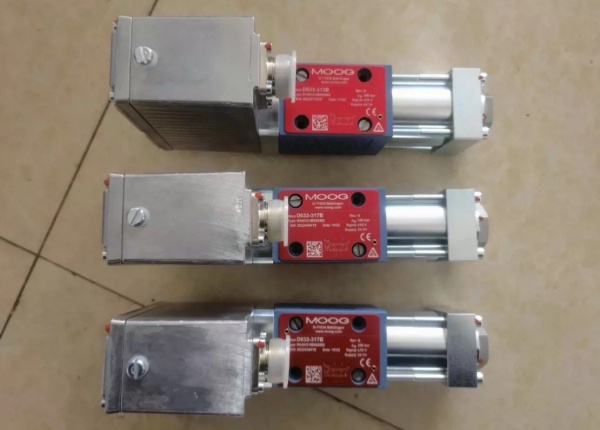
Description
Key Technical Specifications
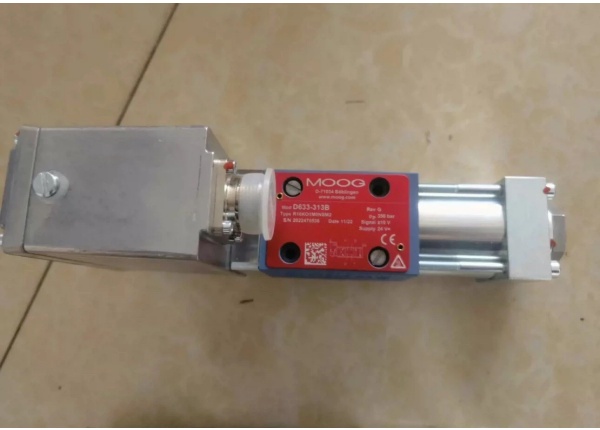
- Model Number: D633-471B
- Manufacturer: Moog Inc. (Industrial Motion Control Group)
- Valve Type: 4-way direct drive servo valve (DDV) with integrated electronics
- Actuation Principle: Permanent magnet linear force motor (direct spool drive—no pilot stage)
- Size Classification: ISO 4401 Size 03 (NG6) – 4-bolt flange pattern (M6 x 1.0)
- Flow Capacity: 90 L/min (23.8 gpm) at Δp=70 bar (1015 psi)
- Maximum Operating Pressure: 400 bar (5800 psi) – continuous service
- Electrical Interface:
- Supply Voltage: 24V DC ±10% (21.6–26.4V)
- Control Input: ±10V analog (12-bit resolution, 100kΩ input impedance)
- Feedback Output: ±10V spool position (12-bit resolution)
- Connector: 6-pin DIN 43650 A (IP65 when mated)
- Coil Current: 250mA nominal, 500mA peak (100ms duration)
- Response Time: 2ms (90% step response from 0–100% command)
- Operating Temperature: -25°C to +70°C (-13°F to +158°F)
- Fluid Requirements: Mineral oil (ISO VG 32–68), NAS 1638 Class 6 (max), 80°C max fluid temp
- Mounting Torque: 15 Nm (11.1 ft-lbs) – flange bolts
- Weight: 2.7kg (5.9 lbs)
- Certifications: CE, RoHS compliant; ATEX/IECEx (optional for Zone 2 hazardous areas)
- Compatible Systems: MOOG D136 MSC I Controllers, D138 MACS Licenses, M3000 Motion Control Systems, small actuators (15–40mm bore), QAIO-001 analog expansion modules

Moog D633-472B
Field Application & Problem Solved
In small hydraulic systems—think injection molding ejectors, paper machine edge guides, or bench-top test rigs—the biggest frustration is the lack of a “right-sized” precision valve. Pilot-operated valves are overkill: they require pilot lines, filters, and regulators that take up space you don’t have (e.g., between paper mill rolls or inside injection molding machine frames) and add maintenance headaches. Generic proportional valves? They’re too sloppy—0.5–1mm positioning error ruins ejector alignment or edge guide accuracy, leading to scrap and rework. A plastics plant in Ohio was replacing pilot filters on their ejectors every 3 months, costing $12k annually and causing 2-hour downtime events when filters clogged. A North Carolina test lab struggled with generic valves that couldn’t replicate consistent force profiles, delaying product validation by weeks.
This valve fixes that by packing direct drive precision into a compact Size 03 package. You’ll find it in: injection molding ejectors (0.05mm positioning accuracy to prevent part sticking), paper machine edge guides (maintaining ±1mm web alignment at 500m/min), compact 10-30 ton presses (ram speed control at 250mm/s), and bench-top test rigs (dynamic force profiles for sensors or small components). Its core value is right-sized performance—no pilot supply means 100% fewer pilot-related failures, 2ms response time outperforms generics by 50%, and the integrated amplifier cuts wiring complexity. For the Ohio plastics plant, swapping to this valve eliminated pilot filter costs and reduced downtime by 8 hours/year. For the North Carolina lab, it cut test repeatability error from 3% to 0.5%, speeding up validation cycles by 30%.
Installation & Maintenance Pitfalls (Expert Tips)
- Fluid Cleanliness: NAS 1638 Class 6 Is Non-Negotiable: Rookies think “25µm filtration is good enough,” but this valve’s spool clearances are 0.005mm—NAS 8 oil will bind the spool in 4–6 months. I replaced three valves at a Tennessee test rig where the client skipped 10µm filters; each failure delayed testing by 2 days. Fix: Install 10µm absolute filters (β10 ≥ 75 per ISO 16889) and test oil cleanliness every 1500 operating hours. If you see sludge or metal particles, drain and flush the system—contamination is the #1 failure cause.
- Shielded Wiring: Single-Point Ground Only: Unshielded cables or double-ended grounding pick up EMI from VFDs, causing 0.3–0.5% position error. A Pennsylvania paper mill’s edge guide oscillated until we rerouted the ±10V signal with shielded twisted-pair, grounded only at the controller. Never ground the shield at both ends—this creates ground loops that corrupt LVDT feedback. Keep signal cables 15cm away from power cables.
- Mounting Torque: 15 Nm Exact—Not 18 or 12: Over-torquing warps the valve body, binding the spool; under-torquing leads to pressure-induced leaks. A Michigan press shop’s valve had erratic flow until we retorqued bolts to 15 Nm with a torque wrench. Use the cross-tightening sequence (1-3-2-4) to distribute force evenly—”hand-tighten plus a twist” is a rookie mistake.
- Null Adjustment: Depressurize and Verify Feedback: Adjusting null under pressure causes drift that shows up as ejector misalignment or edge guide creep. I spent 90 minutes troubleshooting a South Carolina plastics plant’s part sticking issue until I realized the tech adjusted null with 60 bar on the ports. Fix: Bleed the system, apply 0V to the valve, and turn the null screw until feedback reads 0V (±0.01V). Lock it with the jam nut—factory null drifts during shipping.
- Don’t Under-Size the Supply Voltage: Running the valve at 20V DC (below the 21.6V minimum) degrades response time and increases hysteresis. A Florida test lab’s force profile was inconsistent until we checked the power supply—voltage droop under load was dropping it to 19.8V. Fix: Use a 24V DC power supply with 5A capacity (minimum) and install a 1000µF capacitor near the valve to filter voltage spikes.
Moog D633-472B
Technical Deep Dive & Overview
The D633-471B is engineered for small hydraulic systems where space and precision are equally critical. At its core, a permanent magnet linear force motor drives the spool directly—no pilot stage, no pilot flow, no extra hardware. This design delivers two make-or-break benefits for small systems: 2ms response time (faster than pilot valves) because there’s no lag from pilot pressure buildup, and zero pilot supply requirements (no extra hoses, filters, or regulators to fail in tight spaces).
The integrated 24V amplifier creates a self-contained closed loop: it accepts a ±10V command from a motion controller (e.g., MOOG D136), uses an internal LVDT to track spool position, and adjusts the force motor current to hold position within ±0.01mm—even as fluid temperature or pressure fluctuates. The LVDT feedback is non-contact, so it never wears out, and the hard-chromed spool (0.8µm surface finish) resists abrasion from clean oil, extending service life to 20,000+ hours.
The spring-centered spool is a safety must: if power cuts out, springs push the spool to neutral, blocking flow to both actuator ports and preventing unintended movement—critical for ejectors or edge guides where a runaway component could damage molds or web material. The ISO 4401 Size 03 flange fits standard small hydraulic manifolds, making retrofits straightforward (I’ve swapped out generic valves for this model in under 90 minutes, no manifold modifications needed).
What makes it field-proven is its ruggedness: IP65 protection shields it from dust and water jets (common in plant or lab environments), the Viton seals handle standard mineral oils, and the amplifier includes overcurrent/overtemperature protection. Unlike generic proportional valves, it doesn’t sacrifice precision for size—90 L/min flow moves small actuators fast, while closed-loop control ensures consistency. For maintenance teams, it’s a set-it-and-forget-it component: no pilot system to maintain, diagnostics via the feedback signal (check spool position without disassembly), and predictable service life with proper fluid care. It’s not just a valve—it’s the reliable backbone of precision control in small-scale industrial and lab hydraulic systems.