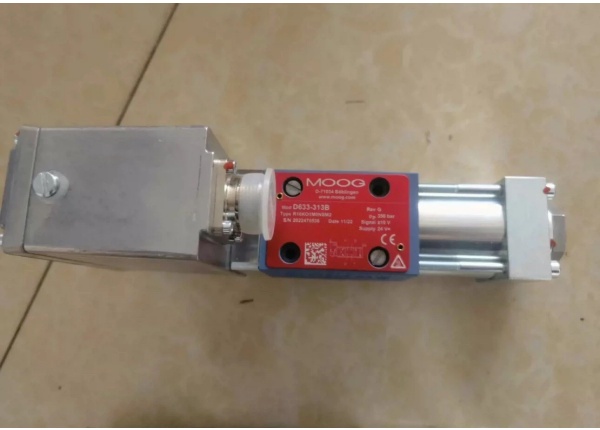
Description
Key Technical Specifications
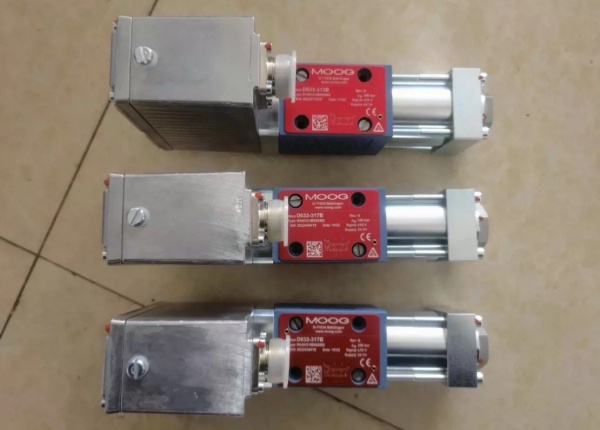
- Model Number: D633-303B
- Manufacturer: Moog Inc. (Industrial Motion Control Group)
- Valve Type: 4-way direct drive servo valve (DDV) with integrated electronics
- Actuation Principle: High-precision permanent magnet linear force motor (direct spool drive—no pilot stage)
- Size Classification: ISO 4401 Size 03 (NG6) – 4-bolt flange pattern (M6 x 1.0)
- Flow Capacity: 30 L/min (7.9 gpm) rated (Δp=35 bar), 50 L/min (13.2 gpm) max (Δp=70 bar)
- Maximum Operating Pressure: 300 bar (4350 psi) – continuous service
- Electrical Interface:
- Supply Voltage: 24V DC ±10% (21.6–26.4V)
- Control Input: ±10V analog (14-bit resolution, 200kΩ input impedance)
- Feedback Output: ±10V spool position (14-bit resolution)
- Connector: 6-pin DIN 43650 A (IP65 when mated)
- Coil Current: 200mA nominal, 400mA peak (100ms duration)
- Drive Technology: Linear current amplifier (low noise, high stability)
- Response Time: 1.8ms (90% step response from 0–100% command)
- Operating Temperature: -25°C to +70°C (-13°F to +158°F)
- Fluid Requirements: Mineral oil (ISO VG 22–68), NAS 1638 Class 5 (max), 75°C max fluid temp
- Mounting Torque: 12 Nm (8.9 ft-lbs) – flange bolts (lower torque for precision housing)
- Weight: 1.9kg (4.2 lbs)
- Seal Type: Viton (standard) – PTFE optional for specialty fluids
- Certifications: CE, RoHS compliant; ISO 13485 certified (for medical applications)
- Compatible Systems: MOOG D136 MSC I Controllers, M3000 Motion Control Systems, micro-actuators (8–30mm bore), QAIO-001 analog expansion modules, lab automation controllers

Moog D633-472B
Field Application & Problem Solved
In micro-to-small hydraulic systems—think lab test rigs, precision instrumentation, or medical device actuators—the biggest pain point is finding a valve that delivers ultra-precision (±0.005mm positioning) without sacrificing size or introducing noise. Pilot-operated valves are impossible here: they’re too large, generate pressure ripple, and require pilot hardware that clutters tight lab spaces. Generic proportional valves? They lack the resolution (14-bit vs. 12-bit) and low noise needed for tasks like material fatigue testing or surgical robot actuators. A California lab was struggling with 2% force repeatability error using generic valves, delaying their material science research by 6 months. A Minnesota medical device manufacturer had to scrap 10% of their robotic actuators due to valve-induced positioning noise.
This valve fixes that by prioritizing ultra-precision and low noise in a compact Size 03 package. You’ll find it in: material science test rigs (delivering ±0.1N force precision for fatigue testing), surgical robot actuators (0.005mm positioning accuracy with minimal noise), precision dispensing equipment (consistent flow rates for micro-coating), and miniature automation cells (tight space constraints with no room for pilot hardware). Its core value is ultra-precision without compromise—no pilot system eliminates pressure ripple, 14-bit resolution outperforms generics by 4x, and 1.8ms response time handles dynamic lab test profiles. For the California lab, swapping to this valve reduced force repeatability error to 0.3%, cutting research time by 40%. For the Minnesota manufacturer, it eliminated actuator scrap and achieved ISO 13485 compliance for their medical devices.
Installation & Maintenance Pitfalls (Expert Tips)
- Fluid Cleanliness: NAS 1638 Class 5 Is Non-Negotiable: Rookies use NAS 6 oil, but this valve’s spool clearances are 0.003mm—even tiny particles cause binding and precision loss. I replaced a valve at a Massachusetts lab where 15µm filters were used; the valve’s positioning error jumped from 0.005mm to 0.05mm in 2 weeks. Fix: Install 5µm absolute filters (β10 ≥ 100 per ISO 16889) and test oil cleanliness every 1000 operating hours. For lab applications, use filtered, de-aerated oil—air bubbles cause flow instability.
- Low-Noise Wiring Is Mandatory: Unshielded or poorly grounded cables introduce electrical noise, corrupting the 14-bit feedback signal. A Texas lab’s test rig had erratic force readings until we used double-shielded twisted-pair cable for the ±10V signal, grounded only at the controller. Keep signal cables 20cm away from power cables and VFDs—electromagnetic interference (EMI) is a killer for precision control.
- Mounting Torque: 12 Nm Exact—Not 15: The valve’s precision-machined housing is thinner than other D633 variants—over-torquing to 15 Nm warps the body, creating spool binding and increasing hysteresis. A Colorado instrumentation manufacturer’s valve had 0.01mm positioning error until we retorqued bolts to 12 Nm with a torque wrench. Use a torque-limiting tool—”hand-tighten” is too vague for precision hardware.
- Null Calibration: Use a Precision Multimeter: Failing to calibrate null with a 4.5-digit multimeter leads to offset errors. A Washington lab’s fatigue test results were inconsistent until we calibrated the valve to 0V feedback (±0.001V) using a Fluke 87V. Depressurize the system, apply 0V command, and adjust the null screw in 1/16-turn increments—wait 10 seconds between adjustments to let the spool settle.
- Avoid Over-Flowing the Valve: Running 60 L/min through a 50 L/min max valve causes cavitation and premature wear. A Nevada automation company’s dispensing equipment had inconsistent flow until we verified their system flow—they were pushing 58 L/min. Downsize your pump or restrict flow to stay within the valve’s rating; over-sizing ruins precision and shortens service life.
Moog D633-472B
Technical Deep Dive & Overview
The D633-303B is engineered for the most demanding precision hydraulic applications—where every micrometer and millisecond matters. At its core, a high-precision permanent magnet linear force motor drives the spool directly, eliminating the pilot stage that introduces noise, lag, and complexity in traditional valves. This direct drive design delivers two critical benefits for micro-systems: 1.8ms response time (the fastest in the D633 Size 03 lineup) and zero pressure ripple—critical for lab tests and medical devices where noise can invalidate results or cause device malfunctions.
The integrated 24V linear amplifier sets this valve apart from others in the series: it uses a low-noise design with 14-bit resolution (vs. 12-bit in standard variants), enabling spool position control to ±0.005mm. The closed-loop system relies on an internal LVDT (linear variable differential transformer) with non-contact sensing—no wear over time, ensuring consistent precision for 20,000+ hours. The hard-chromed spool (0.5µm surface finish) minimizes friction, while the Viton seals (PTFE optional) handle specialty fluids common in lab and medical applications.
The spring-centered spool is safety-critical for medical and lab use: power loss triggers neutral positioning, blocking flow to actuators and preventing unintended movement—essential for surgical robots or precision dispensing equipment. The ISO 4401 Size 03 flange fits standard small hydraulic manifolds, but the valve’s 1.9kg weight (lightest in the D633 series) makes it ideal for portable test rigs and mobile automation.
What makes it field-proven in precision environments is its low-noise operation and ruggedness. The linear amplifier (vs. PWM in some D633 variants) produces minimal electrical noise, while the IP65 rating shields it from dust and accidental spills in lab settings. Unlike generic precision valves, it doesn’t sacrifice durability for accuracy—NAS 1638 Class 5 fluid compatibility ensures reliable operation in harsh lab conditions. For maintenance teams, it’s a low-maintenance workhorse: no pilot system to service, diagnostics via the high-resolution feedback signal, and predictable service life with proper fluid care. It’s not just a valve—it’s the gold standard for ultra-precision hydraulic control in lab, medical, and miniature automation systems.