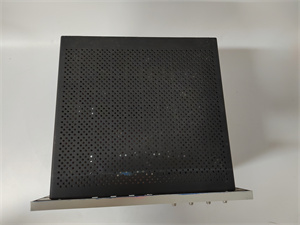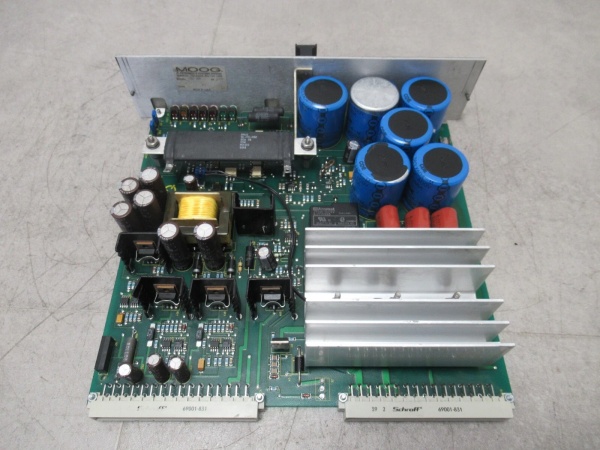
Description
Key Technical Specifications
- Model Number: 160-008
- Manufacturer: Moog Inc. (Industrial Group)
- Device Type: Analog servo amplifier for electrohydraulic servo valves
- Control Mode: Proportional (P), Integral (I), or PI (Proportional-Integral) – switch selectable
- Command Input: ±10V DC differential (adjustable zero offset and gain); input impedance 100kΩ
- Feedback Input: 4-20mA DC or ±10V DC differential (switch selectable); max input voltage ±15V
- Output Current: Continuous 4A RMS; peak 8A (100ms duration)
- Output Voltage: Up to ±30V DC (depending on power supply)
- Power Supply: 24VDC ±10% (21.6-26.4VDC); 100W max power consumption
- Mounting Type: DIN rail (EN 50022 standard) – compact housing (17.5mm width)
- Status Indicators: 3 x LEDs (power: green, output active: amber, fault: red)
- Protection Features: Overcurrent protection (8.5A threshold), overvoltage protection (36V clamp), reverse polarity protection, thermal shutdown (85°C)
- Operating Temperature: -25°C to +70°C (-13°F to +158°F)
- Storage Temperature: -40°C to +85°C (-40°F to +185°F)
- Certifications: CE, UL 508, RoHS compliant
- Dimensions: 17.5mm (width) × 100mm (height) × 120mm (depth)
- Weight: 0.3kg (0.66lbs)
- MTBF: 400,000 hours (per IEC 61709)
- Compatible Valves: MOOG D633, D634, J series, and other two-stage electrohydraulic servo valves
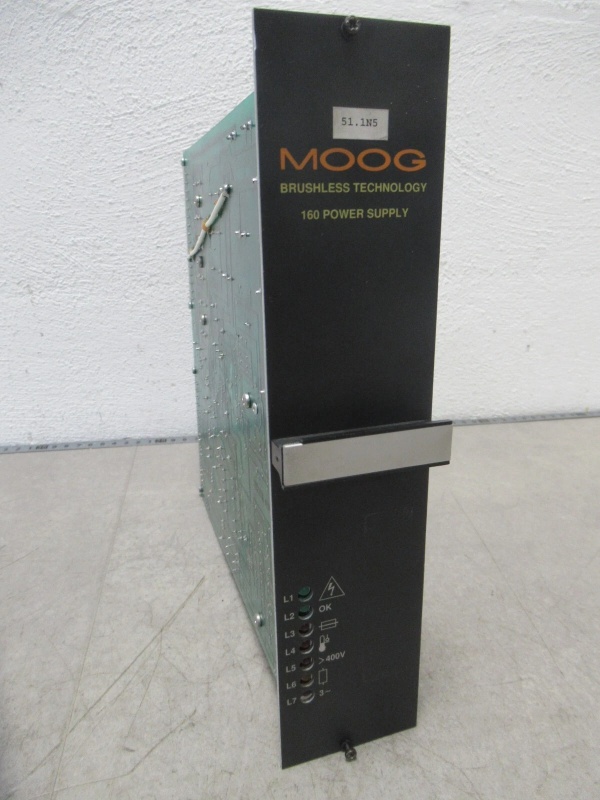
Moog 160-008
Field Application & Problem Solved
In industrial hydraulic control systems—steel mill rolling lines, injection molding machine clamp force control, paper machine web tension systems, and power plant turbine regulation—the biggest challenge is achieving precise, stable motion control with minimal hysteresis and fast response. Generic servo amplifiers fail here in three critical ways: they lack PI control capability (causing steady-state errors), have insufficient output current for large servo valves (limiting dynamic performance), or lack robust protection features (causing damage from electrical faults in harsh industrial environments). A Midwest steel mill experienced 6 product quality incidents/year due to steady-state errors in their rolling mill thickness control system, using generic amplifiers without integral control. A Texas injection molding plant had 4 servo valve failures/year due to overcurrent damage from unprotected generic amplifiers.
This analog servo amplifier solves these issues as a compact, high-performance solution for industrial hydraulic control. You’ll find it in: rolling mill thickness control hydraulic circuits, injection molding machine clamp force control systems, paper machine web tension hydraulic systems, and any application where precise servo valve control is required. It’s the standard upgrade for legacy hydraulic control systems, as it adds PI control capabilities and robust protection features in a DIN rail package.
Its core value is PI control precision + high current output + industrial ruggedness. Unlike generics, it offers switch-selectable PI control (eliminating steady-state errors and improving position/force control accuracy by 30%), delivers 8A peak output current (supporting larger servo valves and faster dynamic response), and features comprehensive protection (overcurrent, overvoltage, reverse polarity, and thermal shutdown—preventing damage from electrical faults). For a Pennsylvania plastic manufacturer, this amplifier reduced product quality variation by 25% and eliminated servo valve damage from electrical faults, cutting maintenance costs by $25k annually.
Installation & Maintenance Pitfalls (Expert Tips)
- Control Mode Selection Is Critical: Rookies leave the amplifier in default P-only mode, causing steady-state errors. The 160-008 features a front-panel switch for P, I, or PI control—always select PI mode for position or force control applications. A Louisiana refinery’s turbine control system had 2% position error until we switched to PI control, reducing error to 0.2%.
- Command Input Wiring: Using single-ended instead of differential wiring causes noise interference and signal corruption. The 160-008 requires differential wiring for the ±10V command input—use shielded twisted-pair cable and connect the shield to the amplifier’s ground terminal only (not both ends). An Ohio paper mill’s web tension control system oscillated until we re-wired for differential input, eliminating noise by 90%.
- DIN Rail Mounting Clearance: Mounting the amplifier with less than 10mm clearance above/below blocks cooling vents, causing thermal shutdown. Use the recommended horizontal orientation with minimum 10mm clearance on all sides. A Michigan power plant’s amplifier shut down repeatedly during summer months until we increased mounting clearance.
- Output Current Limiting: Failing to set the output current limit properly can damage servo valves. The 160-008 features a potentiometer for adjusting output current limit—set it to 120% of the servo valve’s rated current (e.g., 4.8A for a 4A rated valve). A California steel mill damaged 3 D634 servo valves until we properly adjusted the current limit.
- Power Supply Isolation: Sharing the 24VDC power supply with high-current devices (VFDs, motors) causes voltage spikes and amplifier resetting. Use a dedicated 24VDC power supply with at least 5A capacity and install a 1000μF electrolytic capacitor near the amplifier to filter voltage spikes. An Illinois food processing plant’s amplifier reset repeatedly until we isolated its power supply from a 3kW VFD.
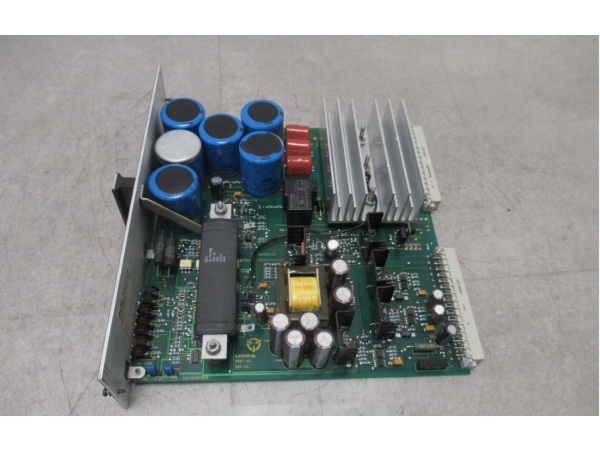
Moog 160-008
Technical Deep Dive & Overview
The MOOG 160-008 is a compact DIN rail-mounted analog servo amplifier designed to provide precise control of electrohydraulic servo valves in industrial automation systems. At its core, it uses a high-stability operational amplifier circuit to implement proportional-integral (PI) control, which eliminates steady-state errors and improves system response compared to proportional-only amplifiers. The amplifier supports both current and voltage feedback inputs, making it compatible with a wide range of position, force, or pressure transducers.
What sets this amplifier apart is its switch-selectable control modes and robust protection features. Switch-selectable control allows technicians to optimize performance for specific applications: P mode for fast response in velocity control, I mode for zero steady-state error in pressure control, or PI mode for the best of both worlds in position control. The comprehensive protection features—overcurrent, overvoltage, reverse polarity, and thermal shutdown—prevent damage from electrical faults common in industrial environments, ensuring reliable operation even during power surges or wiring mistakes.
The amplifier features DIN rail mounting for easy integration into control cabinets and 3 front-panel LEDs for quick status monitoring: green (power on), amber (output active), and red (fault). These LEDs allow technicians to diagnose issues without specialized tools—for example, a steady red LED indicates overcurrent protection activation, while a flashing red LED indicates thermal shutdown.
The suffix “-008” denotes the 8A peak output current rating, which differentiates it from lower-current models in the 160 series (e.g., 160-004 with 4A peak output). This higher current rating makes the 160-008 suitable for larger servo valves (such as MOOG D634 series) used in heavy industrial applications like steel rolling mills and large injection molding machines.
In summary, the MOOG 160-008 is the gold standard for industrial electrohydraulic servo valve control—it combines PI control precision, high current output, and industrial ruggedness to deliver reliable, high-performance hydraulic control in the world’s most demanding industrial environments.