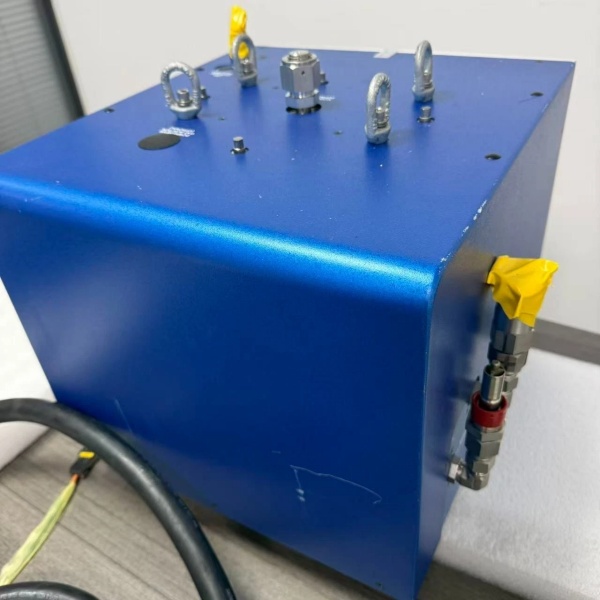
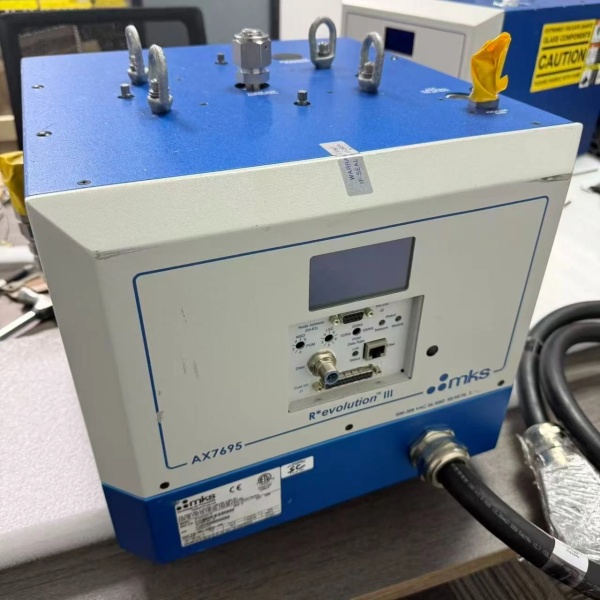
Description
Hard-Numbers: Technical Specifications
-
Plasma Technology: Low-Field Toroidal (patented MKS technology)
-
RF Frequency: 13.56 MHz (ISM band)
-
RF Power Output: Up to 6 kW (6000 W) plasma power
-
Power Control: Moderate degree of power control; accurate reproducibility
-
Ignition Gas: 100% O2 or Ar, or 90% O2/10% N2 (other gases by request)
-
Process Gas Flow: Up to 6.0 slm (standard liters per minute) of 100% O2 or 90% O2/10% N2
-
Operating Pressure: 0.5 to 2.0 Torr @ 1.0 to 6.0 slm (pressure measured at outlet)
-
Radical Output: Up to 6 slm atomic radicals (O, N, etc.)
-
Duty Cycle: 100% (continuous operation)
-
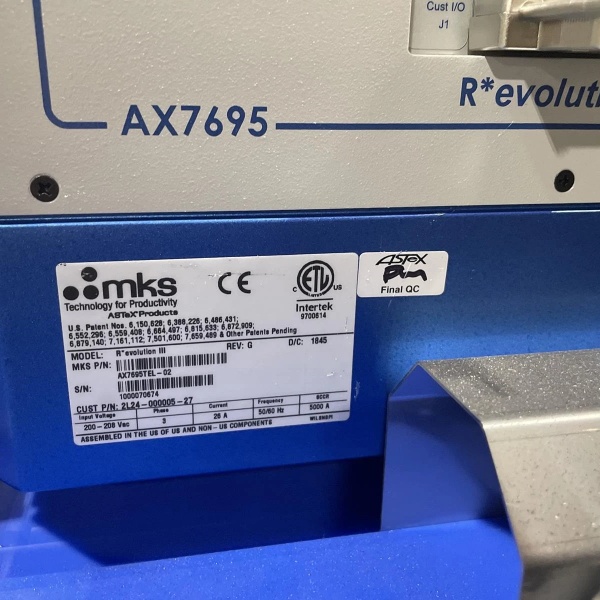
Power Requirements: 180 to 228 VAC, 50/60 Hz, 30A, 3-phase
-
Cooling Water: 1.75 gpm (gallons per minute), <30°C inlet temperature
-
Operating Temperature: Ambient 40°C max
-
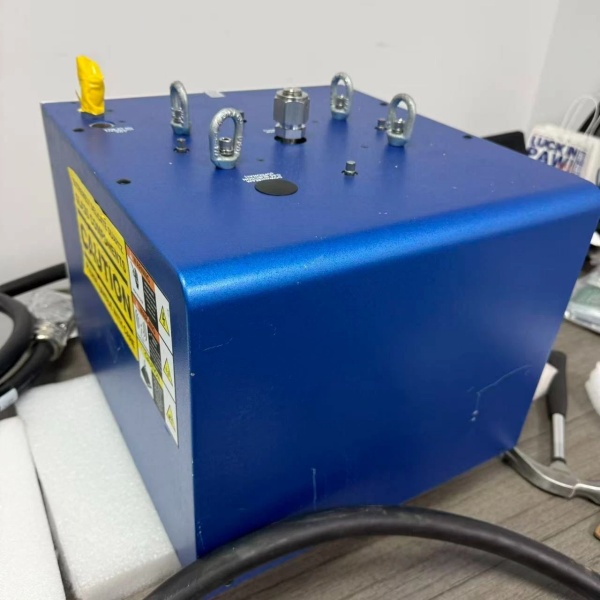
Dimensions: 399 mm × 348 mm × 308 mm (15.7″ × 13.7″ × 12.14″)
-
Weight: 38.6 kg (85 lb)
-
Wetted Materials: 6061-T6 Aluminum, Kalrez®, SiO2 (quartz), 316L SS, Nickel, Fluorosilicone
-
Control Interface: Discrete I/O, RS-232, DeviceNet, Ethernet (MKS TOOLweb-enabled)
-
Compliance: CE, SEMI F47, SEMI S2 (includes S8, S10, S14), UL 61010-1, CAN/CSA-61010-1

MKS RPS AX7695
The Real-World Problem It Solves
Semiconductor wafer processing needs atomic radicals (oxygen, nitrogen) for photoresist stripping and surface preparation, but generating these in the process chamber causes ion damage and contamination. Microwave and ICP systems are bulky, expensive, and hard to maintain. The AX7695 generates plasma remotely in a self-contained quartz chamber, then transports only the neutral radicals to the wafer—no ions, no contamination, no chamber damage. It delivers twice the strip rate of microwave systems at half the cost and one-third the footprint.
Where you’ll typically find it:
-
Photoresist ashers on 300mm logic device lines stripping thick organic layers
-
Gate nitridation systems for advanced CMOS transistor formation
-
Wafer pre-clean chambers removing native oxide before high-k deposition
This unit eliminates the “dirty plasma” problem that causes yield loss in advanced node manufacturing while providing 6 kW power for high-throughput production.
Hardware Architecture & Under-the-Hood Logic
The AX7695 is not just an RF generator—it’s a complete plasma chemistry engine. It integrates the RF power supply, matching network, plasma chamber, and control electronics into one package that mounts directly on the process chamber.
Signal flow and power logic:
-
Gas Input: Process gas (O2, Ar, or O2/N2) enters the quartz plasma chamber at 0.5-2.0 Torr via mass flow controllers. The chamber is pure SiO2 for chemical inertness and low radical recombination.
-
RF Excitation: The internal RF power supply generates 13.56 MHz at up to 6 kW. A toroidal coil couples energy into the gas without electrodes—no metal contamination, no electrode erosion.
-
Low-Field Toroidal Plasma: The patented toroidal geometry creates a dense, low-temperature plasma with high dissociation efficiency. The toroidal field confines electrons while allowing radicals to diffuse outward.
-
Radical Extraction: Charged particles recombine on the quartz walls; only neutral radicals (O*, N*) exit through the outlet port to the process chamber. This “remote” generation prevents ion bombardment damage to the wafer.
-
Matching Network: An internal auto-matching network (L-type or π-type) with motorized vacuum capacitors maintains 50Ω impedance match despite gas chemistry changes. VSWR protection prevents reflected power damage.
-
Control & Monitoring: Discrete I/O handles Plasma On/Off and Power Set commands. RS-232/DeviceNet/Ethernet provides remote monitoring of forward power, reflected power, plasma status, and interlock states via MKS TOOLweb.
-
Protection Interlocks: Internal thermal switch monitors chamber temperature; water flow switch verifies cooling. Either fault shuts down plasma instantly to prevent quartz damage or O-ring failure.
MKS RPS AX7695
Field Service Pitfalls: What Rookies Get Wrong
Assuming It’s Just an RF Generator
The AX7695 is an integrated plasma source, not a standalone RF power supply. It contains the quartz chamber, matching network, and control logic. You cannot substitute a generic 13.56 MHz generator—the impedance matching and radical transport are integral to the design.
-
Field Rule: Never bypass the internal matching network with external tuning. The toroidal coil and chamber geometry are matched as a system. If the “Reflected Power” alarm triggers, check the gas flow and pressure first—plasma impedance changes dramatically with O2 flow rate. A generic RF generator will destroy the quartz chamber by running unmatched; the AX7695 has VSWR protection, but sustained mismatch will still crack the quartz.
Ignoring the Water Flow Interlock
The quartz chamber runs at high temperature; 1.75 gpm cooling water is mandatory. Many techs connect the water lines but don’t verify flow rate—partial blockage or low pressure causes the thermal switch to trip repeatedly, looking like an electronics fault.
-
Quick Fix: Install a flow meter (rotameter) in the cooling water line during commissioning. Verify 1.75 gpm at the inlet with a bucket test if necessary. Check the water temperature—>30°C inlet reduces cooling efficiency and causes thermal shutdowns. If the unit trips on “Thermal Fault” within 5 minutes of plasma start, measure the outlet water temperature; if it’s >45°C, you have insufficient flow or a blocked heat exchanger. Never defeat the flow switch jumper—this voids the SEMI S2 safety certification and will crack the quartz chamber.
Using the Wrong Gas Chemistry
The AX7695 is optimized for O2, Ar, and O2/N2 mixtures. Running pure CF4 or other fluorocarbons will etch the quartz chamber and Kalrez seals, causing catastrophic failure and chamber contamination.
-
Field Rule: Verify the gas type on the nameplate before connecting process gas. The “Wetted Materials” list (6061-T6 Al, Kalrez, SiO2, 316L SS, Ni, Fluorosilicone) defines chemical compatibility. If the process requires fluorinated gases, use the MKS ASTRON or Paragon series (AX7700) designed for NF3 and fluorine chemistry. A contaminated quartz chamber cannot be cleaned—replacement is the only fix, and it’s a 38 kg module that requires chamber venting.