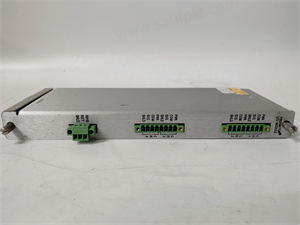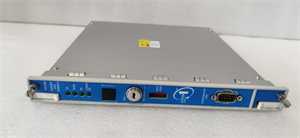
Description
Hard-Numbers: Technical Specifications
- Mains Voltage: 3 × 480 V AC, 50-60 Hz (permissible range: 3 × 330-528 V)
- Mains Current: 20 Aeff (rated input current)
- DC-Bus Voltage: 1.35 × Vmains (≈648 V at 480 V mains)
- Permanent Power: 16.5 kW (at 480 V mains)
- Peak Power: 37 kW (5-second duration)
- Power Loss: 110 W (continuous, without brake resistor)
- Internal Brake Resistor: 250 W continuous / 51.1 kW peak
- External Brake Resistor: ERBD011R01k1 (1.1 Ω, 16.5 kW continuous)
- Minimum Brake Resistance: 11 Ω
- Operating Temperature: 0°C to +45°C
- Weight: 10.5 kg
- Protection Class: IP20 (indoor cabinet only)
- Terminal Torque: 2.3 Nm (20 lb-in) for power terminals
- Recommended Cable Size: 4 mm² (AWG 14/15) for L1, L2, L3, PE
- Altitude Derating: 5% reduction per 100m above 1000m (95% at 2000m, 90% at 3000m, 85% at 4000m)
- Communication: State bus X6 (4-wire) to axis modules
- Hardware Version: E.4x and higher required for compatibility

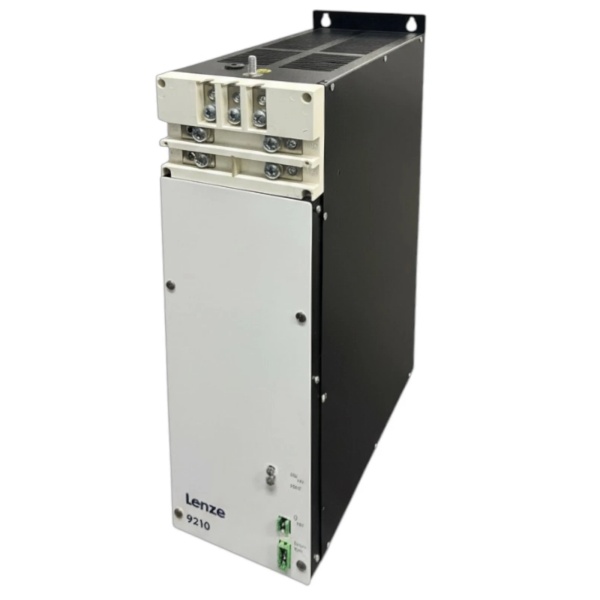
Lenze 9215
The Real-World Problem It Solves
Multi-axis servo systems in semiconductor fabs and precision automation need a centralized DC-bus power source that can handle regenerative energy from decelerating motors without overvoltage trips. Running individual power supplies for each axis is a wiring nightmare and maintenance disaster waiting to happen.
The 9215 converts three-phase mains into a regulated ~648 V DC-bus that feeds multiple axis modules from one box. When your servos brake hard, the unit dumps that regenerative energy into its internal or external brake resistor instead of letting the DC-bus voltage spike and trip your whole line.
Where you’ll typically find it:
- Semiconductor wafer handling robots and positioning stages
- High-speed packaging machinery with coordinated motion
- Material transfer systems in paper mills and printing presses
- CNC feed drives and multi-axis machine tools
The bottom line: One 9215 replaces multiple power supplies, simplifies your cabinet, and keeps your servos running without DC-bus overvoltage shutdowns.
Hardware Architecture & Under-the-Hood Logic
This unit sits between your incoming three-phase mains and the axis modules that actually drive the motors. It doesn’t have its own microcontroller—that’s handled by the axis modules. Its job is raw power conversion and braking.
- Three-phase AC enters through L1, L2, L3 terminals and hits the required mains choke first.
- The six-pulse rectifier bridge converts that AC to DC and charges the capacitor bank.
- DC voltage stabilizes at approximately 1.35 times your mains voltage.
- The +U and -U bus terminals feed that DC power to all connected axis modules in parallel.
- When a motor decelerates and regenerates energy back into the DC-bus, the voltage starts rising.
- The braking circuit dumps excess energy into the internal (250 W) or external (up to 16.5 kW) brake resistor to keep the bus within limits.
- State bus X6 constantly tells axis modules what’s happening: ready, overvoltage, resistor overtemp.
- If something goes wrong, the monitoring circuits cut power and signal faults to the rest of the system.
The module is essentially a power house with brains in the axis modules. It doesn’t control motion—it just keeps the DC-bus clean and stable while the axis modules do the heavy lifting.
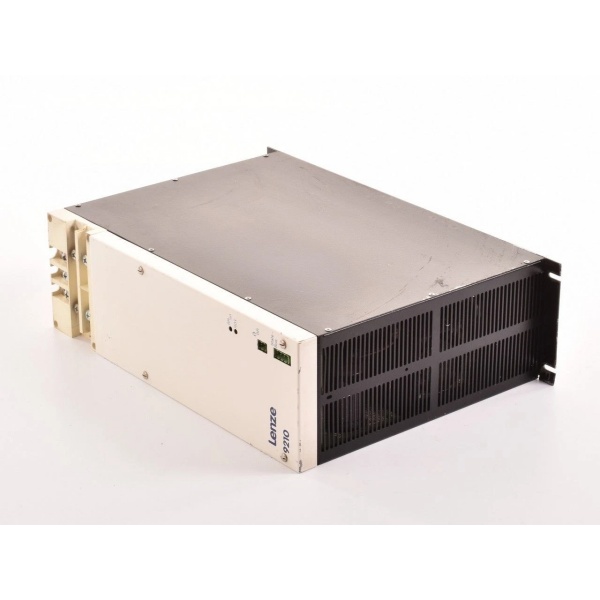
Lenze 9215
Field Service Pitfalls: What Rookies Get Wrong
Skipping the Mains Choke
I see this constantly—guys replace a failed supply module and skip the mains choke because “it worked before.” Then the new unit dies in six months from harmonic distortion and rectifier stress.
Field Rule: Never operate without the specified Lenze mains choke between your incoming power and the 9215. It’s not optional.
Undersized Brake Resistors
Your application generates more regenerative energy than the internal 250 W resistor can handle. The DC-bus spikes and trips on overvoltage during high-speed stops. You blame the drive when the real problem is your resistor choice.
Quick Fix: Calculate your actual braking energy per cycle. If you’re doing frequent hard stops with high-inertia loads, wire in the external ERBD011R01k1 resistor and ditch the internal one entirely.
Mixing Hardware Versions
The 9215 is hardware version E.4x, but you’re mating it to axis modules that are E.2x. The system powers up but communication is flaky and you get random fault codes that don’t make sense.
Field Rule: Check the hardware version labels on ALL modules before installation. E.4x supply modules only play nice with E.4x axis modules. Don’t mix generations—Lenze doesn’t support it and you’ll chase ghosts for weeks.
Loose Terminal Torque
You crank the L1, L2, L3 terminals by feel during a midnight replacement. Two months later, the cabinet smells like ozone and your terminal is a charred mess from arcing.
Field Rule: 2.3 Nm. Not “tight,” not “hand-tight”—2.3 Newton-meters. Buy a calibrated torque driver and use it every time. That 30 seconds of extra work saves you from a 3 AM meltdown.
State Bus Wiring Mistakes
You missed one wire on the four-wire state bus X6 going to the last axis module. That one axis behaves erratically and trips without logging a clear fault because it’s not getting the ready signal properly.
Quick Fix: Count those four state bus wires and verify continuity on each one. Every axis module needs all four wires from X6 connected or the system won’t communicate properly across the backplane.
Altitude Derating Neglect
You’re at 2500m elevation in a mountain facility and running the unit at full 16.5 kW rating like you’re at sea level. The unit runs hot and trips on thermal warnings because the thin air can’t cool it effectively.
Field Rule: Above 1000m, derate 5% per 100m. At 2500m, you’re at 85% capacity. Either reduce your load or upgrade to the 9217 (33 kW) and leave headroom.
Cabinet Airflow Starvation
You packed three supply modules side-by-side with zero clearance. The 9215’s 110 W continuous loss has nowhere to go, and the heat sink hits overtemperature limits.
Field Rule: Minimum 100mm clearance top and bottom. Mount vertically with power terminals at the top. If your cabinet runs hot at 45°C ambient, you need forced air or external cooling—full stop.