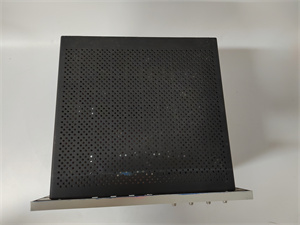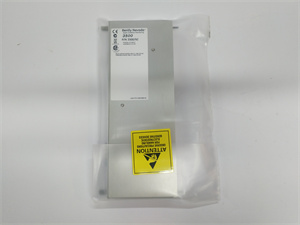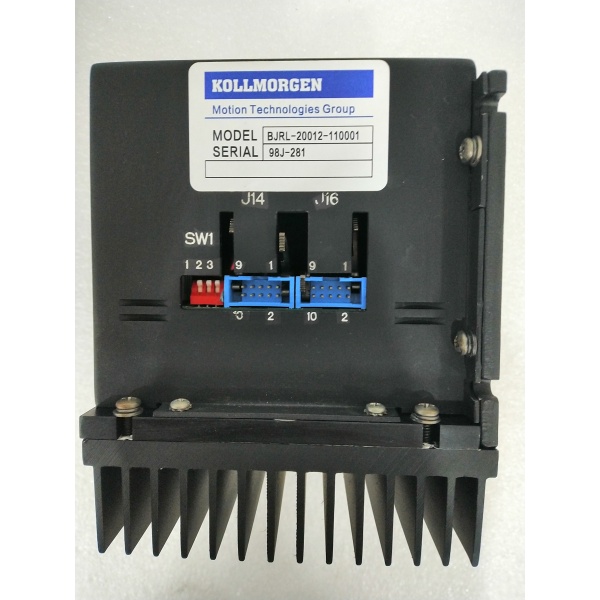
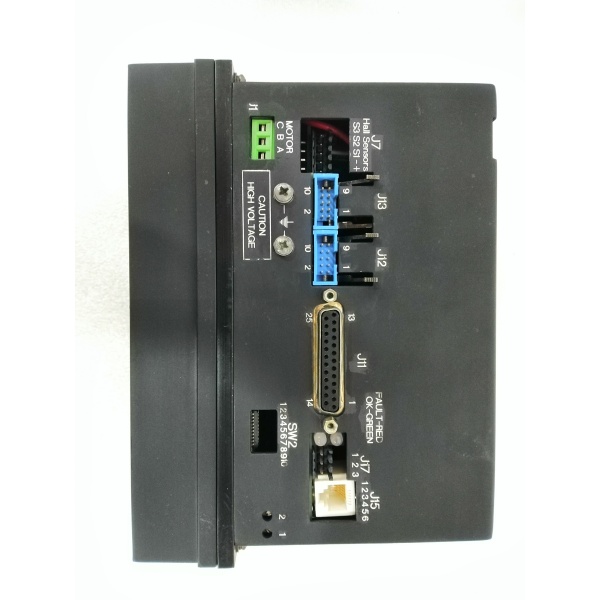
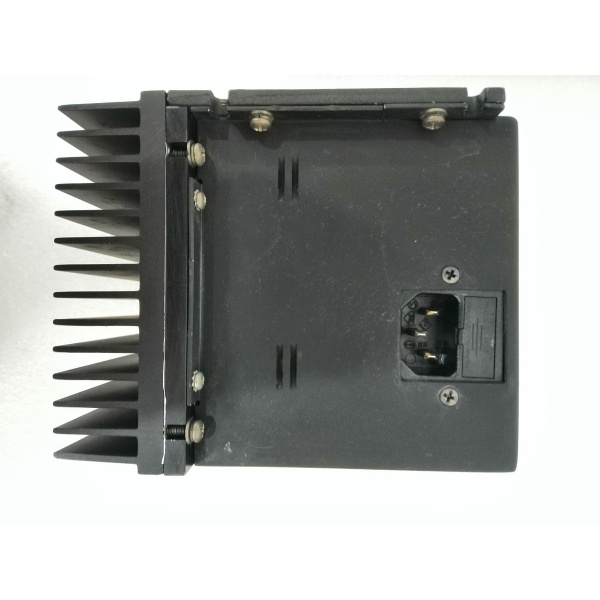
Description
Hard-Numbers: Technical Specifications
-
Input Voltage: 90-135 VAC (single-phase), 50/60 Hz
-
DC Bus Voltage: ~130-190 VDC (derived from AC input)
-
Continuous Output Current: 4-12 Amps DC (model dependent, “20012” indicates 12A capability)
-
Peak Output Current: 25 Amps DC (short-term overload)
-
Output Power: Up to ~2.2 kVA (depending on voltage and current combination)
-
Motor Compatibility: Brushless DC (BLDC) servo motors, 6-step commutation
-
Feedback: Resolver (single-speed or multi-speed) for motor commutation and position
-
Control Modes: Torque, velocity, position (standalone positioner mode)
-
Programming: BJRL language (BASIC-like command structure)
-
Motion Profiles: S-curve, trapezoidal, electronic gearbox, master/slave synchronization
-
I/O:
-
Digital Inputs: 14 optically isolated, 5/12/24VDC compatible (source/sink)
-
Digital Outputs: 6 optically isolated, up to 24VDC, fused, source/sink capable
-
Analog Inputs: 3 × 10-bit (for pots, sensors, analog commands)
-
Analog Output: 1 × 8-bit (for meters, external drive commands)
-
-
Protection: Overcurrent, overvoltage, overtemperature, short-circuit
-
Operating Temperature: 0°C to +50°C (ambient)
-
Storage Temperature: -20°C to +70°C
-
Communication: RS-232/RS-485 for programming and monitoring
-
Dimensions: Compact industrial enclosure (approx. 200 × 150 × 50mm range)
-
Weight: ~2 kg (4.4 lbs)
-
Mounting: Panel or DIN rail mount
-
Status Indication: Single red/green LED for operational status
-
Compatible Motors: Kollmorgen H-Series, RBE Series, other BLDC motors with resolver feedback

Kollmorgen BJRL-20012-110001
The Real-World Problem It Solves
Small to medium positioning systems often get bogged down by the cost and complexity of separate amplifiers, controllers, and programming environments. The BJRL-20012-110001 eliminates the “too many boxes” headache by integrating a full servo amplifier and programmable positioner into one economical package. It handles the messy reality of standalone indexing tables, conveyor positioning, and simple pick-and-place where you need real servo performance without the price tag of a full motion control system.
Where you’ll typically find it:
-
Standalone indexing tables and rotary feeders in packaging machinery
-
Simple conveyor positioning systems for product routing
-
Small gantry and Cartesian robots for light assembly
-
Retrofit applications replacing stepper motors with servo performance
This drive keeps your motion control simple and affordable—no separate PLC, no complex fieldbus configuration, just integrated amplifier and positioner in one box.
Hardware Architecture & Under-the-Hood Logic
The BJRL-20012-110001 isn’t just an amplifier with a positioner bolted on—it’s a true single-microprocessor integrated system where the same processor closes all servo loops and executes the motion program. The six-step commutation provides robust brushless motor control without the complexity of sinusoidal drives, while the self-tuning capability reduces commissioning time.
Internal Signal Flow:
-
AC Input Stage: 90-135VAC single-phase input rectified and filtered to ~130-190VDC bus
-
Microprocessor Control: Single high-performance processor handles commutation, current loop, velocity loop, and position loop simultaneously
-
Six-Step Commutation: Position feedback from resolver determines rotor angle; processor switches output transistors in six-step pattern to drive BLDC motor
-
Current Sensing: Onboard current sensors provide feedback for torque control and overcurrent protection
-
Motion Profile Generation: Processor executes BJRL language program, generating S-curve or trapezoidal velocity profiles with electronic gearing capability
-
I/O Handling: Optically isolated digital I/O interfaces with machine sensors and actuators; analog I/O handles setpoints and monitoring
-
Protection Logic: Hardware and software overcurrent, overvoltage, and thermal protection with automatic fault recovery where safe
Kollmorgen BJRL-20012-110001
Field Service Pitfalls: What Rookies Get Wrong
Assuming “Self-Tuning” Means No Tuning Required
The BJRL has self-tuning capability, but it’s not magic. Rookies enable auto-tune on high-inertia loads or mechanically loose systems and wonder why the motor oscillates or the position loop hunts.
-
Field Rule: Self-tuning works best on rigid, moderate-inertia systems. For high-inertia loads (rotary tables, large leadscrews), start with manual tuning—set conservative gains (low Kp, moderate Ki) and gradually increase while monitoring following error. Check the mechanical system first: backlash, loose couplings, and binding will confuse any auto-tune algorithm. Run the self-tune with the actual load attached, not a dummy inertia. If the motor “sings” or vibrates after tuning, the gains are too aggressive—back off by 30%.
Mixing Up BJR and BJRL Models
The BJR series is DC input (20-40VDC or 20-90VDC), while BJRL is AC input (90-135VAC). Engineers grab a BJR from stores thinking it’s a BJRL, install it on 120VAC, and release the magic smoke.
-
Quick Fix: Check the nameplate before applying power. BJRL = AC Line input (90-135VAC). BJR = DC input (20-40V or 20-90VDC). The input connectors are different, but desperate techs have forced connections. If you need to replace a BJRL with a BJR, you’ll need a DC power supply (130VDC, 12A capability) or step up to a different product line. Never apply AC to a BJR or DC to a BJRL—immediate catastrophic failure will result.
Ignoring the Resolver Alignment on Motor Replacement
The BJRL uses resolver feedback for both commutation and position. When replacing a motor, the resolver must be aligned to the motor’s magnetic poles or the drive will fault on “Commutation Error” or run away.
-
Field Rule: When replacing a motor, verify the resolver alignment procedure. The resolver has a mechanical index (null point) that must align with the motor’s magnetic neutral. If the motor was shipped without alignment data, you’ll need to perform a “phasing” procedure: lock the rotor at a known position, measure resolver output, and adjust mounting until the resolver reads the expected value at that position. Some motors have a factory alignment pin—use it. If the motor runs away on enable or faults immediately, you’ve got a resolver alignment problem, not a drive problem.