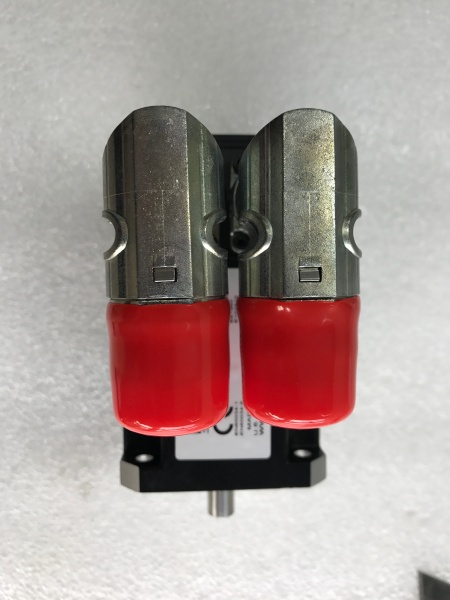
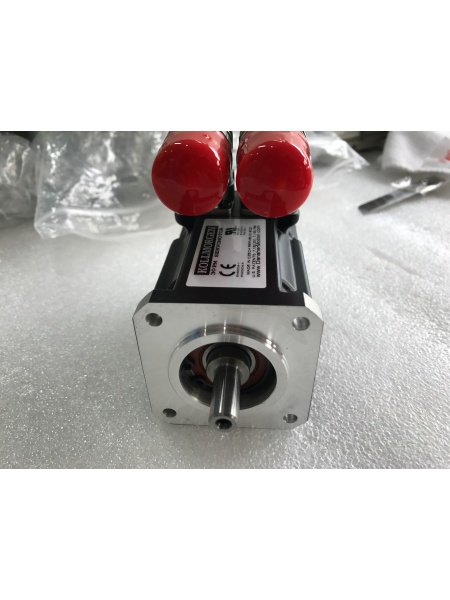
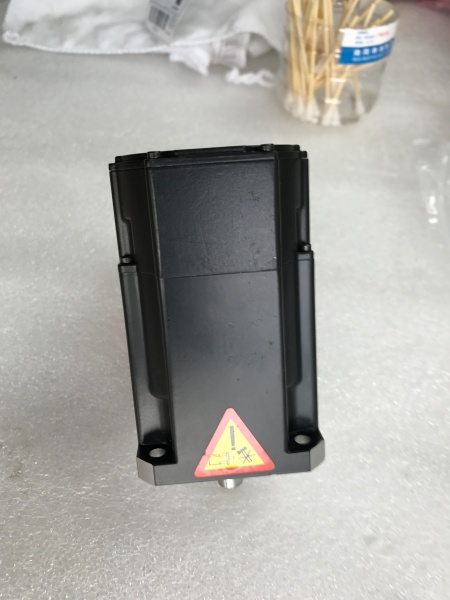
Description
Hard-Numbers: Technical Specifications
-
Motor Type: Brushless permanent magnet synchronous servo (3-phase)
-
Frame Size: IEC 58mm square (NEMA 23 equivalent)
-
Winding Type: C (optimized for 320VDC bus operation)
-
Rated Speed: 8000 RPM (max mechanical speed)
-
Rated Power: 0.32 kW (0.43 HP) at 320VDC bus
-
Stall Torque: 0.48 Nm (4.2 lb-in) continuous at 100°C winding ΔT
-
Peak Torque: 1.47 Nm (13.0 lb-in) short-term overload
-
Rated Torque: 0.39 Nm (3.5 lb-in) at rated speed
-
Rated Current: 1.58 Arms continuous at stall
-
Peak Current: 4.65 Arms (corresponds to peak torque)
-
Voltage Constant (K_E): ~38-40 mV/min (line-to-line back-EMF, estimated for 320V class)
-
Torque Constant (K_T): ~0.30 Nm/A (line-to-line, estimated)
-
Winding Resistance (R_20): ~8-10 Ω (line-to-line, cold, estimated)
-
Winding Inductance (L): ~15-20 mH (line-to-line, estimated)
-
Rotor Inertia: 0.11 × 10⁻⁴ kg·m² (0.11 kg·cm², without brake)
-
Mechanical Time Constant: ~1.5 ms
-
Thermal Time Constant: 15-20 minutes (winding)
-
Insulation Class: F (155°C) with Class B temperature rise (80K)
-
Protection Class: IP65 (dust-tight, low-pressure water jet protected)
-
Mounting: IEC 58mm square flange, 9mm or 11mm keyed shaft (per variant)
-
Shaft Load: 50-70 N radial (max at shaft end), 30-40 N axial
-
Holding Brake: Spring-applied, electrically released disc brake
-
Brake Torque: ~1.0-1.2 Nm (sufficient for vertical loads)
-
Operating Voltage: 24 VDC
-
Power Consumption: ~8-10W (holding), 2-3A inrush to release
-
Release Time: 20-40 ms
-
-
Feedback Device: Resolver (16-bit resolution, 2-pole, “NR” suffix indicates resolver with brake)
-
Operating Temperature: 0°C to +40°C (ambient, derate above 40°C)
-
Storage Temperature: -20°C to +70°C
-
Weight: ~1.5-2.0 kg (3.3-4.4 lbs) with brake
-
Dimensions: 58 × 58 mm flange, ~150-170 mm length (with brake)
-
Compatible Drives: Kollmorgen AKD series, Servostar CD, third-party 320VDC-class servo amplifiers

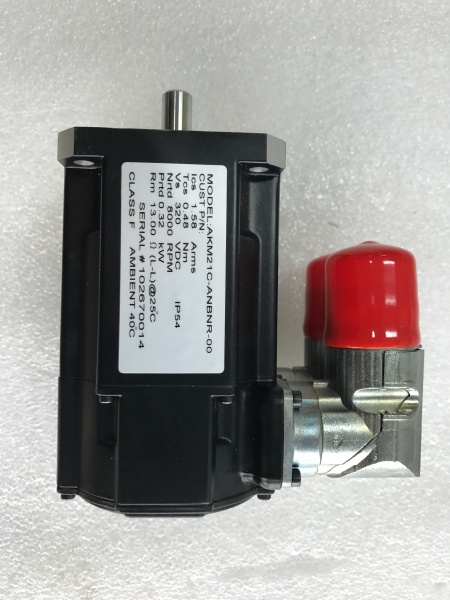
Kollmorgen AKM21C-ANBNR-00
The Real-World Problem It Solves
Small precision axes in packaging and semiconductor equipment need motors that can accelerate fast, hold position accurately, and fit into tight spaces without sacrificing reliability. The AKM21C-ANBNR-00 eliminates the “too big, too slow” compromise by delivering 8000 RPM capability and 1.47 Nm peak torque in a 58mm package smaller than a soda can. It handles the messy reality of high-speed pick-and-place, label application, and wafer handling where cycle times are measured in milliseconds and footprint is at a premium.
Where you’ll typically find it:
-
High-speed packaging machinery for cartoning, labeling, and pouch filling
-
Semiconductor wafer handling and die bonding equipment
-
Precision textile and printing machinery with rapid indexing requirements
-
Small robotic arms and delta robots for light assembly
This motor keeps your small axes fast and precise—no NEMA 34 frame bulk, no stepper motor resonance, just compact servo performance with real feedback.
Hardware Architecture & Under-the-Hood Logic
The AKM21C-ANBNR-00 isn’t a repurposed stepper or DC motor—it’s a purpose-built AC servo with neodymium magnets and optimized electromagnetic design. The “C” winding is specifically wound for 320VDC bus operation (common in small servo drives), providing better torque density than lower voltage alternatives. The integrated resolver provides absolute position feedback without the battery backup headaches of encoders, while the spring-applied brake ensures vertical axis safety during power loss.
Internal Construction:
-
Stator Assembly: Laminated steel core with concentrated 3-phase windings, vacuum-impregnated for thermal conduction
-
Rotor Assembly: High-energy neodymium-iron-boron (NdFeB) magnets on steel hub, balanced for 8000 RPM operation
-
Integrated Brake: Spring-applied disc brake with friction plates, electromagnetic release coil, and manual release lever
-
Resolver Feedback: 16-bit absolute position transducer (2-pole brushless resolver) with analog-to-digital conversion in the drive
-
Thermal Protection: PTC thermistors embedded in windings (130°C trip) for drive-based overload protection
-
Bearing System: Sealed ball bearings (greased for life), rated for 20,000+ hours at rated load and speed
Kollmorgen AKM21C-ANBNR-00
Field Service Pitfalls: What Rookies Get Wrong
Assuming 1.47 Nm Peak Means 1.47 Nm Continuous
The 1.47 Nm peak rating is for transient acceleration only—typically limited to 1-2 seconds by the drive’s peak current capacity (4.65A) and the motor’s small thermal mass. Rookies size mechanics for 1.47 Nm continuous, then watch the motor overheat and trip thermal protection within minutes.
-
Field Rule: Size your mechanics for 0.48 Nm stall torque, use 1.47 Nm only for acceleration/deceleration transients. Calculate the RMS torque for your motion profile—if it exceeds 0.39 Nm (rated torque), you need a larger motor (AKM24 or AKM32 series) or a duty cycle reduction. Monitor the PTC thermistor resistance during commissioning; if it trends toward 1.5kΩ (130°C trip point) during normal operation, your RMS load is too high. The small 58mm frame has limited thermal mass—respect the duty cycle.
Confusing the “NR” Suffix with Encoder Models
The “NR” in AKM21C-ANBNR-00 indicates Resolver feedback with brake. Engineers order this thinking it’s an encoder model (“NE” suffix), then wonder why they can’t get incremental position feedback or why the drive shows “Resolver Feedback” instead of encoder counts.
-
Quick Fix: Verify the feedback type before ordering. “NR” = Resolver (analog, absolute, no battery backup). “NE” = Incremental Encoder (digital, requires homing). “NM” = Multi-turn absolute encoder (EnDat or BiSS). If your application needs encoder feedback for position loop or you need to replace an encoder-equipped motor, do not order the NR variant—it won’t work without resolver-to-encoder conversion in the drive. Check your drive’s feedback configuration; AKD drives handle both, but parameter settings differ significantly.
Ignoring the 320VDC Bus Voltage Requirement
The “C” winding is optimized for 320VDC bus operation. Rookies pair this with 160VDC drives (common for smaller AKM21 windings) and wonder why they can’t achieve rated torque or the motor runs hot at lower speeds.
-
Field Rule: Verify your drive’s DC bus voltage. The AKM21C requires ~320VDC (from 230VAC input) to achieve rated performance. If you’re using a 120VAC input drive with ~160VDC bus, you need the “E” or “G” winding variant, not the “C”. Running a 320V motor on 160V bus results in 50% torque loss and excessive current draw. Check the motor nameplate and drive specifications—voltage mismatch is a common cause of poor performance in small servo systems.