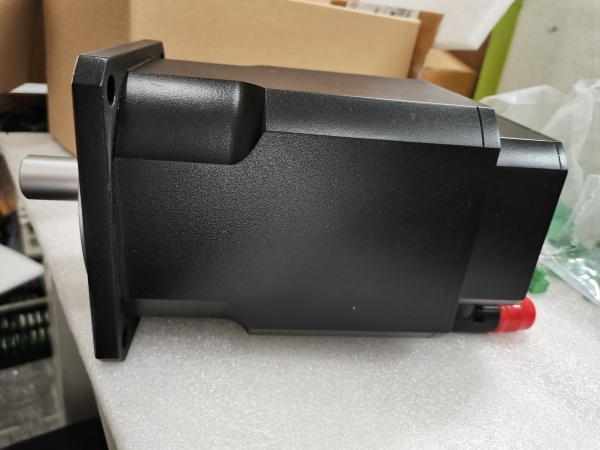
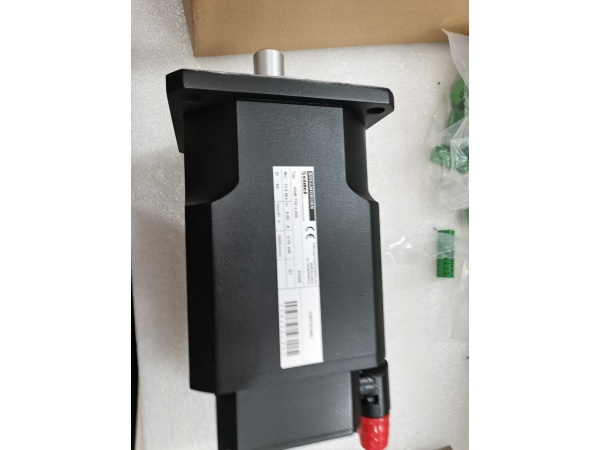
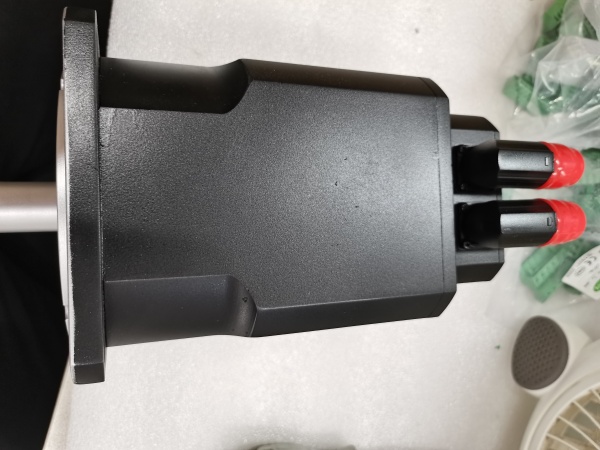
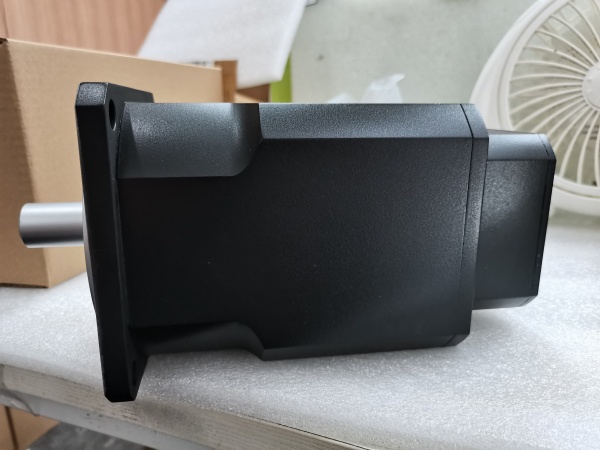
Description
Hard-Numbers: Technical Specifications
-
Motor Type: Brushless permanent magnet synchronous servo (3-phase, 6-pole)
-
Rated Speed: 3000 RPM
-
Rated Power: 2.7 kW (3.6 hp) / 2.68 kW (variant dependent)
-
Rated Torque: 3.0 Nm (at 3000 RPM)
-
Peak Torque: 9.0 Nm (3× rated, short-term overload)
-
Standstill Torque: ~3.5-4.0 Nm (holding torque at zero speed)
-
Rated Current: 6.0 A RMS
-
Peak Current: 13.5 A RMS (corresponds to peak torque)
-
Voltage Class: 400 VAC / 480 VAC (nominal DC bus ~560-600V)
-
Torque Constant (K_T): ~0.67 Nm/A (line-to-line, estimated)
-
Voltage Constant (K_E): ~70-80 mV/min (line-to-line back-EMF, estimated)
-
Winding Resistance (R_20): ~2.5-3.5 Ω (line-to-line, cold, estimated)
-
Winding Inductance (L): ~15-20 mH (line-to-line, estimated)
-
Rotor Inertia: ~0.8-1.2 × 10⁻⁴ kg·m² (0.8-1.2 kg·cm², without brake)
-
Mechanical Time Constant: ~4-6 ms
-
Thermal Time Constant: 20-25 minutes (winding), 40-50 minutes (housing)
-
Insulation Class: F (155°C) with Class B temperature rise (80K)
-
Protection Class: IP64 (dust-tight, splash-proof) or IP65 (variant dependent)
-
Vibration Class: N (per DIN EN 60034-14)
-
Mounting: IEC 77mm square flange, 19mm keyed shaft (optional smooth shaft)
-
Shaft Load: 600-800 N radial (max at shaft end), 200-300 N axial
-
Brake Option: 24 VDC holding brake (optional -G suffix), 12-15 Nm brake torque
-
Feedback Device: Resolver (standard) or incremental encoder (optional)
-
Operating Temperature: 0°C to +40°C (ambient, derate above 40°C)
-
Storage Temperature: -20°C to +70°C
-
Weight: 8-10 kg (17.6-22 lbs) with brake, ~6-8 kg without
-
Dimensions: 77 × 77 mm flange, ~220-250 mm length (with brake)
-
Compatible Drives: Kollmorgen Servostar 600 series, Digifas 7200 series, third-party 400V-class servo amplifiers

6SM77K-3.000
The Real-World Problem It Solves
Medium-duty material handling and indexing applications need a motor that bridges the gap between compact 57mm frames and heavy 107mm units—delivering enough torque for moderate loads without the bulk and cost of oversized servos. The 6SM77K-3.000 eliminates the “Goldilocks problem” by providing 2.7kW in a 77mm package with 9 Nm peak torque for acceleration headroom. It handles the messy reality of conveyor indexing, pallet positioning, and rotary table drives where you need more muscle than a 57mm motor but don’t want to step up to a 100mm+ frame.
Where you’ll typically find it:
-
Medium-duty pallet conveyor systems with 100-300kg loads
-
Rotary indexing tables for assembly and packaging machinery
-
Automated storage and retrieval systems (AS/RS) with moderate lift requirements
-
Food processing equipment requiring IP64/65 washdown protection
This motor keeps your axes moving with the right balance of size and power—no undersized 57mm motors burning out, no oversized 107mm motors wasting energy and cabinet space.
Hardware Architecture & Under-the-Hood Logic
The 6SM77K-3.000 isn’t just a scaled-up 57mm motor—it’s a distinct frame size optimized for thermal capacity and bearing life in continuous duty applications. The 77mm frame allows for larger rotor diameter and stator stack length than the 57mm series, providing higher torque density without requiring rare-earth magnet overdosing. The 6-pole design provides smoother torque ripple than 4-pole alternatives at 3000 RPM, reducing vibration in sensitive positioning applications.
Internal Construction:
-
Stator Assembly: Heavy-gauge laminated steel core with distributed 3-phase windings, vacuum-pressure impregnated (VPI) for thermal conduction and moisture resistance
-
Rotor Assembly: Interior or surface-mounted rare-earth magnets on steel hub, balanced for 3000 RPM operation with 1.2× overspeed margin
-
Bearing System: Oversized sealed ball bearings (greased for life) compared to 57mm variants, rated for 25,000+ hours at rated load
-
Feedback Device: 2-pole or multi-pole resolver (12-bit resolution typical) or high-resolution optical encoder, isolated from motor heat
-
Holding Brake: Spring-applied, electrically released disc brake with 24VDC coil, 12-15 Nm torque rating (optional), engages when power removed for vertical axis safety
-
Thermal Protection: PTC thermistors embedded in windings (130°C trip) for drive-based overload protection
6SM77K-3.000
Field Service Pitfalls: What Rookies Get Wrong
Assuming 9.0 Nm Peak Means 9.0 Nm Continuous
The 9.0 Nm peak rating is for transient acceleration only—typically limited to 3-5 seconds by the drive’s peak current capacity (13.5A) and the motor’s thermal time constant (~20 minutes for windings). Rookies size mechanics for 9 Nm continuous, then watch the motor overheat and trip thermal protection during sustained operation.
-
Field Rule: Size your mechanics for 3.0 Nm rated torque, use 9.0 Nm only for acceleration/deceleration transients. Calculate the RMS torque for your motion profile—if it exceeds 3.0 Nm, you need a larger motor (6SM77S or 6SM107 series) or a duty cycle reduction. Monitor the PTC thermistor resistance during commissioning; if it trends toward 1.5kΩ (130°C trip point) during normal operation, your RMS load is too high. The 77mm frame has better thermal mass than 57mm, but it still has limits.
Mixing Up the 6SM77K and 6SM77S Variants
The S variant has significantly higher torque (17 Nm rated, 4.41kW) and different electrical parameters (9.9A rated). Engineers grab a K from stores thinking it’s an S, install it, and wonder why the axis won’t accelerate fast enough or stalls under load.
-
Quick Fix: Verify the nameplate suffix before installation. The K variant has ~40% less torque than the S (3.0 Nm vs 17 Nm) and requires less current (6.0A vs 9.9A). If you must substitute, recalculate the torque requirements—a K variant in an S application will run at 18% capacity and likely fail to move the load. Check the drive’s motor database; if it doesn’t have the exact variant, enter the parameters manually from the motor datasheet (torque constant, resistance, inductance, inertia). Never assume “77mm is 77mm” in the 6SM series.
Ignoring the 24V Brake Inrush Current Reality
The holding brake draws 3.8A inrush current at 24VDC to release—far more than the ~0.75A holding current. Rookies size the brake power supply for holding current only, then watch the supply sag and the brake chatter or fail to release when the axis tries to move.
-
Field Rule: Size the brake power supply for 3.8A inrush, not 0.75A holding. Use a supply with at least 5A capacity, or add a dedicated brake relay with a large capacitor (1000μF, 35V) to handle the inrush. Wire the brake through the drive’s brake output (which typically has current limiting and timing control) or use an external relay with a suppression diode (1N4007 or better). Check brake release time with a scope—if it’s >60ms from command to full release, your supply is sagging or the brake air gap has increased from wear. Measure the air gap annually; if it exceeds 0.5mm, the brake needs service or replacement.