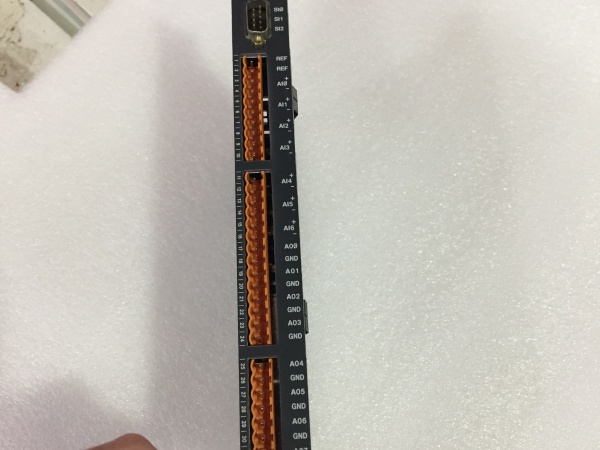
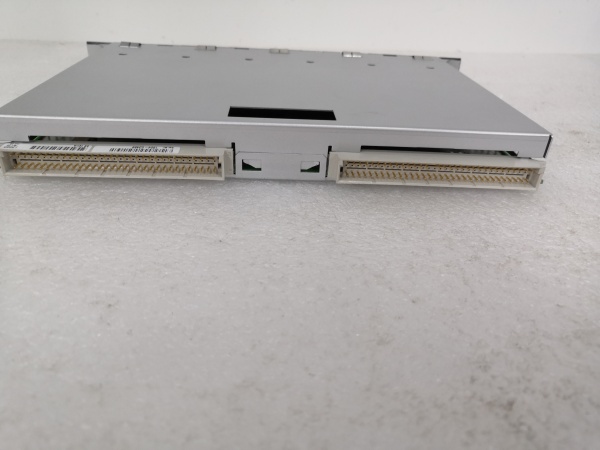
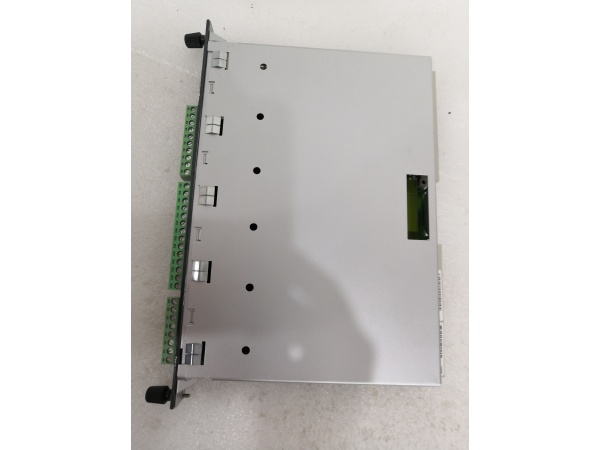
Description
Hard-Numbers: Technical Specifications
-
Protocol Support: CANopen, Modbus RTU/TCP, EtherCAT (via expansion), RS-232/485 serial
-
Processor: 1 GHz ARM Cortex-A9 (32-bit RISC architecture)
-
Memory:
-
RAM: 512 MB DDR3
-
Flash Storage: 4 GB eMMC or NAND Flash
-
EPROM: Boot firmware storage
-
-
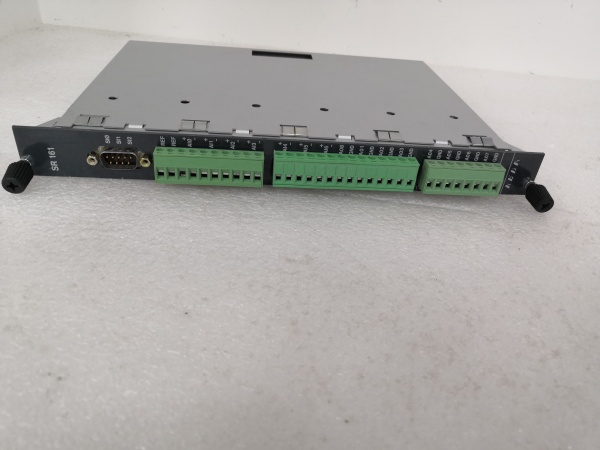
Digital I/O: 16 × digital inputs, 16 × digital outputs (24VDC, configurable sourcing/sinking)
-
Analog I/O: 4 × analog inputs, 4 × analog outputs (±10V or 4-20mA, 12-bit resolution)
-
Communication Ports:
-
2 × CAN bus interfaces (ISO 11898, up to 1 Mbps)
-
1 × RS-232/485 serial port
-
1 × Ethernet 10/100 Mbps (on some variants)
-
-
Operating Voltage: 24 VDC (±20%, typical industrial 24V nominal)
-
Power Consumption: 15-25 W typical (depends on I/O loading)
-
Operating Temperature: 0°C to +55°C (standard), -20°C to +60°C (extended variants)
-
Storage Temperature: -40°C to +85°C
-
Humidity: 5% to 95% RH non-condensing
-
Physical Dimensions: 180 × 120 × 35 mm (7.1″ × 4.7″ × 1.4″) approximate
-
Weight: 0.7 kg (1.5 lbs) board only
-
Mounting: DIN rail adapter or panel mount via standoffs
-
Programming: KEBA KeStudio (IEC 61131-3), C/C++ for embedded applications
-
Certifications: CE, FCC Class A, UL (industrial control equipment)

KEBA SR161
The Real-World Problem It Solves
Injection molding machines and robotic cells need a compact, powerful control core that can handle fast I/O scanning, multi-axis coordination, and real-time communication without the bulk and cost of a full-size rack PLC. The SR161 eliminates the “too slow, too big, too expensive” dilemma by packing a 1GHz ARM processor, onboard I/O, and dual CAN bus into a single PCB that mounts right in the machine’s electrical cabinet. It handles the messy reality of servo drive synchronization, temperature control loops, and production line handshaking without requiring separate motion controllers or communication gateways.
Where you’ll typically find it:
-
Embedded as the main CPU in injection molding machine controllers (plastic processing equipment)
-
Robot arm control cabinets handling path planning and I/O coordination
-
Material handling system controllers for conveyor sorting and AGV dispatch
-
Compact OEM machinery where space is at a premium and cost control is critical
This board keeps your machine control centralized and responsive—no external I/O racks, no protocol converters, just a single PCB running your entire automation logic.
Hardware Architecture & Under-the-Hood Logic
The SR161 isn’t just an off-the-shelf single-board computer—it’s an industrial control core with deterministic I/O handling and real-time kernel optimization. The ARM Cortex-A9 runs a embedded Linux or real-time operating system (RTOS) with KEBA’s runtime environment, providing IEC 61131-3 PLC functionality alongside C/C++ application support. The dual CAN interfaces allow it to act as a bridge between higher-level automation networks and lower-level device networks.
Internal Signal Flow:
-
CPU Processing: 1GHz ARM Cortex-A9 executes the KEBA runtime kernel with cycle times down to 1 ms for I/O updates
-
Memory Management: 512MB DDR3 handles runtime variables and program execution; 4GB Flash stores firmware, application code, and recipe data
-
I/O Handling: Onboard FPGA or ASIC manages the 16 digital inputs/outputs and 4 analog channels with hardware-level timestamping and interrupt capability
-
CAN Communication: Dual CAN controllers (Bosch CAN 2.0B) manage real-time device networks—typically one for servo drives, one for sensors/I/O modules
-
Serial/Ethernet: RS-232/485 for legacy device integration; Ethernet (where equipped) for HMI connectivity and SCADA integration
-
Power Management: 24VDC input with onboard DC-DC converters generating 5V, 3.3V, and 1.8V rails for processor and I/O logic
KEBA SR161
Field Service Pitfalls: What Rookies Get Wrong
Assuming the 4GB Flash is User-Expandable Storage
Engineers treat the 4GB eMMC like an SD card and try to dump log files, production databases, and HMI graphics onto it, then wonder why the controller crashes when the flash wears out. Industrial eMMC has limited write cycles (typically 3,000-10,000 per block) and isn’t meant for heavy logging.
-
Field Rule: The 4GB Flash is for firmware and application code only—treat it as read-mostly. Use external storage (USB stick, network drive, or SD card slot if equipped) for production logs and data logging. Monitor the flash health via the KEBA diagnostics; if you see “Flash Wear Level” warnings above 80%, you’re writing too much data to the internal storage. Move your logs to external media before you get a boot failure.
Mixing Up the Two CAN Bus Networks
The dual CAN ports look identical, but they’re typically configured for different baud rates and purposes—CAN1 at 1 Mbps for servo drives (high-speed motion), CAN2 at 125 kbps for I/O modules (longer cable runs). Rookies wire them backwards or use the same termination resistors on both, causing network collisions and “Bus Off” errors.
-
Quick Fix: Check the machine electrical drawings before touching the CAN wiring. CAN1 (X1) usually connects to servo drives with 120Ω termination at the drive end; CAN2 (X2) connects to remote I/O with termination at the last module. Measure the resistance between CAN_H and CAN_L at the SR161 connector—if you don’t see ~60Ω (two 120Ω resistors in parallel), your termination is wrong. Never enable termination on both ends of the same bus unless it’s a short stub.
Ignoring the 0-55°C Temperature Limit in Injection Molding Cabinets
Injection molding machine electrical cabinets can hit 60-70°C during summer months due to heater bands and hydraulic power units. The SR161’s 0-55°C rating gets violated, causing thermal throttling, random reboots, or Flash corruption.
-
Field Rule: Install a cabinet fan or heat exchanger if the ambient temperature exceeds 50°C. Monitor the CPU temperature via KeStudio diagnostics—if you’re seeing sustained readings above 50°C, add ventilation. The ARM Cortex-A9 will throttle at 60°C and shutdown at 70°C to protect itself. If you can’t cool the cabinet, spec the extended temperature variant (-20°C to +60°C) or relocate the SR161 to a cooler auxiliary enclosure with remote I/O cabling.