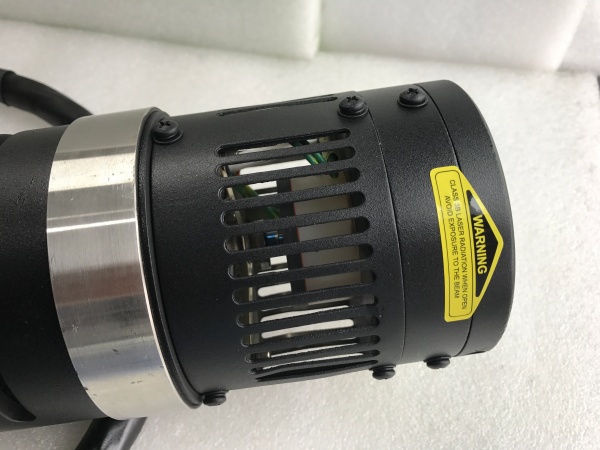
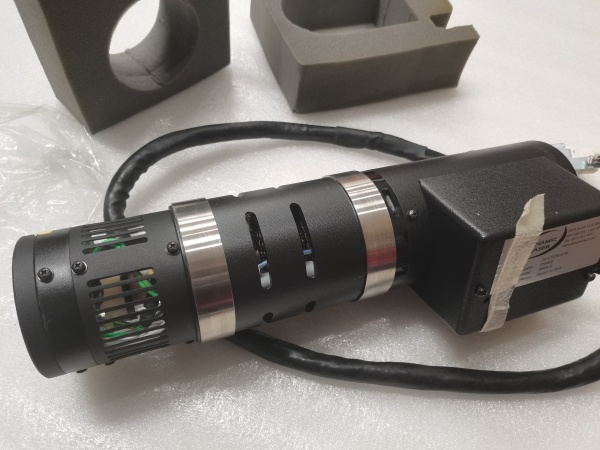
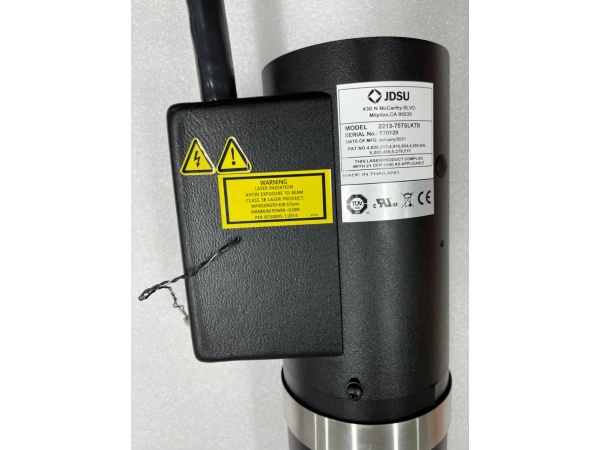
Description
Hard-Numbers: Technical Specifications
-
Laser Type: Air-cooled argon ion laser (noble gas discharge)
-
Output Power: 75 mW (nominal, single-mode fiber or free-space output)
-
Primary Wavelength: 457.9 nm (blue) or 488 nm (cyan) – configuration dependent
-
Wavelength Stability: <0.1 nm (24-hour drift)
-
Spectral Bandwidth: <0.001 nm (single-frequency operation)
-
Beam Quality: TEM₀₀ (single transverse mode), M² <1.2
-
Beam Divergence: <1.2 mrad (full angle)
-
Noise: <2% RMS (30 Hz-10 MHz bandwidth)
-
Pointing Stability: <30 µrad (after warm-up)
-
Polarization: Linear, >100:1 extinction ratio
-
Warm-up Time: <5 minutes to full stability (fast preheat mode)
-
Tube Lifetime: >10,000 hours (typical, cathode-dependent)
-
Cooling: Axial air cooling (integrated blower, flexible vibration-isolation duct)
-
Operating Temperature: 10°C to 40°C (ambient)
-
Storage Temperature: -20°C to +60°C
-
Humidity: <85% RH non-condensing
-
Power Supply: Requires external 2113-75SLT or 2213-75SLT power supply (200-240V AC, 22A, 50/60 Hz)
-
Dimensions: ~100 mm × 70 mm × 30 mm (laser head only); cylindrical symmetry
-
Weight: ~0.5-1.0 kg (laser head); ~5-10 kg (with power supply)
-
Construction: Metal-ceramic (cermet) plasma tube, beryllium oxide (BeO) ceramic components, integral resonator mirrors

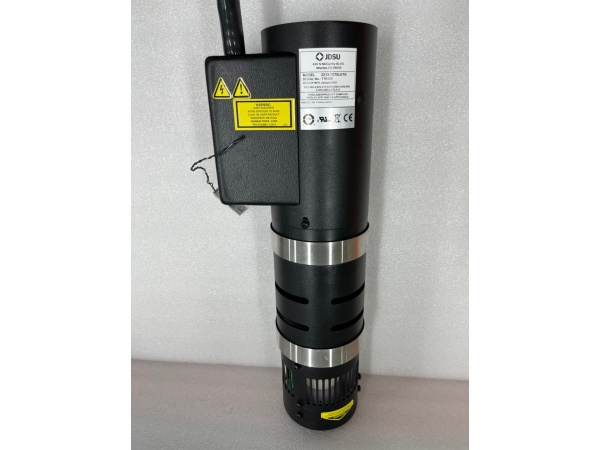
JDSU 2213-75TSLKTB
The Real-World Problem It Solves
Semiconductor wafer inspection systems, flow cytometers, and DNA sequencers need stable, high-power blue laser light with excellent beam quality and low noise. Solid-state lasers at 488nm are available but lack the power stability and beam purity of gas lasers. The 2213-75TSLKTB provides 75mW of diffraction-limited 488nm or 457.9nm light with <2% noise and <0.1nm wavelength stability—critical for detecting 0.1µm defects on silicon wafers or resolving fluorescent labels in cell sorting.
Where you’ll typically find it:
-
KLA-Tencor wafer inspection systems (SP1, AIT series) for particle detection
-
Becton Dickinson FACSCalibur flow cytometers for cell analysis
-
ABI DNA sequencers for capillary electrophoresis
-
High-speed laser printers and graphics arts systems
This laser bridges the gap between low-power diode lasers (unstable, poor beam quality) and water-cooled argon systems (bulky, high maintenance), providing a compact, air-cooled solution with gas-laser performance.
Hardware Architecture & Under-the-Hood Logic
The 2213-75TSLKTB is not a complete laser system—it’s the laser head only, requiring a separate power supply and control interface. It uses a DC-excited noble gas discharge in a metal-ceramic plasma tube.
Signal flow and power logic:
-
Plasma Tube: The heart is a beryllium oxide (BeO) ceramic plasma tube with tungsten cathode and multiple anode segments. Argon gas at low pressure (few torr) fills the tube.
-
DC Discharge: The power supply delivers 20-40A DC at 100-200V to ionize the argon, creating a plasma that emits light at multiple wavelengths (454.5nm, 457.9nm, 465.8nm, 472.7nm, 476.5nm, 488.0nm, 496.5nm, 501.7nm, 514.5nm). Prism or filter wavelength selection isolates the desired line (457.9nm or 488nm).
-
Optical Resonator: Internal dielectric mirrors form a Fabry-Perot cavity. The rear mirror is high-reflectivity; the output coupler transmits ~1-2%. The resonator is super-invar or zerodur construction for thermal stability.
-
Axial Cooling: An integrated blower forces air through the tube bore and over the plasma tube exterior. A flexible duct isolates blower vibration from the laser head—critical for beam pointing stability.
-
Current Control: The power supply regulates discharge current to ±0.1%, stabilizing output power. Light feedback or external power meter can close the loop for <1% long-term stability.
-
Beam Delivery: Output is either free-space (Gaussian TEM₀₀ beam) or fiber-coupled (single-mode polarization-maintaining fiber) depending on configuration.
JDSU 2213-75TSLKTB
Field Service Pitfalls: What Rookies Get Wrong
Assuming It’s Plug-and-Play Like a Diode Laser
This is a gas discharge laser requiring high-voltage DC power, water cooling (in some variants), and careful optical alignment. The 2213-75TSLKTB is just the head—you need the matching 2113-75SLT or 2213-75SLT power supply, interlock system, and often a separate chiller for the power supply (not the head).
-
Field Rule: Never apply power without verifying the complete system configuration. The power supply requires 200-240V AC at 22A—standard 120V outlets won’t work. Check the power supply model number; the 2213-75TSLKTB head is incompatible with older 2111-series supplies. If the head doesn’t light after 30 seconds, shut down immediately—prolonged low-current operation destroys the cathode.
Ignoring the Beryllium Oxide (BeO) Hazard
The plasma tube contains beryllium oxide (BeO) ceramic, a toxic material if inhaled as dust. While intact tubes are safe, cracked or damaged tubes release hazardous particles.
-
Quick Fix: If the laser head is dropped or shows physical damage (cracks in the white ceramic sections), do not power it on. Evacuate the area and contact JDSU/Lumentum for hazmat disposal procedures. Never attempt to disassemble the laser head—the BeO plasma tube is sealed and non-serviceable. When replacing a failed head, check the old unit for cracks before removal; if cracked, use HEPA vacuum and PPE per your site’s hazardous materials protocol.