
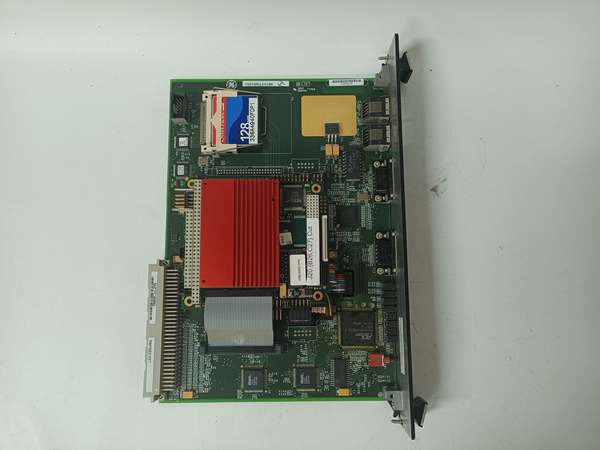
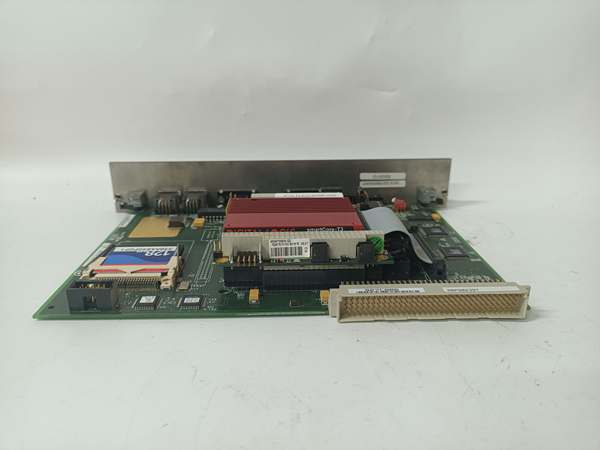
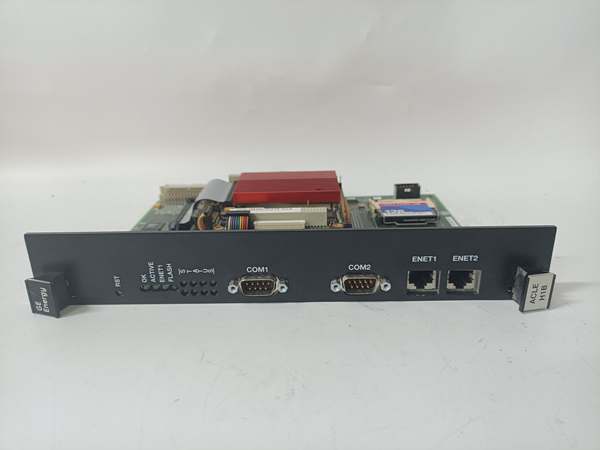
Description
Key Technical Specifications
| Parameter | Value |
|---|---|
| Processor | High-Performance RISC Microprocessor (Upgrade over standard ACLE-H1B) |
| Cache Memory | Integrated L2 Cache (Processor dependent) |
| RAM / Data Capacity | Expanded SDRAM (Typically 128MB or higher for complex applications) |
| Flash Memory | Expanded Non-Volatile Flash (8MB or higher for OS and App Storage) |
| Communication Ports | 2x 10/100 Base-TX Ethernet (RJ45), 2x CANbus, 1x USB, 1x SD Card Slot |
| Expansion | PCI Controller for high-speed backplane bus communication |
| Mounting | DIN-Rail Installation (Occupies two half-slots in EX2100/Mk VIe rack) |
| Operating Temp | 0°C to +60°C (32°F to 140°F) |
| Storage Temp | -40°C to +85°C |
| Humidity | 5% to 95% (Non-condensing) |
| Dimensions | Approx. 23.5 cm × 10.8 cm (9.25 x 4.25 inches) |
| Weight | 0.57 kg (1 lb 4 oz) |
| Indicators | Active, OK, ENET, Status, Flash LEDs; Hardware Reset Switch |
| Compliance | CE, UL, Industrial EMC Standards |
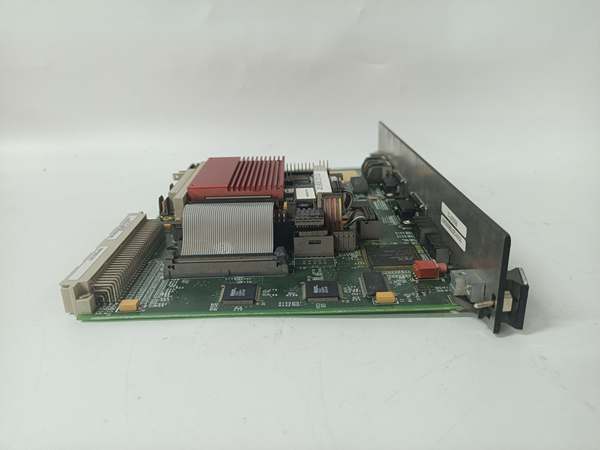
GE IS215ACLEH1B
Product Introduction
The is a mission-critical, revised-generation Application Control Layer Module (ACLE) engineered by GE for its renowned Speedtronic Mark VIe and EX2100e excitation control platforms. As the direct evolution of the standard H1B model, the “C” revision incorporates enhanced processing capabilities and expanded memory architecture, making it uniquely suited for the most demanding real-time turbine and excitation control applications. It serves as the “brain” of the I/O pack, executing the core application code, handling complex boolean and analog logic, managing I/O forcing, and orchestrating high-speed data exchange between field devices and the central control room.
Built around a robust, upgraded RISC processor with integrated L2 cache, the ACLE-H1BC delivers the computational horsepower required for advanced control algorithms, faster sweep frequency response (SFR) testing in exciters, and minimal latency in critical protection schemes. Its rich set of interfaces—including dual redundant 10/100 Base-TX Ethernet ports, dual CANbus interfaces, a USB port, and an SD card slot—ensures seamless integration into modern distributed control system (DCS) architectures. Encased in a rugged, compact form factor designed for DIN-rail mounting, the thrives in the harsh electrical and thermal environments of power generation plants, providing the reliability and deterministic performance essential for protecting multi-million-dollar rotating equipment.
Key Selling Points & Differentiators
- Enhanced Processing Power for Complex Control: Features an upgraded RISC microprocessor and expanded SDRAM/Flash memory, providing superior computational speed and data logging capabilities compared to the base H1B model, ideal for complex exciter control sequences.
- Redundant Communication Architecture: Equipped with dual 10/100 Base-TX Ethernet ports and dual CANbus interfaces, enabling seamless network redundancy to prevent single-point-of-failure communication losses.
- Flexible Configuration & Data Logging: Supports online application configuration loading and includes an SD card slot for extended data logging, event recording, and fast disaster recovery in the field.
- Seamless Backward Compatibility: Designed to fit seamlessly into existing Mark VIe and EX2100e I/O packs, replacing older H1A or H1B revisions without requiring a complete system overhaul or rack reconfiguration.
- Rigorous Validation & Burn-In: Every refurbished unit undergoes a stringent 48-hour dynamic stress test. We validate processor performance, memory integrity, Ethernet/CANbus connectivity, and SD card read/write cycles under load. Includes a serialized test report and a 12-month warranty.
- Immediate Dispatch: We maintain a specialized inventory of Mark VIe/EX2100e controllers and I/O packs. New surplus and tested units are ready for 24-hour worldwide shipping to meet your emergency outage and planned maintenance needs.
FAQ
- It acts as the main application controller (ACLE) within the I/O pack. It executes the turbine or exciter control application code, processes I/O data, performs logical operations, and manages network communications.
- How does the “C” revision differ from the standard IS215ACLEH1B?
The “C” revision typically features an upgraded processor architecture and expanded memory (both RAM and Flash) to handle more complex application code and faster data processing requirements, particularly in advanced EX2100e excitation systems.
- Is this module compatible with my existing Mark VIe rack?
Yes, the is fully backward compatible with standard Mark VIe and EX2100e I/O packs and racks, utilizing the same DIN-rail mounting footprint and connector pinouts as the H1B.
- What communication ports are available on the front panel?
The front panel features two 10/100 Base-TX Ethernet ports (RJ45), two CANbus ports, a USB port, and an SD card slot for configuration, diagnostics, and data logging.
- Does the 12-month warranty cover issues related to firmware corruption?
The warranty covers hardware failures under normal operating conditions. While the module includes robust non-volatile flash memory and CRC checks to prevent corruption, issues arising from improper firmware updates or power loss during a flash write cycle may require a case-by-case evaluation.

GE IS215ACLEH1B
Quality Transparency SOP
- Incoming Verification: Serial number traceability and cross-referencing against GE databases. Comprehensive visual inspection under magnification for burnt components, damaged Ethernet/USB ports, or bent pins.
- Functional Bench Test: Mounted in a dedicated Mark VIe/EX2100e test rig. Power-on self-test (POST) is monitored, and the upgraded processor speed and expanded memory (RAM/Flash) integrity are verified using diagnostic software.
- Signal Integrity & Stress Testing: Subjected to a continuous 48-hour dynamic stress test, including thermal cycling, forced Ethernet/CANbus packet flooding to test communication stack stability, and read/write endurance testing on the SD card slot.
- Firmware/Config Verification: Current firmware version and application code are backed up. The expanded flash memory is checked for bad sectors.
- Final QC & Packaging: Final quality control sign-off completed and dated. Sealed in a custom anti-static bag with moisture absorption packets. Shipped in reinforced cardboard packaging with industrial-grade foam padding to prevent transit damage.
Transparency required: Test reports and video evidence of the bench tests are available upon request. We maintain a strict policy of never claiming “100% failure-free” as all industrial electronic components naturally degrade over time and under operational stress.
Technical Risk Avoidavoidance
Improper Firmware/Application Code Migration from Older Revisions
Risk: While the is backward compatible with H1B hardware, its updated processor and expanded memory architecture may require a specific minimum firmware version or slight application code modifications. Forcing an older H1B firmware image onto an H1BC processor can cause kernel panics, watchdog timer overflows, or communication stack crashes.
Prevention: Always verify the target firmware version compatibility in the GE Mark VIe/EX2100e release notes before migrating code. Perform a “diff” check between the old and new hardware profiles in the ToolboxST software.
Anecdote: A controls engineer swapped an aging H1B controller for a new H1BC to gain faster processing speeds. They attempted to clone the old H1B’s firmware directly onto the H1BC without checking the compatibility matrix. The mismatch caused a critical overspeed protection algorithm to miss its execution window, resulting in a forced turbine trip during the subsequent startup sequence.
SD Card Incompatibility Causing Boot Failures
Risk: The ‘s upgraded memory architecture interacts differently with the front-panel SD card slot compared to older revisions. Using an older, slower, or improperly formatted SD card can cause the controller to hang during the boot sequence or fail to mount the filesystem, leading to a loss of historical data logging.
Prevention: Only use industrial-grade, name-brand SD cards (e.g., SanDisk Industrial or Kingston High Endurance) formatted to the exact FAT32 specifications recommended in the GE user manuals. Avoid using consumer-grade cards purchased from general retail stores.
Anecdote: A technician used a standard off-the-shelf SD card to update the configuration on a newly installed H1BC controller. The card’s slow write speeds caused the controller to timeout during the reboot sequence, leaving the turbine in a “Locked Out” state until a controls specialist could be flown in to re-flash the board using the hardwired JTAG interface.
Backplane Seating Issues Due to DIN-Rail Tolerances
Risk: The is a double-wide module mounted on a DIN rail. Over time, DIN rails can become warped or accumulate debris. Because the H1BC has a tighter manufacturing tolerance than older revisions, a slightly bent DIN rail can prevent the bottom of the board from seating flush into the backplane connector, leading to intermittent PCI bus errors.
Prevention: Before installing the , inspect the DIN rail for flatness and cleanliness. Ensure the rail is securely fastened to the panel. Apply even pressure to both the top and bottom of the module when seating it into the backplane.
Anecdote: A plant upgraded several I/O packs to the revision. Within a week, they experienced sporadic “PCI Parity Error” alarms. The root cause was traced to a slightly bowed DIN rail in one of the racks; the older, thinner H1B boards had flexed to accommodate the bend, but the newer, stiffer boards lost contact with the bottom row of backplane pins.
Practical Summary: Treat the as a drop-in performance upgrade for your existing Mark VIe or EX2100e I/O packs. Always verify firmware compatibility before flashing, use only industrial-grade SD cards for data logging, and ensure your DIN rails are perfectly straight to guarantee proper backplane seating. Keeping the serialized test report and a verified backup of your application code on hand will ensure a swift, error-free migration.


