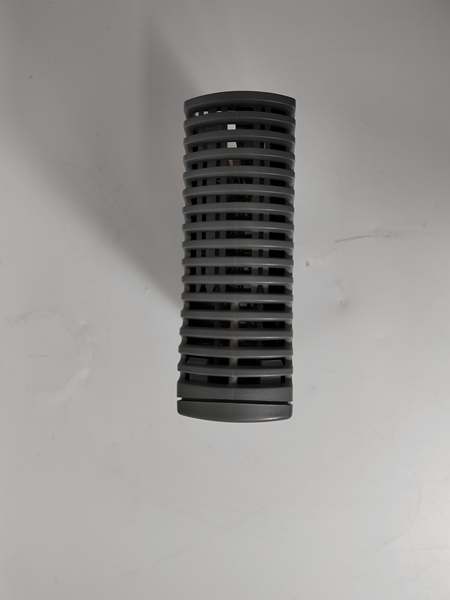
Description
Key Technical Specifications
- Model Number: T9432
- Manufacturer: ICS Triplex (Emerson Automation Solutions)
- Channel Count: 16 isolated analog input channels (configurable per channel)
- Supported Signal Types: 4-20mA (sinking/sourcing), 0-10V DC, RTD (Pt100/Pt1000/Ni100), thermocouple (J/K/T/E/R/S/B)
- Resolution: 16-bit ADC conversion
- Accuracy: ±0.1% full scale (25°C), ±0.2% over operating temperature range
- Isolation: 1500V AC (channel-to-channel, channel-to-system)
- Power Supply: 20-32VDC (redundant backplane power compatible)
- Power Consumption: 8-10W (typical, full channel load)
- Response Time: 100ms (max, all channels active)
- Environmental Rating: IP20 (module), IP65 (when used with protective enclosure)
- Certifications: IEC 61508 (SIL 3), ATEX, IECEx, FM, CSA
- Physical Dimensions: 31mm (W) × 266mm (H) × 303mm (D)
- Weight: 1.2kg (2.65 lbs)

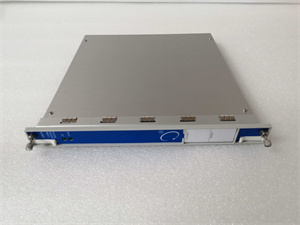
ICS TRIPLEX T9432
Field Application & Problem Solved
In safety-critical industries like oil refineries, chemical plants, and nuclear power facilities, the biggest challenge is reliable analog signal acquisition from sensors in harsh, high-interference environments. Temperature, pressure, and flow sensors often produce weak signals that are prone to noise, drift, or complete failure—risks that can shut down production or trigger unsafe operating conditions. This module solves that by combining triple modular redundancy (TMR) with channel-level isolation, ensuring no single point of failure can disrupt signal transmission.
You’ll typically find this module in refinery distillation columns monitoring reactor temperatures via thermocouples, chemical plant batch processes tracking pressure transducers (4-20mA), or nuclear power auxiliary systems reading RTDs for coolant temperature. In these settings, legacy modules often suffer from cross-channel interference or drift in extreme temperatures, leading to false alarms or missed critical changes. The T9432’s 1500V isolation eliminates crosstalk, while its ±0.1% accuracy maintains signal integrity even in -40°C freeze-offs or 70°C plant heat.
Its core value lies in balancing precision with fault tolerance. For example, in a chemical reactor control system, if one of the module’s three redundant channels fails, the TMR architecture automatically votes on the correct signal—no operator intervention needed. This prevents unplanned shutdowns while ensuring the safety instrumented system (SIS) still meets SIL 3 requirements. It also reduces calibration frequency, a major plus in hard-to-access locations like offshore platforms or boiler rooms.
Installation & Maintenance Pitfalls (Expert Tips)
- Signal Type Configuration Must Match Hardware: Rookies often configure channels in software for thermocouples but forget to wire the module’s internal cold junction compensation (CJC) terminals. This leads to wildly inaccurate temperature readings (off by 50°C+). Always verify that software signal type, wiring (3-wire vs. 4-wire for RTDs), and terminal block connections align—use the module’s built-in diagnostic LEDs to confirm CJC is active.
- Redundant Power Wiring Is Non-Negotiable: The module accepts redundant 24VDC power, but many installers skip this, relying on a single power feed. In refineries or power plants, power sags are common—lose power to the module, and you lose critical sensor data. Run two separate power cables from redundant power supplies, and terminate them to the module’s dedicated redundant power terminals (labeled V+1/V-1 and V+2/V-2).
- Isolation Doesn’t Replace Proper Grounding: While the module has 1500V isolation, poor shield grounding on sensor cables will still introduce noise. I’ve seen this cause intermittent “out-of-range” faults that are impossible to trace. Ground the cable shield at ONE end (preferably the module side, not the sensor) and keep signal cables at least 12 inches away from high-voltage power cables. Avoid daisy-chaining shields—each cable should have its own dedicated ground.
- Calibration Interval Isn’t “Set It and Forget It”: The module’s ±0.1% accuracy degrades over time in harsh environments (corrosion, vibration, temperature cycling). Don’t just follow the 2-year factory recommendation—if the module is in a chemical plant with frequent pH washes or a power plant with high vibration, calibrate annually. Use a precision signal generator (calibrated to NIST standards) for each channel, and record drift data—if a channel drifts more than ±0.2%, replace the module (drift is often irreversible).
ICS TRIPLEX T9432
Technical Deep Dive & Overview
The T9432 is a single-slot intelligent analog input module designed for integration into ICS Triplex Trusted series racks. At its core is a TMR architecture: three independent processing channels, each with its own ADC, power supply, and logic. When a sensor signal is received, each channel converts and processes it, then the module’s voting logic selects the majority signal—this eliminates errors from single-channel failures (e.g., ADC drift, component damage).
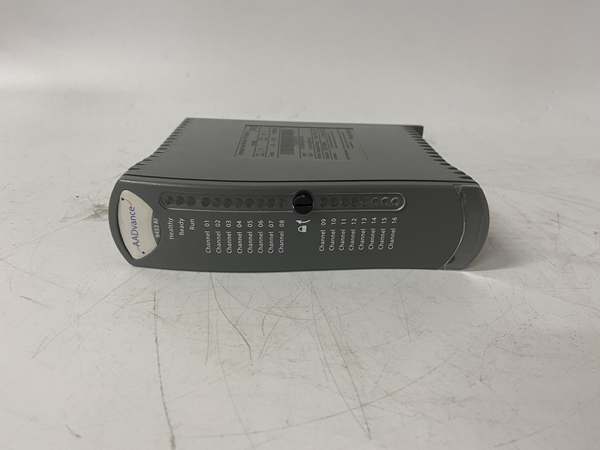
The module communicates with the Trusted controller via the backplane bus, operating as a slave device that pushes data to the CPU at configurable intervals (10ms to 1s). Unlike dumb analog modules, it includes on-board diagnostics: each channel has a status LED (green = normal, amber = warning, red = fault) and the module logs faults (overcurrent, underrange, channel failure) to the controller’s event buffer. This allows for remote troubleshooting—no need to climb a 30-foot ladder to check a sensor; you can pull channel status from the HMI.
For signal conditioning, the module uses precision instrumentation amplifiers with programmable gain, adapting to weak RTD signals (as low as 10mV) or strong 0-10V signals without external signal converters. The internal cold junction compensation for thermocouples is temperature-controlled, using a dedicated sensor on the module’s circuit board to offset ambient temperature changes—critical for accurate readings in unheated equipment rooms.
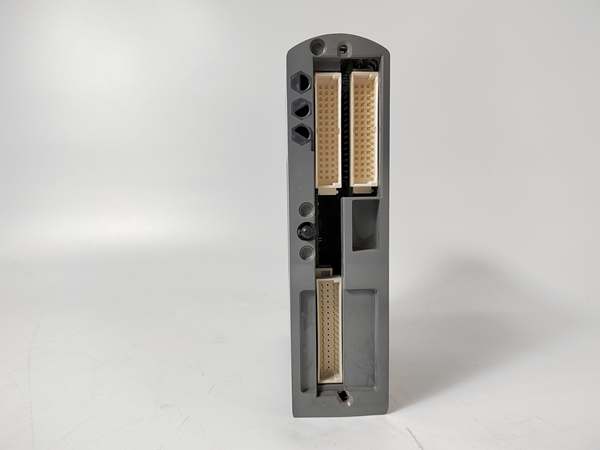
Physically, the single-slot design saves rack space, a premium in crowded control cabinets. It’s hot-swappable, but only if you follow the procedure: disable the module in the controller software first, then pull the extraction lever. Rushing this can damage the backplane connector—I’ve seen modules short out because someone yank them without disabling power to the slot. Overall, it’s a workhorse module that excels in environments where failure isn’t an option—built for technicians who need reliability over flashy features.