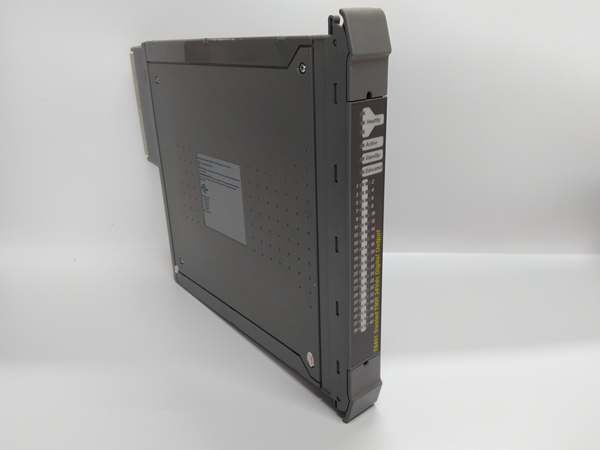

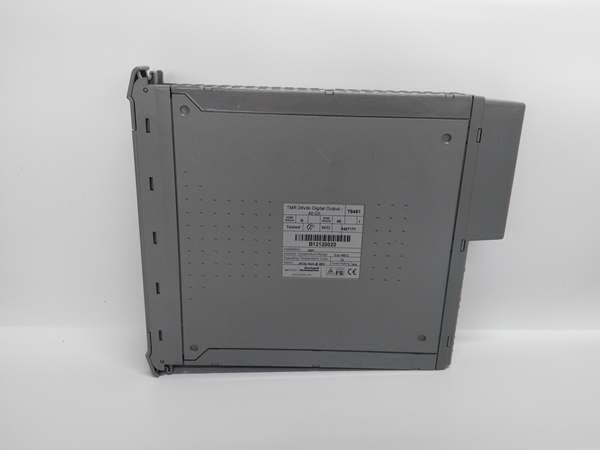
Description
Key Technical Specifications
- Model Number: T8451
- Manufacturer: ICS Triplex (Emerson)
- Channel Count: 16 guarded digital output channels (8 channels per independent power group)
- Output Voltage Range: 20–32 VDC (nominal 24 VDC)
- Output Current Rating: 1A continuous per channel; 2A peak (1 second duration)
- Isolation Rating: 2500V DC channel-to-backplane; 1000V DC channel-to-channel; 2500V DC power group-to-group
- Redundancy Architecture: Triple Modular Redundancy (TMR) with majority voting logic
- Diagnostics: Continuous open/short circuit detection, output state verification, fuse status monitoring, module self-test
- Operating Temperature: -40°C to 70°C (-40°F to 158°F)
- Power Consumption: 12W typical (backplane power); 28W max (full field load)
- Certifications: IEC 61508 SIL 3, ATEX, IECEx, FM Class I Div 2, CSA
- Physical Form Factor: Single-slot rack-mounted, 266mm (H) × 31mm (W) × 303mm (D), 1.1kg (2.42lbs)
- Hot-Swap Capability: Supported (no system shutdown required in redundant configurations)

ICS TRIPLEX T8451
Field Application & Problem Solved
In refineries, chemical plants, and offshore oil platforms, the biggest risk in ESD systems is a “silent failure” of a digital output module—where a channel fails to switch an actuator, but the system doesn’t detect the fault. Legacy non-guarded output modules only send commands; they don’t verify if the command was executed. This leads to scenarios where a valve fails to close during a gas leak, because the module thinks it sent the command, but the channel is dead. Non-TMR modules add another layer of risk: a single component failure can take out an entire bank of channels, disabling critical shutdown functions.
The T8451 solves these problems. You’ll find it driving solenoid valves that isolate process lines, shutdown relays that trip pumps, and alarm horns in high-risk SIS applications. In chemical batch processing, it controls the valves that vent excess pressure from reactors—its guarded output functionality verifies that each valve moves to the commanded state, logging a fault within 10ms if there’s a mismatch. In offshore platforms, its wide temperature range and corrosion-resistant design hold up to salt spray and humidity, eliminating the need for costly environmental enclosures.
Its core value is twofold: first, guarded outputs eliminate silent failures by verifying that the field device (valve, relay) responds to the module’s command. Second, TMR redundancy ensures a single channel or component failure won’t disable the output bank. Unlike standard output modules, the T8451 doesn’t require external safety relays to meet SIL 3 compliance, cutting wiring complexity and failure points by 50% in most installations. For plant operators, this means fewer unplanned shutdowns from false faults, and more confidence that the SIS will work when it matters most.
Installation & Maintenance Pitfalls (Expert Tips)
Power Group Separation is Non-Negotiable
Rookies often wire both 8-channel power groups to a single field power supply, which defeats the module’s fault-isolation design. If one power group experiences a short circuit, it will take out all 16 channels instead of just 8. Always wire each power group to a separate, fused 24VDC supply. Label the groups clearly in the wiring diagram, and use separate conduit runs for each group’s field wiring. This isolation is critical for safety—during a fault, it ensures that half the channels remain operational to execute emergency shutdowns.
Fuse Replacement Requires Exact OEM Specs
Each channel has a 2A fast-acting front-panel fuse that protects against overcurrent. A common mistake is replacing these fuses with higher-amperage units to “prevent blowing.” This is a fatal error—oversized fuses won’t protect the channel from short circuits, and they can damage the module or the connected actuator. Use only the OEM-specified fuses (2A, 250V fast-acting, Littelfuse 322 series equivalent). Before replacing a blown fuse, always trace the root cause: a repeated fuse failure usually means a shorted solenoid valve or damaged field wiring, not a faulty fuse.
Hot-Swap Demands Output Group Deactivation
Yes, the T8451 supports hot-swapping, but pulling the module without disabling its output group in the controller is a rookie mistake that triggers unplanned ESD trips. Before replacement, log into the Trusted HMI and put the output group in “test mode”—this tells the controller to ignore the module’s signals and keep the redundant module (if installed) in control. Wait 10 seconds for the controller to acknowledge, then remove the module. After reinstallation, take the group out of test mode only after the module syncs with the redundant pair (verify via the front-panel “SYNC” LED). Rushing this step will cost you hours of downtime and a stern talking-to from the plant manager.
Shield Grounding Prevents Intermittent Faults
The T8451’s 2500V isolation won’t protect against electromagnetic interference (EMI) from VFDs or high-voltage cables. Rookies often ground shielded field wiring at both ends (module and actuator), creating ground loops that cause false “short circuit” faults. Use shielded twisted-pair cable for field wiring, and terminate the shield only at the module end—leave the actuator end floating. This eliminates ground loops and reduces EMI by 90% in most cases. For actuators in high-EMI areas (e.g., near motor control centers), route cables away from power lines or use metal conduit for extra protection.
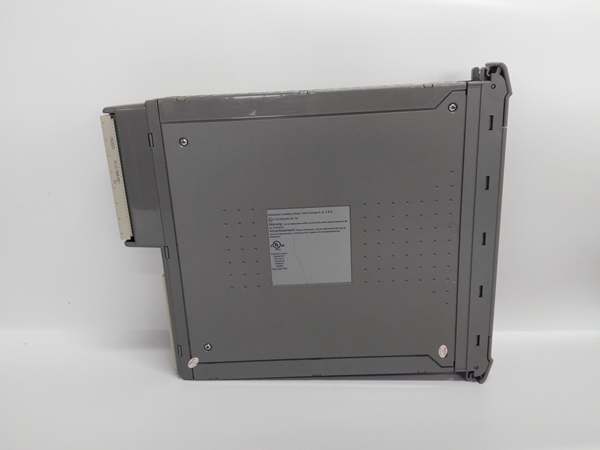
ICS TRIPLEX T8451
Technical Deep Dive & Overview
The T8451 is a 16-channel TMR guarded digital output module engineered for Trusted Series SIS, built to provide fail-safe switching of critical actuators in high-risk industrial environments. At its core, it uses three independent processing channels (one per TMR leg) that receive commands from the Trusted controller, vote on the correct output state, and drive the field-side channels. The majority voting logic ensures that a failure in one leg (e.g., a faulty transistor) is ignored—only if two legs fail does the module trigger a system alarm.
What sets the T8451 apart from standard output modules is its guarded output functionality. For each channel, the module doesn’t just send a command—it verifies that the field device responded. It measures the current draw of the actuator (valve, relay) to confirm that it’s in the commanded state (on/off). If there’s a mismatch—e.g., the module sends a “close valve” command, but the current draw shows the valve is still open—the module logs a fault and defaults the channel to a safe state (off) within 10ms. This eliminates silent failures, which are the leading cause of SIS non-compliance during regulatory audits.
The module’s two 8-channel power groups are electrically isolated from each other, so a fault in one group doesn’t affect the other. This is critical for emergency shutdowns, where you need at least half the channels to remain operational to isolate hazards. The T8451 communicates with the Trusted CPU via the redundant backplane using the proprietary Triplex protocol, with a latency of less than 5ms per command—fast enough for real-time ESD response. Its dual-core processor handles diagnostics and state verification, offloading this work from the main controller and keeping scan times low in large systems.
In summary, the T8451 is a workhorse module for safety-critical applications. It’s not flashy, but it does one thing better than any generic output module: it ensures that the SIS works when it matters most. Its guarded outputs, TMR redundancy, and fault isolation make it indispensable for any plant that values safety, compliance, and uptime.