


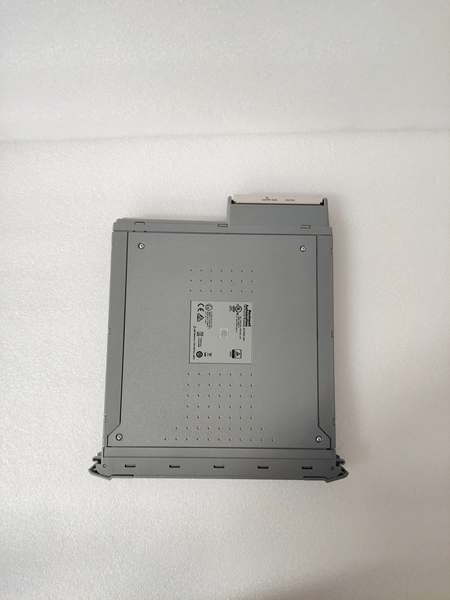
Description
Key Technical Specifications
- Redundancy and Control Performance: The TMR redundant architecture equips the module with three independent processing units. It relies on a majority voting system to ensure the accuracy and reliability of output signals. Even if a single component malfunctions, the system can still operate continuously. It can directly output 24V DC to drive safety valves, and precisely monitor valve positions through input channels, supporting both 4 – 20mA analog position sensors and limit switches with resistor networks.
- Safety and Stability: Each channel of the module is equipped with photoelectric isolation protection up to 2000V, which can effectively avoid signal interference and circuit damage caused by voltage fluctuations or short circuits, ensuring the safety of signal transmission. Meanwhile, its IP67 protection level enables it to resist harsh conditions such as dust and humidity on industrial sites, and it can operate stably in the temperature range of -40°C to 85°C.
- Configuration and Maintenance Advantages: It adopts a field power supply grouped power supply method, with 5 groups of power supplies and 8 channels in each group, which guarantees the stable operation of the system. It supports hot-swappable operation and is compatible with DIN rails. It uses standard industrial connectors, making on-site installation and later maintenance and replacement more convenient and efficient without affecting the overall operation of the system.

Field Application & Problem Solved
- Petrochemical Valve Safety Control System: In petrochemical production, valves are crucial for regulating material flow and pressure. The T8449 module can monitor the position and working status of key valves in real time. When a valve malfunctions or deviates from the set position, the module can quickly feed back the fault information and cooperate with the control system to issue adjustment commands. Its TMR redundancy design avoids production safety accidents such as material leakage caused by valve control failure, ensuring the continuity of the production process.
- Power Plant Pipeline Valve Monitoring: There are a large number of valves in the water supply, steam and other pipeline systems of power plants. The stability of their operation is related to the safe power generation of the power plant. The T8449 module can be integrated with the power plant’s DCS monitoring system. It not only monitors the valve status in real time but also realizes remote control of the valves through the Modbus RTU protocol. Its strong anti-interference and high-temperature resistance can adapt to the complex electromagnetic and high-temperature environment of the power plant, solving the problem of inaccurate valve monitoring caused by harsh on-site conditions.
Installation & Maintenance Pitfalls (Expert Tips)
- Matching of Peripheral Equipment: When connecting sensors and valves, ensure that the sensor type matches the module’s supported 4 – 20mA analog signal or limit switch resistor network type. Using mismatched sensors will lead to inaccurate position monitoring and failure to achieve normal control functions.
- Standardized Wiring Operation: When wiring the grouped power supply and signal lines, separate the power lines from the signal lines to avoid electromagnetic interference. At the same time, ensure that the wiring is firm and reliable. Loose wiring may cause unstable signal transmission. In addition, pay attention to the insulation protection of the wiring to prevent short circuits due to damage to the wire skin.
- Standardized Hot-Swapping Operation: Although the module supports hot swapping, before replacing it, it is necessary to confirm that the system has switched to the redundant operation state. Operators should wear anti-static gloves during the operation to avoid static electricity damaging the internal components of the module, and record the module’s original configuration parameters to ensure that the new module can quickly resume work after replacement.