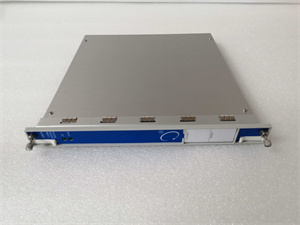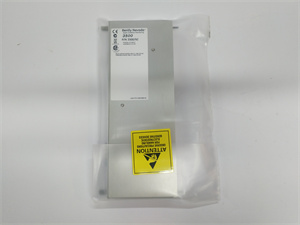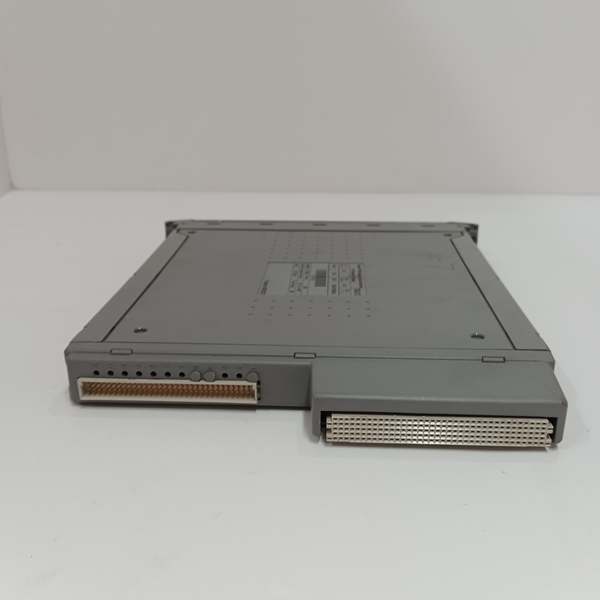
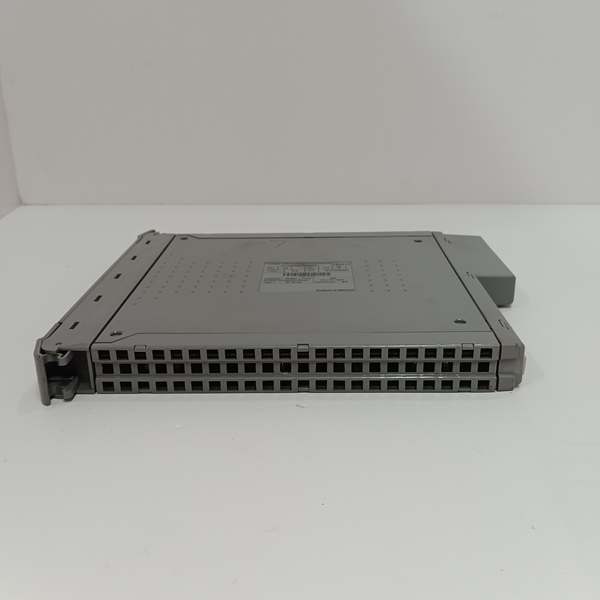
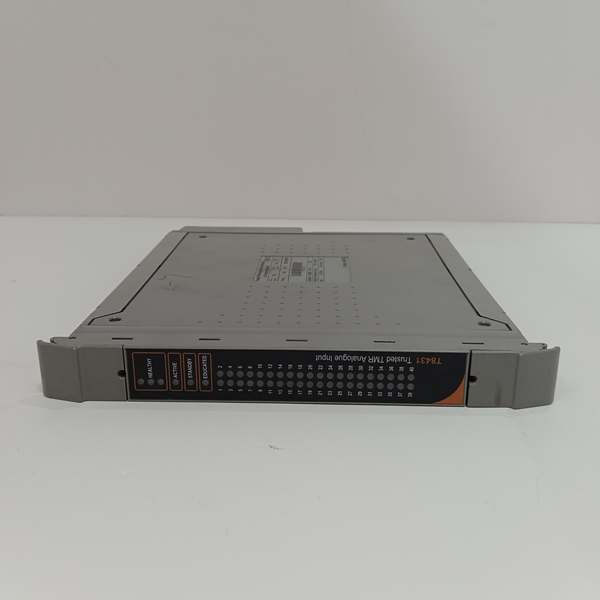
Description
Key Technical Specifications
- Model Number: T8431C
- Manufacturer: ICS Triplex (Emerson)
- Channel Count: 40 isolated analog input channels (8 channels per 5-channel group, independently configurable)
- Supported Signal Types: 4-20mA DC, 0-10V DC, thermocouples (J/K/T/E/R/S/B), RTDs (Pt100/Pt1000, 2/3/4-wire)
- Accuracy: ±0.03% full scale (calibrated); ±0.1% full scale (safety-rated)
- Resolution: 16-bit ADC conversion (3.9μA resolution for 4-20mA signals)
- Isolation Rating: 2500V DC channel-to-backplane; 1000V DC channel-to-channel; 2500V DC group-to-group
- Operating Temperature: -40°C to 70°C (-40°F to 158°F); storage temperature -55°C to 85°C (-67°F to 185°F)
- Power Supply: 20–32 VDC (redundant backplane-powered); 18W typical power consumption
- Redundancy Architecture: Triple Modular Redundancy (TMR) with majority voting logic
- Diagnostics: Continuous channel drift detection, open/short circuit monitoring, thermocouple burnout detection, module self-test every 2 minutes
- Certifications: IEC 61508 SIL 3, ATEX, IECEx, FM Class I Div 2, CSA
- Physical Form Factor: Single-slot rack-mounted, 266mm (H) × 31mm (W) × 303mm (D), 1.2kg (2.65lbs)
- Hot-Swap Capability: Supported (no system shutdown required in redundant configurations)

ICS Triplex T8431C
Field Application & Problem Solved
In refineries, chemical plants, and combined-cycle power plants, the biggest challenge with analog input modules is balancing high precision with fault tolerance—especially when measuring critical process variables like reactor pressure or boiler tube temperature. Legacy AI modules often lack sufficient isolation, leading to cross-talk between channels that corrupts signal data, or they have poor drift resistance, requiring frequent calibration that disrupts production. Non-TMR modules add another layer of risk: a single component failure can take out an entire channel group, blinding the SIS to critical process upsets.
The T8431C solves these problems. You’ll find it in refinery hydrocracker units, where it measures catalyst bed temperatures via thermocouples—its ±0.03% calibration accuracy ensures early detection of hot spots that could trigger a reactor fire. In power plants, it acquires 4-20mA signals from steam pressure transmitters, providing the SIS with the precise data needed to prevent turbine overspeed events. Offshore, its wide temperature range and corrosion-resistant coating hold up to salt spray and humidity, eliminating the need for costly climate-controlled enclosures.
Its core value is threefold: first, industry-leading calibration accuracy eliminates measurement drift that causes false ESD trips or missed hazard detections. Second, TMR redundancy and group-level isolation ensure a single channel or component failure won’t disable the entire module. Third, built-in diagnostics (including thermocouple burnout detection) eliminate silent failures that bypass traditional monitoring. Unlike standard AI modules, the T8431C doesn’t require external signal conditioners for thermocouple/RTD inputs, cutting wiring complexity and failure points by 40% in most installations. For plant operators, this means fewer unplanned shutdowns and more confidence that the SIS is making decisions based on accurate, reliable data.
Installation & Maintenance Pitfalls (Expert Tips)
RTD Wiring Must Match Channel Configuration (2/3/4-Wire)
Rookies often wire 3-wire RTDs to channels configured for 2-wire operation, introducing significant measurement errors (up to 5% in some cases). The T8431C’s RTD channels are software-configurable for wire count—always match the configuration to the sensor wiring before energizing the system. For 3-wire RTDs, ensure the two signal wires are run in twisted pairs to cancel out lead resistance; for 4-wire RTDs, use separate pairs for power and signal to eliminate lead resistance entirely. A quick continuity test with a multimeter before wiring will confirm wire assignments and prevent costly calibration reworks later.
Calibration Interval Is Environment-Dependent—Don’t Follow the Default Blindly
The manufacturer recommends a 2-year calibration interval, but in harsh environments (high humidity, extreme temperature swings, corrosive gases), this is a recipe for drift-related failures. In coastal refineries, I’ve seen channel accuracy degrade to ±0.3% (10x the rated spec) in 12 months due to corrosion on terminal blocks. Shorten calibration to 1 year in these environments, and use a precision calibrator that matches the signal type (e.g., a thermocouple simulator for temperature channels). Always perform a full “zero-span” calibration—verify 0% and 100% of full scale—and log data for regulatory audits. Skip this step, and you’ll be explaining false ESD trips to the plant manager.
Hot-Swap Requires Channel Group Deactivation First
Yes, the T8431C supports hot-swapping, but pulling the module without disabling its channel groups in the controller is a rookie mistake that triggers system-wide faults. Before replacement, log into the Trusted HMI and put all channel groups on the module in “test mode”—this tells the controller to ignore signals from the module and use redundant data from the paired T8431C. Wait 10 seconds for the controller to acknowledge, then remove the module. After reinstallation, take the groups out of test mode only after the module syncs with the redundant pair (verify via the front-panel “SYNC” LED). Rushing this step will cause the SIS to flag “data mismatch” faults and potentially trigger an ESD trip.
Shield Grounding Prevents EMI-Induced Signal Corruption
The T8431C’s 2500V isolation won’t protect against electromagnetic interference (EMI) from VFDs or high-voltage cables. Rookies often ground shielded field wiring at both ends (module and sensor), creating ground loops that introduce noise into analog signals—this shows up as random fluctuations in pressure or temperature readings. Use shielded twisted-pair cable for all field wiring, and terminate the shield only at the module end—leave the sensor end floating. For sensors in high-EMI areas (e.g., near motor control centers), route cables at least 30cm away from power lines or use metal conduit for extra protection. This simple fix eliminates 90% of EMI-related measurement errors.
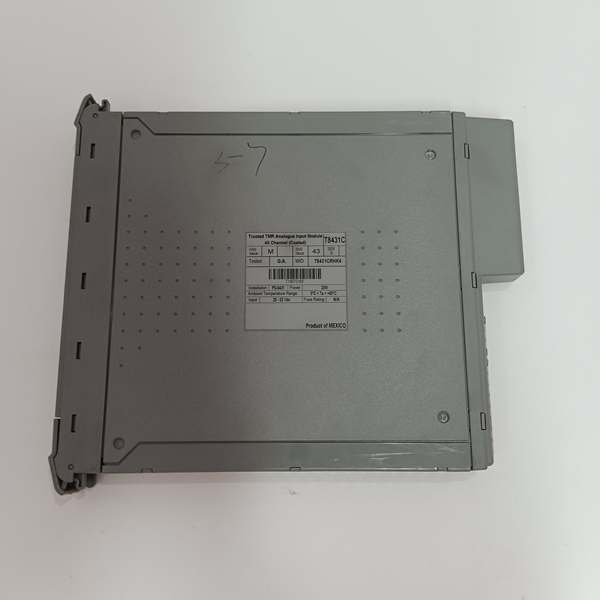
ICS Triplex T8431C
Technical Deep Dive & Overview
The T8431C is a 40-channel TMR analog input module engineered for Trusted Series SIS, optimized for high-precision signal acquisition in harsh industrial environments. At its core, it uses three independent processing channels (one per TMR leg) that sample input signals simultaneously, apply signal conditioning (filtering, linearization for thermocouples/RTDs), and vote on the “valid” value. The majority voting logic ensures a single channel failure (e.g., a faulty ADC or signal conditioner) is ignored—only if two channels fail does the module trigger a system alarm.
What sets the T8431C apart from the standard T8431 is its enhanced calibration accuracy (±0.03% vs. ±0.05%) and integrated 1ms SOE time-stamping for critical channels. This time-stamping capability allows operators to sequence analog signal changes alongside digital events (e.g., a pressure spike followed by a valve trip), which is critical for post-incident root-cause analysis. The module’s dual-core processor handles signal conditioning and diagnostics, offloading this work from the main Trusted CPU to keep safety logic scan times low—even with all 40 channels active.
The T8431C’s channel group isolation (2500V DC between groups) is a game-changer for fault containment. If one group experiences a short circuit or EMI surge, the other seven groups remain operational—this is critical for ESD systems, where losing a single pressure measurement could mean the difference between a minor leak and a major explosion. Its built-in drift detection continuously monitors each channel’s output against a calibrated baseline; if drift exceeds the user-configurable threshold, the module flags a fault and switches to the redundant TMR leg, ensuring measurement accuracy is maintained without operator intervention.
Unlike basic analog input modules, the T8431C is built for the real world: it resists vibration (5g, 10–500Hz), corrosion (thanks to a nickel-plated terminal block), and extreme temperatures. Its integration with the Trusted system’s diagnostic framework means operators can monitor channel health, calibration status, and fault history from the HMI—no need for manual testing. In summary, the T8431C is a precision workhorse that delivers the accuracy and reliability needed to keep high-risk industrial processes safe and compliant.