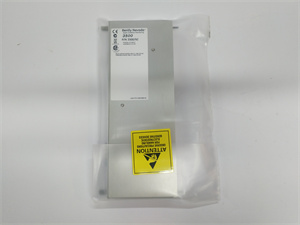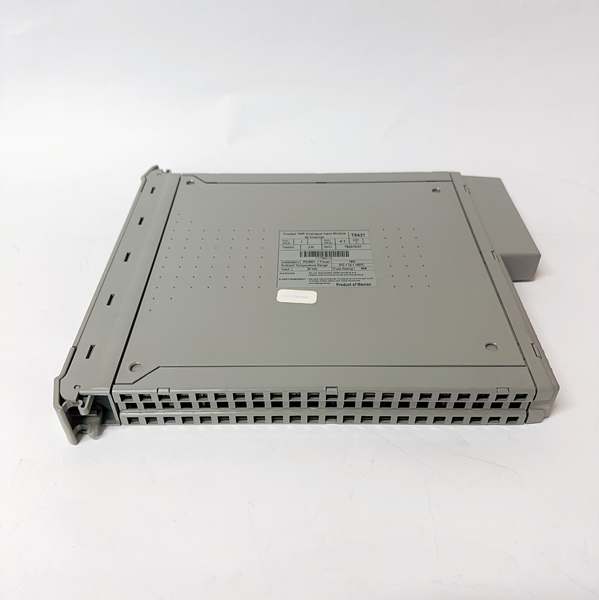

Description
Key Technical Specifications
- High Fault Tolerance and Safety: The module uses a TMR triple modular redundancy structure for each input channel, which can avoid system failures caused by single-point component damage. It conducts self-tests every 2 minutes and has comprehensive diagnostic functions, which can detect faults such as out-of-range signals and stuck channels. Meanwhile, it complies with the IEC 61508 standard and has SIL 3 certification, which can fully meet the safety requirements of critical industrial processes.
- High-Precision and Flexible Signal Acquisition: It has excellent signal acquisition accuracy, with a safety accuracy of ±1% of full scale and a calibration accuracy of up to 0.03%. The input current range is 0 – 22mA, and the input voltage range is 0 – 6VDC, which can be adapted to the signal output of various common industrial sensors. Each channel is configurable with 4 state thresholds, and when the state changes, it can trigger sequence-of-events (SOE) reporting with an event resolution of 1ms.
- Strong Environmental Adaptability and Anti-Interference: The module can work stably in an environment with 10%-95% non-condensing humidity. It has a galvanic isolation capacity of 2500V DC, which can effectively resist electrical transients and industrial electrical noise. In addition, it supports channel-by-channel digital filtering configuration, which can choose 50Hz or 60Hz noise suppression modes according to the on-site environment to ensure the cleanliness of signal transmission.

ICS Triplex T8431
Field Application & Problem Solved
- Offshore Oil Platform Wellhead Monitoring: Offshore oil wellheads are in harsh environments with high humidity and strong corrosion, and the monitoring of pressure and flow signals is crucial. The T8431 module collects signals from wellhead pressure transmitters and flow meters in real time. Its TMR architecture prevents signal acquisition interruption due to module local faults. The 2500V high isolation performance can resist the electromagnetic interference from marine electrical equipment, ensuring that the pressure and flow data are accurately transmitted to the control center to avoid oil leakage and explosion accidents.
- Chemical Reactor Temperature and Pressure Control: In chemical production, the temperature and pressure parameters in the reactor directly affect the reaction effect and safety. The T8431 module can collect multiple groups of temperature and pressure analog signals in the reactor at the same time through 40 channels. Its 0.03% high calibration accuracy ensures that the collected data is true and reliable. When a channel fails, the redundant structure can seamlessly switch, avoiding production accidents or substandard product quality caused by signal distortion or loss.

ICS Triplex T8431
Installation & Maintenance Pitfalls (Expert Tips)
- Pay Attention to Calibration Cycle: The recommended calibration check interval for the input channels of the module is 2 years. If it is used in a harsh environment with large temperature changes and serious corrosion, the calibration frequency should be appropriately increased. Uncalibrated modules for a long time will have reduced acquisition accuracy, which may lead to misjudgment of the control system.
- Standardize Hot-Swapping Operations: Although the module supports hot-swapping, it is necessary to turn off the corresponding channel signal switch before replacement. Do not directly pull out the module during the peak period of signal acquisition. Otherwise, it may cause instantaneous interference to the entire control system and even damage the backplane interface of the chassis.
- Configure Filtering Parameters Reasonably: When installing and setting up, select the appropriate filtering mode according to the on-site power frequency and interference situation. For example, select 50Hz filtering in the general industrial power environment. Blindly choosing the pass-through mode without filtering will make the signal vulnerable to interference, while unnecessary high-level filtering will delay the signal response speed.