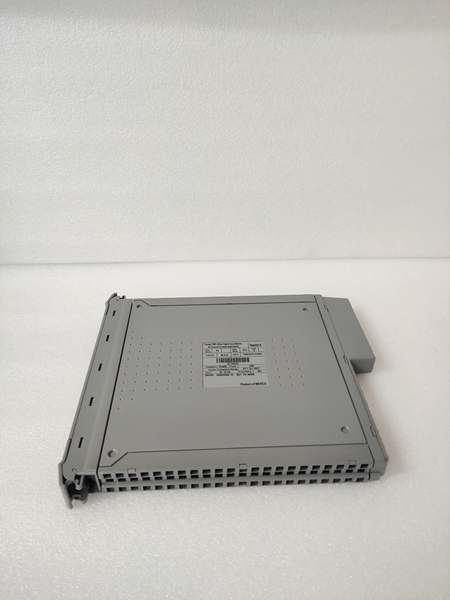
Description
Key Technical Specifications
- Model Number: T8403CX
- Manufacturer: ICS Triplex (Emerson)
- Channel Count: 40 isolated digital input channels (2-wire, sink/source configurable)
- Input Voltage Range: 20–32 VDC (rated for 24 VDC nominal)
- Input Current: 2mA per channel (nominal at 24 VDC)
- SOE Resolution: 1ms time-stamp accuracy (critical for fault tracing)
- Isolation Rating: 2500V DC channel-to-backplane; 1000V DC channel-to-channel
- Digital Filtering: Configurable 50/60Hz noise rejection (user-selectable via software)
- Operating Temperature: -40°C to 70°C (-40°F to 158°F)
- Power Consumption: 18W typical (backplane-powered, redundant supply supported)
- Diagnostics: Continuous open/short circuit detection, channel health monitoring, module self-test
- Certifications: IEC 61508 SIL 3, ATEX, IECEx, FM Class I Div 2, CSA
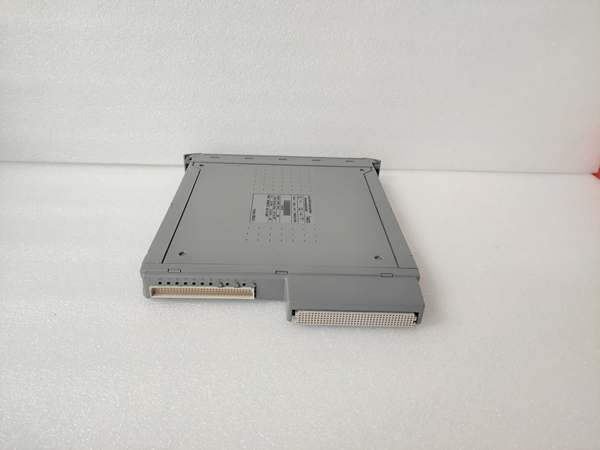
- Physical Form Factor: Single-slot rack-mounted, 266mm (H) × 31mm (W) × 303mm (D), 1.2kg (2.65lbs)
- Hot-Swap Capability: Supported (no system shutdown required in redundant configurations)

ICS TRIPLEX T8403CX
Field Application & Problem Solved
In high-risk industrial environments—refineries, chemical plants, offshore oil platforms—the biggest pain point with standard digital input modules is slow SOE resolution and lack of fault tolerance. When a critical event (e.g., a gas leak, pressure spike, or flame detection) occurs, plant operators need to know the exact sequence of sensor triggers to root-cause the incident. Legacy modules with 10ms+ SOE resolution blur the order of events, making it impossible to determine what failed first. Worse, non-TMR modules can fail silently, missing a sensor trigger and allowing a hazard to escalate into a catastrophic event.
The T8403CX solves both problems. You’ll find it in ESD systems where it collects signals from pressure switches, emergency stop buttons, and flame detectors—applications where 1ms SOE accuracy is non-negotiable for post-incident analysis. It’s also a staple in turbine control systems, where it monitors vibration switches and overspeed detectors; the TMR architecture ensures a single channel failure won’t miss a critical trip signal. In offshore platforms, its wide temperature range and corrosion-resistant design hold up to salt spray and extreme humidity, eliminating the need for costly environmental enclosures.
Its core value is twofold: first, the 1ms SOE resolution lets operators reconstruct event sequences with surgical precision, cutting root-cause analysis time from days to hours. Second, the TMR redundancy and built-in line monitoring eliminate silent failures—if a channel has an open circuit (broken wiring) or short circuit (ground fault), the module flags it immediately and logs the fault with a time stamp. Unlike standard modules, it doesn’t require external signal conditioners for noise rejection, reducing wiring complexity and failure points in the control loop.
Installation & Maintenance Pitfalls (Expert Tips)
SOE Time Sync Is Make-or-Break for Event Tracing
Rookies often install the T8403CX without syncing its internal clock to the plant’s GPS or NTP server. This is a fatal mistake—if the module’s time is out of sync with other SIS components, SOE logs will be useless for event reconstruction. Always configure NTP time sync in the Trusted software before commissioning the module. Set the time zone to match the plant’s location, and verify sync status via the front-panel LED (steady green = synced; flashing red = out of sync). In offshore platforms with poor GPS coverage, use a local NTP server to avoid time drift.
Channel Filtering Must Match Plant Power Frequency
The module’s configurable 50/60Hz filtering is designed to reject line noise, but rookies often leave it set to the default (50Hz) regardless of the plant’s power grid. If your plant uses 60Hz power, this mistake will cause intermittent “false trigger” faults—sensors will appear to trip and reset randomly, leading to unnecessary ESD activations. Always match the filter frequency to the plant’s power grid (check the main transformer nameplate if unsure). For high-noise environments (e.g., near large motors), enable the filter—never run channels in “unfiltered” mode unless you’re using shielded cable and have no other option.
Hot-Swap Requires Channel Group Deactivation
Yes, the T8403CX supports hot-swapping, but pulling the module without deactivating its input group will trigger a system-wide fault. Rookies often skip this step, leading to unplanned ESD trips that cost $50k+ in downtime. Before replacing, log into the Trusted HMI and put the input group in “test mode”—this tells the controller to ignore signals from the module during the swap. Wait 10 seconds for the controller to acknowledge, then remove the module. After reinstallation, take the group out of test mode only after the module syncs with the redundant pair (verify via LED status).
Shield Grounding Prevents Intermittent Faults
The module’s 2500V isolation won’t protect against electromagnetic interference (EMI) from high-voltage cables or motor drives. Rookies often ground shielded cable at both ends (module and sensor), creating ground loops that cause false short-circuit faults. Use shielded twisted-pair cable for field wiring, and terminate the shield only at the module end—leave the sensor end floating. This eliminates ground loops and reduces EMI by 90% in most cases. For sensors in high-EMI areas (e.g., near VFDs), route cables away from power lines or use metal conduit for extra protection.

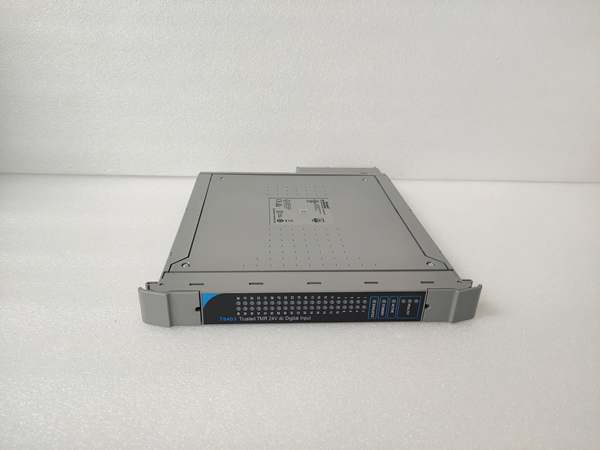
ICS TRIPLEX T8403CX
Technical Deep Dive & Overview
The T8403CX is an enhanced 40-channel TMR digital input module designed for Trusted Series safety systems, optimized for high-speed SOE logging and fault tolerance. At its core, it uses three independent processing channels (one per TMR leg) that sample input signals simultaneously, vote on the “valid” state, and transmit data to the controller via the redundant backplane. The majority voting logic ensures a single channel failure (e.g., a faulty optocoupler) is ignored—only if two channels fail does the module trigger an alarm.
What sets the T8403CX apart from the standard T8403 is its 1ms SOE resolution. Each input trigger is time-stamped with a precision clock synced to the plant’s NTP server, allowing operators to sequence events in the exact order they occurred. This is critical for post-incident analysis—for example, determining whether a pressure switch tripped before or after a flame detector in a refinery fire. The module’s built-in line monitoring adds another layer of reliability: it continuously checks for open circuits (broken sensor wiring) and short circuits (wiring touching ground), logging faults with a 1ms time stamp for root-cause analysis.
The module communicates with the Trusted CPU via the proprietary Triplex protocol, with a latency of less than 2ms per channel—fast enough for real-time ESD system response. Its dual-core processor handles SOE logging and diagnostics, offloading this work from the main controller and keeping scan times low in large systems. Unlike basic digital input modules, it’s built for harsh industrial conditions: it resists vibration (5g, 10–500Hz) and corrosion, and its wide temperature range lets it be mounted in field cabinets without environmental protection.
In summary, the T8403CX is a workhorse module for safety-critical applications—built not for lab conditions, but for the messy, high-stakes reality of live industrial control. Its combination of 1ms SOE resolution, TMR redundancy, and built-in diagnostics makes it indispensable for any plant that values uptime, safety, and fast incident analysis.