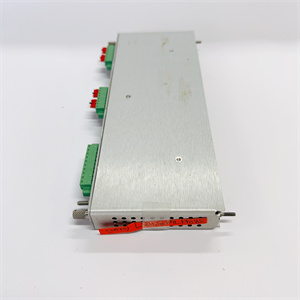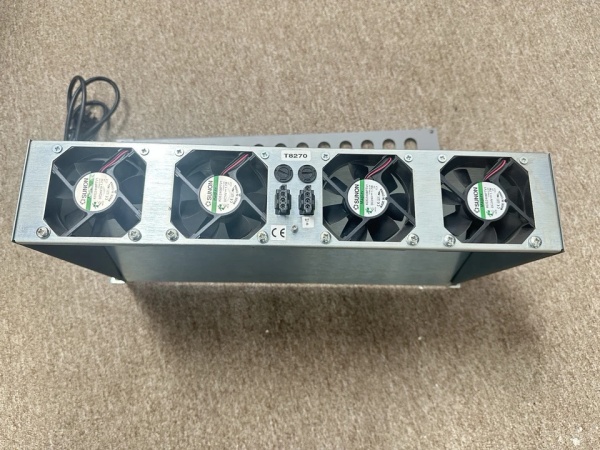
Description
Key Technical Specifications
- Model Number: T8270
- Manufacturer: ICS Triplex (Emerson)
- Channel Count: 8 isolated analog output channels (independently configurable)
- Supported Signal Types: 4-20mA DC (sink/source), 0-10V DC (voltage output)
- Output Accuracy: ±0.1% full scale (calibrated), ±0.25% full scale (safety-rated)
- Output Resolution: 16-bit DAC conversion
- Isolation Rating: 2500V DC channel-to-backplane; 1000V DC channel-to-channel
- Operating Temperature: -40°C to 70°C (-40°F to 158°F)
- Power Supply: 20–32 VDC (redundant backplane-powered), 15W typical power consumption
- Redundancy Architecture: Triple Modular Redundancy (TMR) with majority voting logic
- Diagnostics: Continuous output drift detection, open/short circuit monitoring, module self-test
- Certifications: IEC 61508 SIL 3, ATEX, IECEx, FM Class I Div 2, CSA
- Physical Form Factor: Single-slot rack-mounted, 266mm (H) × 31mm (W) × 303mm (D), 1.2kg (2.65lbs)
- Hot-Swap Capability: Supported (no system shutdown required in redundant configurations)
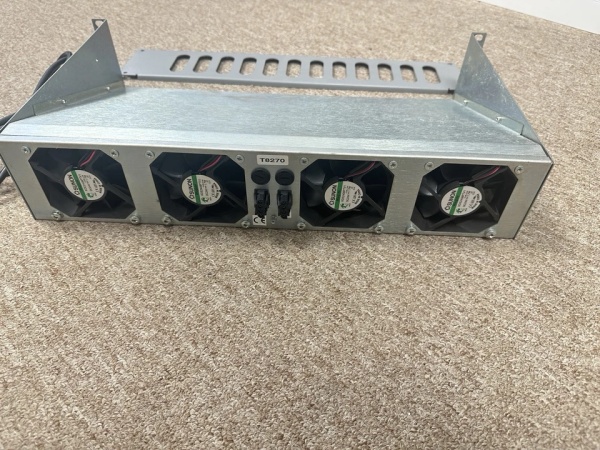
ICS Triplex T8270
Field Application & Problem Solved
In refineries, chemical plants, and power generation facilities, the biggest pain point with analog output modules is maintaining precision control while avoiding single-point failures. Legacy non-TMR AO modules often drift out of calibration in harsh environments, leading to incorrect valve positioning or actuator misoperation—issues that can cause product quality defects or safety hazards. Worse, a single component failure can disable an entire output bank, leaving the SIS unable to adjust critical process parameters during an emergency.
The T8270 solves these problems. You’ll find it controlling control valves in distillation columns, where precise 4-20mA signals regulate flow rates to maintain product purity. In combined-cycle power plants, it sends 0-10V signals to damper actuators, adjusting air intake to optimize boiler efficiency and prevent overheating. In offshore oil platforms, its wide temperature range and corrosion-resistant design hold up to salt spray and humidity, eliminating the need for costly environmental enclosures.
Its core value is twofold: first, 16-bit precision and ±0.1% accuracy ensure consistent, repeatable control of final elements—critical for maintaining process stability in high-risk applications. Second, TMR redundancy and built-in drift detection eliminate silent failures; if a channel drifts beyond the calibrated range, the module flags a fault and switches to the redundant TMR leg, keeping the process running without interruption. Unlike generic AO modules, the T8270 doesn’t require external signal conditioners, reducing wiring complexity and failure points in the control loop.
Installation & Maintenance Pitfalls (Expert Tips)
Channel Configuration Must Match Actuator Signal Type
Rookies often configure all channels to 4-20mA by default, then try to connect 0-10V actuators without updating the software. This causes “output out-of-range” faults that are hard to trace—especially if the module is in a redundant rack. Always verify channel-by-channel configuration in the Trusted software before wiring, and cross-check with the actuator’s signal input specification. For 4-20mA loops, ensure the actuator is wired as a current sink or source to match the module’s setting; mismatched wiring will result in no output signal and false “open circuit” faults.
Calibration Can’t Be Skipped in Extreme Environments
The manufacturer recommends a 2-year calibration interval, but in harsh environments (high humidity, extreme temperature swings, corrosive gases), this is too long. In coastal refineries, I’ve seen channel drift exceed 0.5% (five times the rated accuracy) in 12 months. Shorten calibration to 1 year in these environments, and use a precision calibrator that matches the signal type (e.g., a 4-20mA current source for current channels). Always perform a “zero-span” calibration—verify 0mA/0V and 20mA/10V outputs— and log calibration data for regulatory audits.
Hot-Swap Requires Output Group Deactivation First
Yes, the T8270 supports hot-swapping, but pulling the module without disabling its output group in the controller is a rookie mistake that triggers unplanned process upsets. Before replacement, log into the Trusted HMI and put the output group in “test mode”—this tells the controller to hold the last valid output value on the redundant module (if installed) and ignore fault signals during the swap. Wait 10 seconds for the controller to acknowledge, then remove the module. After reinstallation, take the group out of test mode only after the module syncs with the redundant pair (verify via the front-panel “SYNC” LED). Rushing this step will cause valve hunting or actuator drift, leading to process instability.
Loop Wiring Must Avoid Ground Loops
The T8270’s 2500V isolation won’t protect against ground loops—one of the most common causes of output signal drift. Rookies often ground both the module’s output common and the actuator’s signal common, creating a loop that introduces noise into the analog signal. For 4-20mA loops, use a 2-wire or 4-wire configuration (depending on the actuator’s power requirements) and ground only at the module end. Use shielded twisted-pair cable, and terminate the shield only at the module—leave the actuator end floating to eliminate ground loops and reduce EMI pickup.
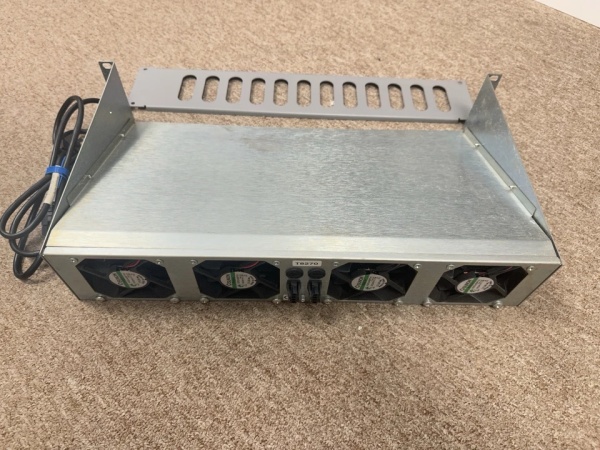
ICS Triplex T8270
Technical Deep Dive & Overview
The T8270 is an 8-channel TMR analog output module engineered for Trusted Series safety instrumented systems, designed to provide precision, fault-tolerant control of critical actuators in high-risk industrial applications. At its core, it uses three independent processing channels (one per TMR leg) that receive output commands from the Trusted controller, convert the digital signal to analog via a 16-bit DAC, and drive the field-side loops. The majority voting logic ensures that a failure in one processing channel (e.g., a faulty DAC) is ignored—only if two channels fail does the module trigger a system alarm.
What sets the T8270 apart from standard AO modules is its integrated diagnostic capabilities. For each channel, the module continuously monitors output current/voltage and compares it to the commanded value. If a channel drifts beyond the user-configurable threshold (typically ±0.1% full scale), the module automatically switches to the redundant TMR leg and logs a fault with a time stamp. For 4-20mA loops, it also detects open circuits (broken wiring) and short circuits (wiring touching ground), ensuring operators are alerted to field-side faults before they cause process upsets.
The module communicates with the Trusted CPU via the redundant backplane using the proprietary Triplex protocol, with a latency of less than 5ms per channel—critical for real-time process control. Its dual-core processor handles DAC conversion and diagnostics, offloading this work from the main controller and keeping scan times low in large systems. Unlike basic analog output modules, the T8270 is built for harsh industrial conditions: it resists vibration (5g, 10–500Hz) and corrosion, and its wide operating temperature range lets it be mounted in field cabinets without environmental protection.
In summary, the T8270 is a precision workhorse module—built not for lab conditions, but for the messy, high-stakes reality of live industrial control. Its combination of 16-bit accuracy, TMR redundancy, and integrated diagnostics makes it indispensable for any plant that values process stability, safety, and compliance.