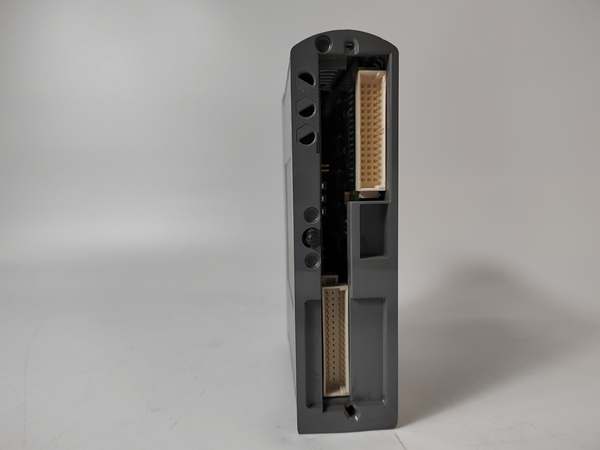
Description
Key Technical Specifications
- Model Number: T8235
- Manufacturer: ICS Triplex (Integrated into Rockwell Automation)
- Network Ports: 2 x 10/100BASE-T Ethernet (RJ45 connectors)
- Protocol Support: TCP/IP, UDP, Modbus TCP, Ethernet/IP (for Rockwell ecosystem integration)
- Redundancy: Hot-standby port redundancy (auto-failover < 50ms)
- Backplane Interface: Trusted TMR system backplane (64-bit parallel bus)
- Operating Voltage: 24VDC nominal (18VDC – 32VDC)
- Power Consumption: 8W typical, 12W max
- Operating Temperature: -20°C – 70°C (standard), -40°C – 75°C (extended conformal coating variant)
- Storage Temperature: -40°C – 85°C
- Humidity Rating: 5% – 95% non-condensing
- Certifications: IEC 61508 SIL 3, UL 508, CE, ATEX Zone 2 (conformal coated)
- Isolation: 1500VAC port-to-backplane, 1000VAC port-to-port
- Conformal Coating: Optional (IPC-A-610 Class 3) for corrosive environments
- Dimensions: 132mm x 107mm x 27mm (H x W x D)
- Weight: 0.38kg

ICS Triplex T3484
Field Application & Problem Solved
In safety-critical industrial environments—refineries, LNG terminals, nuclear power plants—reliable communication between safety instrumented systems (SIS) and distributed control systems (DCS) is non-negotiable. The biggest challenge here is avoiding single points of failure in network connectivity: a dropped Ethernet link or faulty communication module can disconnect the Trusted TMR controller from the central monitoring system, leading to blind spots in critical process data or delayed safety responses. Legacy single-port communication modules exacerbate this risk, as a single cable fault or port failure severs communication entirely.
You’ll typically find the T8235 installed in Trusted controller chassis controlling high-risk processes: catalytic crackers in refineries, emergency shutdown systems (ESD) in petrochemical plants, or turbine protection systems in power stations. For example, in an LNG terminal, the module connects the Trusted controller (managing cryogenic storage pressure) to the plant’s DCS, transmitting real-time pressure data and receiving remote commands. Its dual redundant ports are wired to separate network switches—if one port or cable fails, the module auto-fails over to the second port in under 50ms, ensuring no data loss or communication interruption.
Its core value lies in redundancy and safety compliance. Unlike generic Ethernet modules, the T8235 is SIL 3 certified, meaning it meets the fault-tolerance requirements of SIS where even milliseconds of downtime can have catastrophic consequences. In environments where regulatory compliance (e.g., OSHA, EPA) is mandatory, its certified design eliminates the risk of non-compliance from using unapproved communication hardware. Additionally, its support for Modbus TCP and Ethernet/IP ensures seamless integration with both legacy DCS systems and modern Rockwell Automation ecosystems, avoiding the need for costly protocol converters.
Installation & Maintenance Pitfalls (Expert Tips)
- Redundant Port Wiring: Separate Paths Are Non-Negotiable: Rookies often wire both Ethernet ports to the same switch to “save time.” This defeats redundancy—if the switch fails, both ports go down. Always run each port to independent network switches (with separate power supplies) and route cables through different physical paths (e.g., separate cable trays) to avoid simultaneous damage from accidents or environmental hazards.
- Conformal Coating: Don’t Skip It in Corrosive Environments: In coastal refineries or chemical plants with high humidity or corrosive vapors, the standard uncoated module will fail within 12–18 months due to PCB corrosion. Spend the extra on the conformal coating option (IPC-A-610 Class 3)—it adds $200–$300 upfront but saves $10k+ in downtime and replacement costs later.
- IP Addressing: Avoid Conflict with Controller CPU: The T8235 requires a unique IP address on the same subnet as the Trusted controller’s CPU. A common mistake is assigning the same IP to both the module and CPU, causing network collisions and intermittent communication. Use a network scanner to verify IP availability before configuration, and document addresses in the system manual.
- Cable Quality: Use Industrial-Grade Shielded CAT5e/CAT6: Standard office Ethernet cables degrade quickly in industrial environments—EMI from motors or variable frequency drives (VFDs) causes data corruption, and unshielded cables are prone to physical damage. Always use shielded, industrial-grade CAT5e or CAT6 cables with crimped RJ45 connectors (not punch-down) to ensure signal integrity. Ground the shield at the switch end only to prevent ground loops.
ICS Triplex T3484
Technical Deep Dive & Overview
The T8235 is a purpose-built communication module designed to provide redundant, SIL 3-certified Ethernet connectivity for ICS Triplex’s Trusted TMR safety systems. At its core, it features two independent 10/100BASE-T Ethernet transceivers, each with dedicated PHY chips and signal processing circuitry, connected to the Trusted backplane via a 64-bit parallel bus. This dual-transceiver design enables hot-standby redundancy: the module continuously monitors both ports, and if a link drops (detected via loss of carrier or CRC errors), it automatically switches traffic to the active port in less than 50ms—fast enough to avoid process disruptions or safety system misfires.
Unlike consumer-grade Ethernet modules, the T8235 is built for industrial harshness. Its optional conformal coating protects PCB traces from moisture, dust, and corrosive chemicals, while the 1500VAC isolation between ports and backplane suppresses EMI and transient voltage spikes common in industrial settings. The module’s firmware is optimized for low latency—critical for safety applications—with a packet processing time of <1ms, ensuring real-time data transmission between the controller and DCS.
Integration with the Trusted TMR system is seamless: the module plugs into the controller chassis backplane, drawing power from the chassis’ redundant 24VDC supply. It supports both client and server modes, allowing the Trusted controller to initiate data transfers (e.g., sending process alarms to the DCS) or respond to requests (e.g., receiving setpoint changes from the operator console). For field service engineers, its simplicity is a strength: configuration is done via the Trusted Workbench software (no standalone tools), and status LEDs on the front panel (link, activity, fault) provide instant visibility into port health.
The T8235’s greatest advantage is its balance of reliability and compliance. It doesn’t add unnecessary features (e.g., Wi-Fi, advanced routing) that introduce complexity—its sole job is to transmit data securely and redundantly. In safety-critical systems, this focus on core functionality is critical: every additional feature is a potential point of failure. For plants operating in high-risk industries, the T8235 isn’t just a communication module—it’s a regulatory-compliant safety component that ensures critical data never stops flowing.