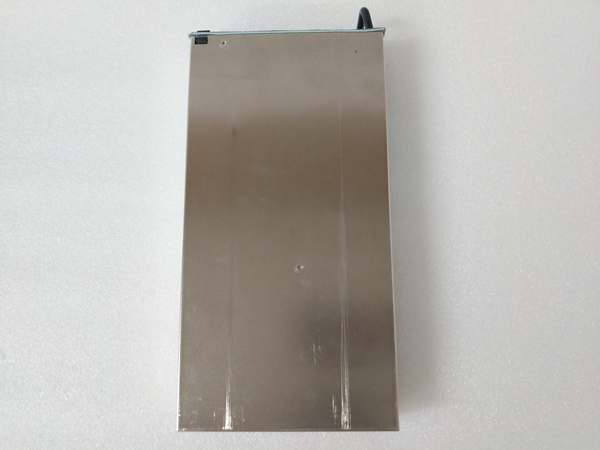
Description
Hard-Numbers: Technical Specifications
-
Input Voltage Range: 85–264 VAC (47–63 Hz) or 100–300 VDC universal input
-
Output Voltage: 24 VDC nominal (±5%), adjustable to 28 VDC via external controller
-
Output Power: 750 W per module continuous
-
Output Current: 10 A max at 24VDC (per module), 1A max (some configurations)
-
Efficiency: ≥85% (up to 90% typical)
-
Rack Capacity: Up to 3 modules per T8200 power shelf (2250 W total)
-
Redundancy Mode: N+1 or 2oo3 TMR configuration supported
-
Operating Temperature: 0°C to +60°C (standard), -20°C to +60°C (some variants), -40°C to +70°C (extended)
-
Storage Temperature: -40°C to +85°C
-
Isolation Rating: 250 V continuous working, reinforced isolation between input/output/ground
-
Protection Features: Overvoltage, undervoltage, overcurrent, short-circuit, thermal shutdown with auto-recovery
-
Hot-Swap: Yes, with zero transfer time when redundant modules present
-
Form Factor: 19-inch 1U rackmount (44mm H × 483mm W × 340mm D typical)
-
Weight: 2.3–2.7 kg (5.1–6.0 lbs) per module
-
Cooling: Forced air (integrated fans) or natural convection (depending on variant)
-
Status Indication: LED indicators for Power OK, Fault, Self-Test; relay contacts for remote fault annunciation
-
Communication: RS-485/RS-232 for status monitoring and voltage/current configuration
-
Certifications: CE, UL, CSA, ATEX (system-level), TÜV IEC 61508 SIL 3 capable

ICS Triplex T8231
The Real-World Problem It Solves
A power supply failure in a Safety Instrumented System doesn’t just stop production—it can disable your entire safety layer when you need it most. The T8231 eliminates the “single point of failure” nightmare that plagues conventional power architectures by running three independent 750W power packs in parallel, voting the outputs 2-out-of-3. If one pack dies, shorts, or drifts out of regulation, the other two seamlessly carry the load without a single millisecond of interruption.
Where you’ll typically find it:
-
Powering TMR processor chassis (T8100) and expander chassis (T8300) in offshore platform ESD systems
-
Providing redundant 24VDC to burner management systems (BMS) in power generation turbines
-
Supporting SIL 3 fire & gas detection systems in petrochemical refineries with zero-downtime maintenance requirements
This power pack keeps your safety system alive even when the grid fluctuates or a power module fails—no spurious trips, no dangerous power loss, just brute-force availability.
Hardware Architecture & Under-the-Hood Logic
The T8231 isn’t just three power supplies bolted together—it’s an intelligent TMR power system with active current sharing and real-time health monitoring. Each power pack contains independent AC/DC conversion stages, regulation loops, and protection circuits. The modules communicate via the backplane to balance load currents and detect discrepancies before they become failures.
Internal Power Flow:
-
Universal Input Stage: Each pack accepts 85-264VAC or 100-300VDC through independent rectification and PFC (Power Factor Correction) circuits
-
DC-DC Conversion: Isolated switching converters step down to 24VDC with individual regulation loops maintaining ±1% voltage accuracy
-
2oo3 Output Voting: Three diode-ORed outputs feed a common bus; if one pack drifts >5% or fails, the isolation diodes prevent back-feeding while the remaining packs assume full load
-
Current Sharing: Active load balancing circuitry ensures each pack carries equal current (within 10%) during normal operation, preventing thermal stress on individual units
-
Health Monitoring: Each pack monitors its own input voltage, output voltage/current, internal temperature, and fan speed; deviations trigger local fault LEDs and remote relay contacts
-
Hot-Swap Control: Backplane interlock logic ensures a replacement pack synchronizes its output voltage with the active bus before engaging, preventing inrush current or voltage sags during replacement
ICS Triplex T8231
Field Service Pitfalls: What Rookies Get Wrong
Assuming All Three Packs Are Created Equal
Engineers throw three T8231s in a T8200 shelf and assume they’re in TMR mode by default. Wrong. The modules default to N+1 redundant mode unless explicitly configured for 2oo3 voting via the power controller or DIP switches. In N+1, you have backup but not the fault-tolerant voting that prevents a single failed pack from dragging down the bus voltage.
-
Field Rule: Check the configuration jumpers or software settings before commissioning. For SIL 3 applications, force 2oo3 mode and verify the “VOTE” LED pattern on each pack—steady green on all three means healthy voting; amber on one means that pack is isolated but the bus remains stable.
Ignoring the Input Current Inrush on Black Start
Three T8231s starting simultaneously from a cold black start can draw 30-40 amps of inrush current each, tripping upstream breakers or sagging the 480VAC MCC supply. Rookies wire them to the same feeder without calculating the combined inrush, then wonder why the breaker trips on every power restoration.
-
Quick Fix: Stagger the power-up sequence using time-delay relays or configure the power controller for sequential start (if supported). Size upstream breakers for 125% of combined steady-state current plus inrush, or use three separate feeders from different phases. Measure inrush with a clamp meter during commissioning—if you’re seeing >100A total for 3 packs, you’ve got a problem.
Mixing Old T8231 and New T8231C Packs in the Same Shelf
The T8231C has enhanced diagnostics and slightly different output impedance characteristics. Running one C-series pack with two legacy packs in current-sharing mode can cause circulating currents and thermal runaway—the C pack fights the older units for load share, overheating all three.
-
Field Rule: Never mix revisions in the same active shelf. If you must replace one legacy T8231, either upgrade all three to T8231C or configure the new pack as a cold standby (N+1 mode) rather than active TMR. Check the label revision letter (Rev H vs. Rev C) before installation—if they don’t match, don’t mount them together.