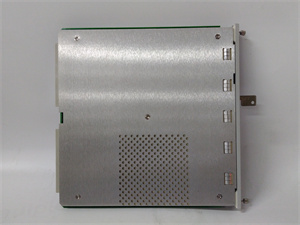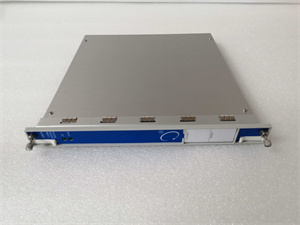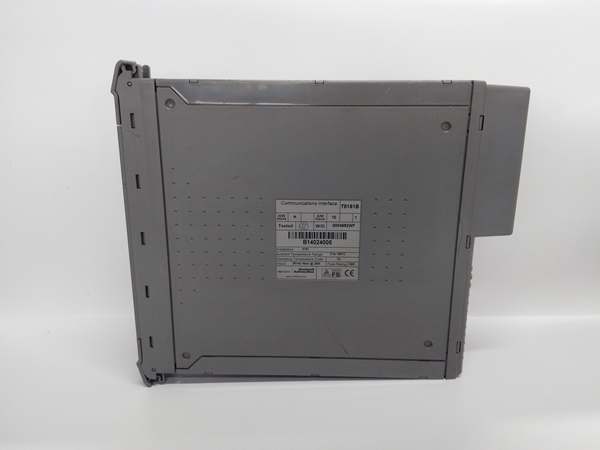
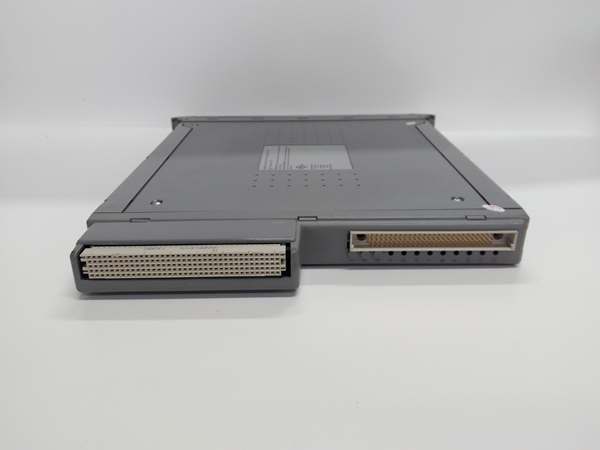
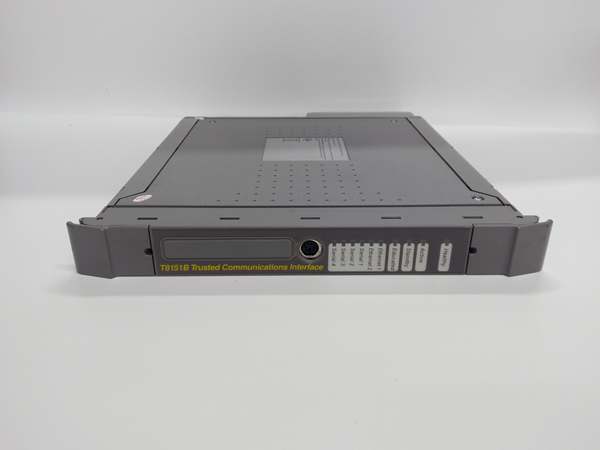
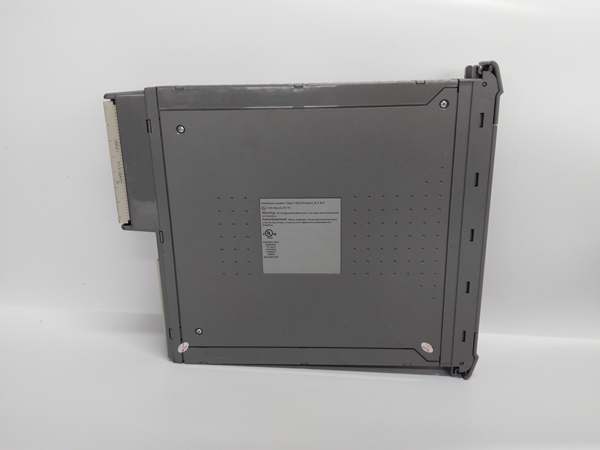
Description
Hard-Numbers: Technical Specifications
-
Protocol Support: Modbus RTU (Master/Slave), Open Modbus TCP, Trusted Peer-to-Peer, Trusted Enhanced Peer-to-Peer, ICS2000, CP2000
-
Ethernet Ports: 2 × 10/100BaseT (dual, isolated, Rev C+ supports 100BaseT)
-
Serial Ports: 4 rear isolated ports (2 × RS-232/422/485, 2 × RS-422/485) + 1 front RS-232 diagnostic port
-
Baud Rates: 1200 to 115200 baud (configurable per port)
-
SOE Buffer: 4000 events onboard (backup system event log on Rev C+)
-
Backplane Supply: 20 Vdc to 32 Vdc (dual redundant feeds from IMB)
-
Power Dissipation: 10 W max
-
Operating Temperature: 0°C to +60°C (32°F to 140°F)
-
Storage Temperature: -25°C to +70°C (-13°F to 158°F)
-
Relative Humidity: 10% to 95% RH (non-condensing)
-
Isolation Ratings:
-
50 V Basic: Module to backplane, module to diagnostic port
-
250 V Basic: Module to rear serial ports, module to Ethernet, between all external ports
-
-
Processor: Motorola PowerPC with Trusted Operating System (real-time kernel)
-
Memory: EPROM (bootstrap), Flash (firmware upgradable via front panel)
-
Physical: 266 mm H × 31 mm W × 303 mm D (10.5″ × 1.2″ × 12.0″), 1.13 kg (2.49 lb)
-
Module Location: T8100/T8300 I/O module slot
-
Fusing: Not user serviceable (onboard electronic protection)

ICS TRIPLEX T8151B
The Real-World Problem It Solves
Safety processors should be crunching safety logic, not wasting cycles polling SCADA for heartbeat messages or translating Modbus registers for the DCS. The T8151B eliminates that bottleneck by handling all external communication grunt work—TCP/IP sockets, serial protocols, event logging—freeing the TMR Processor to focus on what matters: keeping your process safe. It sits between the Trusted backplane and the outside world, translating safety data into protocols your HMI understands.
Where you’ll typically find it:
-
Bridging Trusted SIS controllers to Honeywell Experion or Yokogawa CENTUM VP via Modbus TCP
-
Connecting redundant safety controllers in peer-to-peer architectures across turbine/compressor skids
-
Buffering 4000 Sequence of Events (SOE) timestamps for post-trip forensic analysis in power plants
This module keeps your safety network responsive and your processor load low—no more scan time creep from chatty SCADA clients.
Hardware Architecture & Under-the-Hood Logic
The T8151B isn’t just a protocol converter—it’s a full-blown communication coprocessor with its own PowerPC brain and Trusted OS. It votes data 2oo3 with the TMR Processor over the triplicated Inter-Module Bus (IMB) while keeping all external ports electrically isolated and transient-protected. The module maintains dual redundant 24V feeds and monitors its own health via watchdog timers.
Internal Signal Flow:
-
IMB Interface: Receives triplicated data from the T8110B TMR Processor over three independent IMB channels
-
2oo3 Voting: Votes incoming safety data 2-out-of-3 before processing; transmits replies back via all three IMB channels
-
Protocol Processing: Motorola PowerPC runs the Trusted OS real-time kernel, handling protocol stacks (Modbus, Peer-to-Peer) in isolated memory space
-
Port Isolation: All Ethernet and serial transceivers are galvanically isolated from each other and from the module’s internal power supplies
-
SOE Buffering: Timestamps and queues up to 4000 events in onboard memory for retrieval by historians or engineering workstations
-
Health Monitoring: Watchdog timers monitor processor operation and PSU outputs; faults trigger front-panel indicators and IMB status bits
ICS TRIPLEX T8151B
Field Service Pitfalls: What Rookies Get Wrong
Mixing Up T8151 and T8151B Pinouts
Early T8151 modules (Rev H and below) used dual 10Base2/10BaseT Ethernet and had a daughterboard for serial ports. T8151B Rev C+ moved to single-PCB design with 10/100BaseT and integrated serial ports. The physical connectors look similar, but the pinouts and termination requirements differ—swapping them without checking the revision letter causes network collisions or serial ground loops.
-
Field Rule: Check the label before wiring. T8151B Rev C+ has “100BaseT” silkscreened near the Ethernet jacks. If you see “10Base2” (BNC connectors), you’re holding the old T8151—use the T8153 termination assembly wiring diagram, not the T8173 Gateway Adapter pinout.
Forgetting the T812X for Modbus Master Mode
The T8151B ships as a Modbus Slave by default. Engineers try to initiate Modbus Master requests (polling remote flow computers or VFDs) and wonder why the ports won’t transmit. The base module lacks the physical interface adapter for Master mode—you need the T8122 or T8123 Processor Interface Adapter mounted on the module.
-
Quick Fix: Verify your application needs. If the T8151B must act as Master (initiate requests), order the T812X adapter kit and install it before commissioning. Check TriStation 1131 configuration—”Modbus Master” won’t even appear as an option without the hardware detected.
Ignoring the 4000-Event SOE Buffer Limit
The SOE buffer fills fast during plant upsets—4000 events sounds like a lot until you have a turbine trip with 50 I/O points changing state every scan. Rookies configure SOE logging on every digital point without calculating buffer turnover, then lose critical pre-trip data when the buffer wraps.
-
Field Rule: Do the math. At 50ms scan time, 4000 events fills in 200 seconds (3.3 minutes) if 40 points change every scan. Prioritize only safety-critical points for SOE logging (ESD valves, trip solenoids, fire sensors). Set up the T8013 SOE Historian PC to poll the T8151B every 60 seconds during normal ops, every 10 seconds during startups/shutdowns. Monitor the “SOE Buffer Full” bit in TriStation—if it’s toggling, you’re losing events.