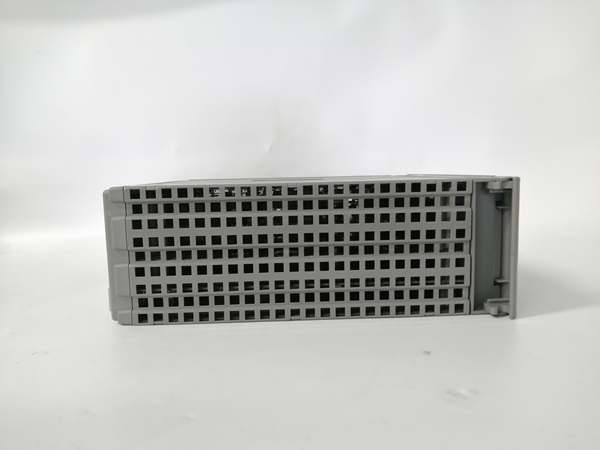
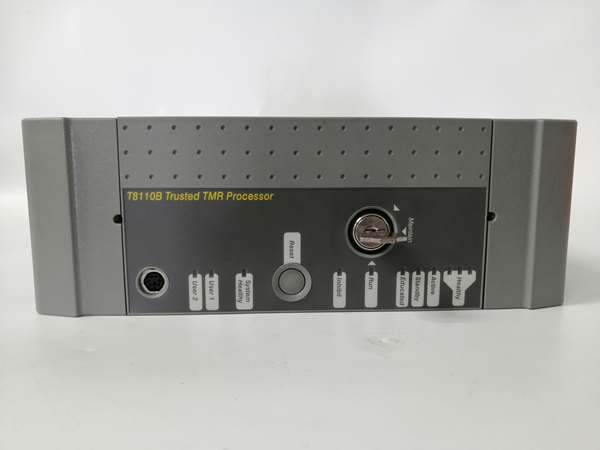
Description
Hard-Numbers: Technical Specifications
-
Protocol Support: TriStation 1131, Modbus TCP/IP (via T8151B comms module), RS422/485 serial, IRIG-B002/122 time sync
-
Processor: Motorola PowerPC series, 100 MHz clock
-
Memory Architecture:
-
DRAM: 16 MB EDO (60 ns)
-
EPROM: 512 kB
-
FLASH: 2 MB
-
NVRAM: 128 kB (retained variables)
-
-
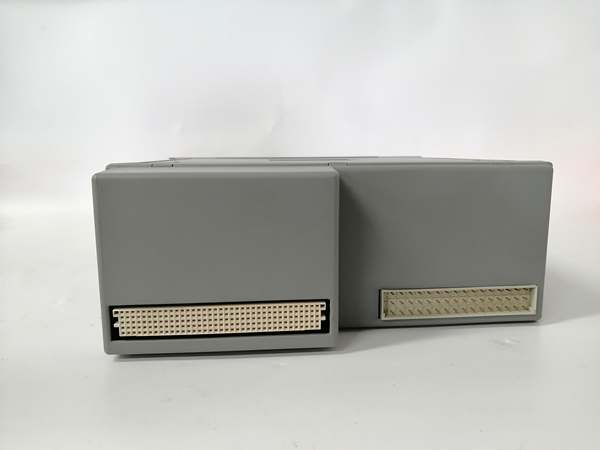
I/O Interface: Triple redundant Inter-Module Bus (IMB) – triplicated serial backplane
-
SOE Buffer: 1,000 events onboard, transferable to 4,000 event CI buffer
-
Retained Variable Storage: Booleans 1 byte, Analogues 4 bytes, Timers 5 bytes per variable
-
Operating Temperature: 0°C to +60°C (32°F to 140°F)
-
Non-Operating Temperature: -25°C to +70°C (-13°F to 158°F)
-
Humidity Range: 10% to 95% RH (non-condensing)
-
Power Requirements: 20-32 Vdc system supply, 80W maximum load/heat dissipation
-
Isolation/Transient Rating: 2 kV transients and bursts, 2.5 kHz for t=60 seconds
-
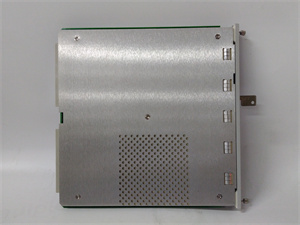
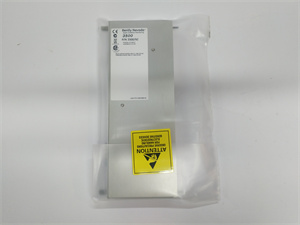
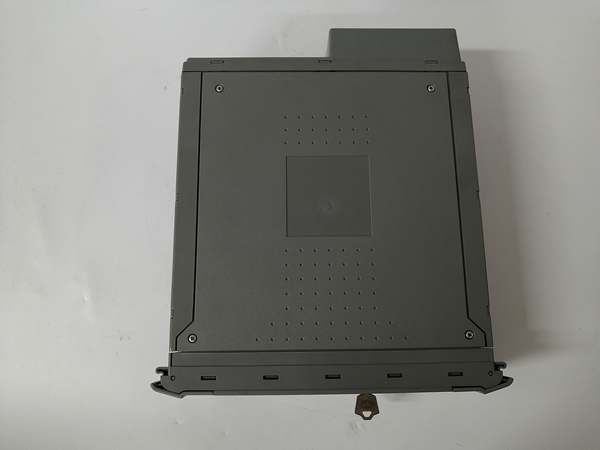
Physical: 266 mm H × 93 mm W × 303 mm D (10.5″ × 3.6″ × 12.0″), 2.94 kg (6.48 lb)
-
Safety Certification: TÜV IEC 61508 SIL 3
-
Compatible Chassis: T8100 (processor chassis), T8300 (expander chassis)

ICS Triplex T8110B
The Real-World Problem It Solves
A single CPU failure in a Safety Instrumented System can either cause a dangerous failure to danger (process continues unsafe) or a spurious trip (million-dollar shutdown). The T8110B eliminates both nightmares by running three independent PowerPC processors in lock-step, voting every output decision 2-out-of-3. If one processor drifts due to a clock glitch, memory corruption, or thermal stress, the other two smother it before it can command a bad output.
Where you’ll typically find it:
-
Turbine control and compressor protection systems on offshore platforms
-
Emergency Shutdown (ESD) and Fire & Gas (F&G) logic solvers in refineries
-
Burner Management Systems (BMS) in power generation and boiler houses
This processor keeps your safety logic running even when silicon fails—no single point of failure, no dangerous undetected faults, just brute-force fault tolerance.
Hardware Architecture & Under-the-Hood Logic
The T8110B isn’t a single-board computer—it’s three complete computers welded together with voting logic. Each Fault Containment Region (FCR) houses an independent Motorola PowerPC with its own memory map, clock, and I/O voter. They execute the same application program cycle in perfect synchronization, cross-checking each other’s work before any output reaches the IMB backplane.
Internal Signal Flow:
-
Lock-Step Execution: All three PowerPC processors fetch and execute the same instruction simultaneously from independent EPROM/DRAM banks
-
Dual-Ported Memory Voting: Each processor has voted 2oo3 read access to the other two FCRs’ memory systems—if Processor A reads garbage, Processors B and C out-vote it
-
Discrepancy Detection: Input voters on each FCR compare the other two processors’ output states; divergence triggers a fault containment alert
-
Synchronization Maintenance: If one processor drifts (clock skew, thermal jitter), dedicated resynchronization logic forces it back into lock-step with the majority
-
Triplicated IMB Output: Each processor drives one channel of the triple-redundant Inter-Module Bus; I/O modules perform final 2oo3 voting at the field interface
-
SOE Timestamping: State changes are captured with 1ms resolution and queued in the 1,000-event buffer for post-incident analysis via the CI buffer expansion
ICS Triplex T8110B
Field Service Pitfalls: What Rookies Get Wrong
Assuming “Hot Replacement” Means Yank-and-Plug Without Consequences
The T8110B supports online replacement—but only in a properly configured redundant chassis. Pull the primary processor from a simplex T8100 chassis mid-scan, and you’ve just crashed your SIS. Even in TMR configurations, extracting the wrong module during a voting cycle can force a bumpless transfer that doesn’t go so bumplessly.
-
Field Rule: Verify the chassis has at least two healthy T8110B modules running before touching anything. Check the “HEALTH” LED on all three processors—steady green across the board means safe to extract. If any LED is amber or red, troubleshoot that first. Always use the Companion Slot procedure: install the replacement in the companion slot first, let it sync, then execute the transfer via TriStation—never just pull the old one.
Ignoring the 80W Heat Dissipation Reality
Eighty watts is a lot of heat for a 3.6-inch wide card. Rookies cram three T8110Bs into a T8100 chassis with blocked ventilation or failed T8270/T8271 fan trays, then wonder why they get thermal shutdowns or memory errors in summer months.
-
Quick Fix: Verify the T8270 rack fan or T8271 roof fan is spinning at full speed before commissioning. Check airflow direction—front intake, rear exhaust, no obstructions within 6 inches. In hot climates, monitor the chassis internal temp via TriStation diagnostics; if you’re seeing sustained 55°C+ ambient, add external cooling or relocate the cabinet. Thermal stress kills DRAM and PowerPC solder joints over time.
Messing with IRIG-B Wiring Without Checking Signal Integrity
The T8110B has exclusive IRIG-B002/122 time sync inputs for SOE timestamping. Junior engineers run unshielded twisted pair or share grounds with 24V motor circuits, then complain about “jittery” timestamps or 50ms errors in their trip analysis.
-
Field Rule: Use shielded coaxial or twisted-pair cable (RG-58 or better) for IRIG-B runs, keep them under 100 feet unless using line drivers, and ground the shield at one end only—preferably at the IRIG source. Never run IRIG cables in the same conduit as VFD power or solenoid wiring. Check the time sync status byte in TriStation before declaring SOE operational; if it’s not locked, your forensic timestamps are garbage.