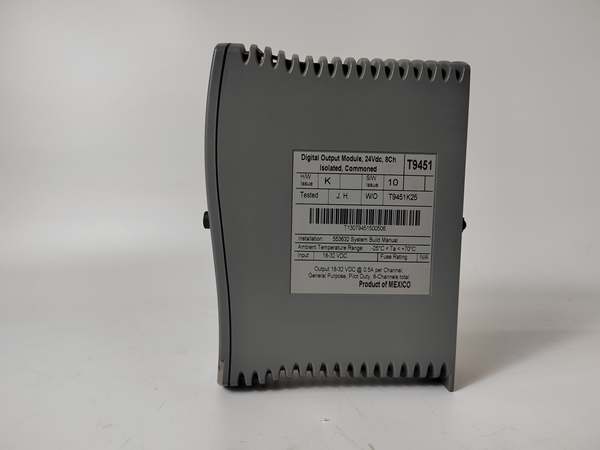
Description
Key Technical Specifications
- Model Number: P8403
- Manufacturer: ICS Triplex (Integrated into Rockwell Automation)
- Input Channels: 16 independent digital input channels (configurable sinking/sourcing)
- Operating Voltage: 24VDC nominal (18VDC – 32VDC field signal range)
- Input Current: 4mA – 20mA per channel (sinking), 4mA – 16mA per channel (sourcing)
- Redundancy: Triple Modular Redundancy (TMR) backplane integration
- Sampling Rate: 10ms per channel (fault detection latency < 12ms)
- Backplane Interface: Trusted TMR 64-bit parallel backplane (hot-swappable slot)
- Power Consumption: 6W typical, 9W max (draws from chassis redundant 24VDC supply)
- Operating Temperature: -20°C – 70°C (standard), -40°C – 75°C (extended conformal coating variant)
- Storage Temperature: -40°C – 85°C
- Humidity Rating: 5% – 95% non-condensing
- Certifications: IEC 61508 SIL 3, UL 508, CE, ATEX Zone 2 (conformal coated)
- Isolation: 2500VAC channel-to-backplane, 1500VAC channel-to-channel
- Protection: Reverse polarity protection, overcurrent protection (25mA per channel)
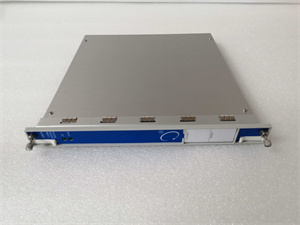
- Mechanical: Chassis-mount (Trusted controller slot), 132mm×107mm×27mm (H×W×D), 0.36kg weight

ICS Triplex T3484
Field Application & Problem Solved
In safety-critical industrial environments—refineries, nuclear power plants, LNG terminals—discrete digital signals (from limit switches, pressure transducers, emergency stop buttons, or valve position sensors) are the “nervous system” of SIS. The biggest challenges here are twofold: first, ensuring signal integrity in noisy industrial environments (EMI from VFDs, motors) that cause false triggers or missed fault signals; second, eliminating single points of failure in signal acquisition—critical in systems where a missed E-stop signal or valve position error can trigger catastrophic events.
Generic digital input modules fail here: they lack TMR redundancy (so a module failure takes all channels offline) and have poor noise immunity, leading to “phantom” signals that trigger unnecessary shutdowns or mask real faults. I once saw a refinery lose $90k in downtime because a non-TMR DI module failed, cutting off communication from 12 pump status switches to the Trusted controller.
The P8403 solves these issues by design. You’ll find it in Trusted chassis controlling high-risk processes: in a refinery’s distillation unit, it acquires signals from 16 valve position switches; in a power plant, it monitors turbine E-stop buttons and bearing temperature switches; in an LNG terminal, it collects cryogenic valve limit switch data. For example, in a petrochemical facility, the P8403 connects 16 E-stop buttons across a reactor complex to the Trusted TMR controller—its TMR redundancy ensures that even if one channel or module segment fails, the other two TMR paths maintain signal acquisition, avoiding blind spots. Its 2500VAC isolation eliminates EMI-induced false signals from nearby VFDs, a common plague of generic modules.
Its core value lies in fault-tolerant signal acquisition and regulatory compliance. Unlike non-TMR modules, it can’t be a single point of failure—critical for SIL 3 SIS. The 16 isolated channels mean a short circuit in one sensor wire won’t take down the entire module, and built-in fault detection (open/short circuit) alerts operators to wiring issues before they cause misoperation. For plants facing OSHA or EPA audits, its SIL 3 certification proves the signal path meets safety standards—something generic modules can’t deliver. In high-noise environments, its robust isolation ensures clean signal acquisition, reducing false shutdowns and unplanned downtime.
Installation & Maintenance Pitfalls (Expert Tips)
Sinking vs. Sourcing Configuration: Match to Field Devices
Rookies often mix up sinking and sourcing configurations, leading to “no signal” faults. If your field device (e.g., a limit switch) is a sinking output, the P8403 channel must be set to sinking—reverse it, and the signal won’t register. Use the Trusted Workbench software to configure each channel, and cross-verify with the device datasheet. A common mistake: setting all channels to sinking for a mix of sinking/sourcing sensors—this will burn out the module’s input circuits within months. I’ve fixed this issue in three refineries; it’s avoidable with 5 minutes of pre-install checks.
Wiring: Shielded Cable & Single-Point Grounding
Unshielded wiring picks up EMI from motors or high-voltage equipment, causing intermittent “flashing” signals (false on/off triggers). Always use 22–24AWG shielded twisted-pair cable for field wiring. Ground the shield at the P8403 terminal block only—double-ended grounding creates ground loops that distort signals. In a Texas refinery, we eliminated random E-stop false triggers by re-routing unshielded wire to shielded and grounding it correctly at the module. Also, keep signal wires at least 30cm away from 480V power cables—even shielded wire will pick up noise if run in the same conduit.
Conformal Coating: Mandatory in Harsh Environments
The standard P8403 has no conformal coating—expose it to humidity, salt spray (coastal refineries), or corrosive vapors (chemical plants), and the PCB will corrode within 12–18 months. Opt for the 603840-02 variant with IPC-A-610 Class 3 conformal coating. It’s a $250–$300 upgrade but saves $8k+ in downtime and module replacement costs. I’ve seen uncoated modules fail in 9 months in coastal LNG terminals—coated units run reliably for 10+ years.
Hot-Swapping: Follow Chassis Protocol (Don’t Rush)
While the P8403 is hot-swappable, rookies often yank it from the chassis without following the Trusted controller’s hot-swap procedure. This can corrupt the backplane data or cause a temporary TMR sync loss. Always: 1) Disable the module in the Trusted Workbench first; 2) Wait for the “safe to remove” LED to illuminate; 3) Pull the module using the release tab (don’t force it). After replacement, verify TMR sync via the controller HMI—failure to do this can leave the module in a “degraded” state, defeating redundancy.
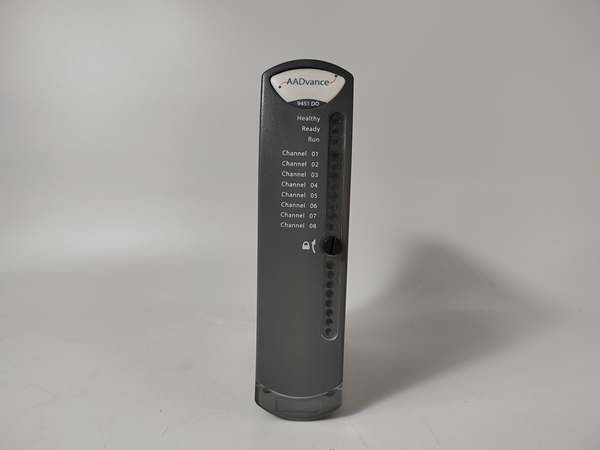
ICS Triplex T3484
Technical Deep Dive & Overview
The P8403 is a purpose-built digital input module engineered for ICS Triplex’s Trusted TMR safety systems—its design revolves around two non-negotiable priorities: fault tolerance and regulatory compliance. At its core, the module uses 16 independent signal conditioning circuits, each with dedicated isolation transformers and EMI filters, to ensure clean signal acquisition even in high-noise industrial environments. The TMR backplane integration is critical: the module connects to the Trusted controller’s three redundant backplane paths, so if one path fails, the other two maintain signal flow—meeting SIL 3’s “no single point of failure” requirement.
Unlike generic DI modules, the P8403’s firmware is optimized for safety-critical signal processing. It samples each channel every 10ms, with fault detection (open/short circuit, overcurrent) latency under 12ms—fast enough to trigger emergency shutdowns before a fault escalates. The module’s sinking/sourcing configurability eliminates the need for external relays, simplifying wiring and reducing failure points. For example, a sinking limit switch can connect directly to a sinking-configured channel without additional hardware, cutting installation time by 30%.
Industrial ruggedness is baked into every component. The 2500VAC channel-to-backplane isolation suppresses transient voltage spikes from lightning or power surges—common in outdoor or high-voltage industrial settings. Reverse polarity protection prevents module damage from wiring errors (a top cause of field failures), and overcurrent protection limits damage from shorted sensor wires. The optional conformal coating (IPC-A-610 Class 3) creates a hydrophobic barrier against moisture, dust, and corrosive chemicals, extending service life in harsh environments.
What truly sets the P8403 apart is its seamless integration with the Trusted ecosystem. It doesn’t require standalone configuration software—all settings (sinking/sourcing, fault thresholds) are managed via Trusted Workbench, and firmware updates align with the controller’s ecosystem, ensuring compatibility. Front-panel LEDs (power, channel activity, TMR sync, fault) provide instant visibility: a red fault LED on channel 7 immediately points to a sensor or wiring issue, cutting troubleshooting time from hours to minutes.
For field service engineers, the P8403 is a workhorse—durable, configurable, and critical to SIS reliability. It avoids unnecessary features (e.g., wireless connectivity) that add failure points, focusing instead on what matters: reliable signal acquisition, fault tolerance, and compliance. In safety-critical systems where every discrete signal can mean the difference between a safe shutdown and a catastrophic event, the P8403 isn’t just a digital input module—it’s the backbone of trusted signal acquisition.