Description
Key Technical Specifications
-
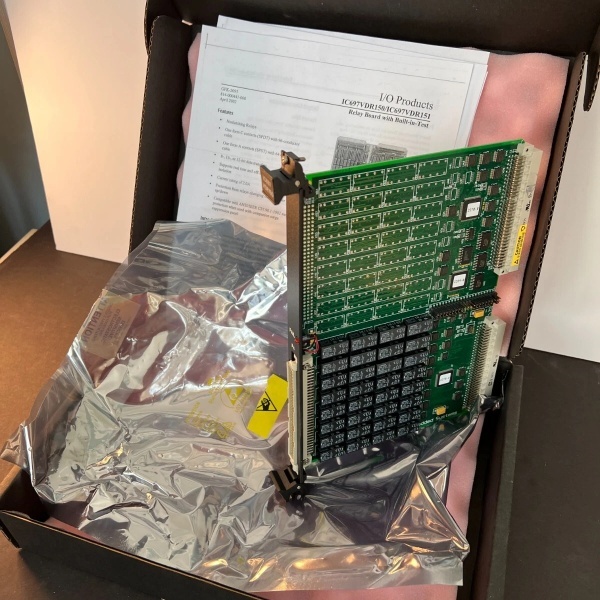
Model Number: IC697VDR150
-
Manufacturer: GE Fanuc / Emerson
-
Output Points: 32 Form-C relays (non-latching)
-
Contact Rating: 2 A resistive @ 250 VAC / 220 VDC; 0.5 A pilot-duty L/R = 40 ms
-
Coil Power: 24 VDC bus-derived; 150 mA from +5 V back-plane (logic only)
-
Response Time: 6.5 ms max (0.5 ms coil + contact make)
-
Isolation: 1500 VAC for 1 min / 250 VAC continuous field-to-logic; 500 V group-to-group
-
Connectors: Two 96-pin DIN front-panel connectors (IC697ACC801/804 cables to IC697ACC822 terminal blocks)
-
Protection: Snubber (R=47 Ω, C=0.015 µF) & MOV on each coil; 3 A group fuse (internal, not user-replaceable)
-
Diagnostics: Green “MODULE OK,” individual red LEDs for coil fault / blown-driver
-
Built-in-Test: NC pole of each double-throw relay read back to verify contact state
-
Operating Temperature: 0 °C to +60 °C (conformal-coated)
-
VME Compliance: ANSI/IEEE 1014-1987, A24/A16, D32/16

IC697VDR151
Field Application & Problem Solved
A Series 90-70 turbine controller doesn’t want sixteen ice-cube relays flopping around—it wants one VME card that can drive 32 contactors, solenoids, and trip coils straight from the rack. Slide IC697VDR150 into any I/O slot, land two cables to the terminal blocks, and you have 32 isolated, LED-indicated, Form-C outputs ready for PLC commands. When the card fails you lose the output group and the unit folds to manual; swap the module (draw-out style), snap the two cables back in, and the loads re-energise exactly as before—no software reload, no re-addressing. Found in every Series 90-70 / RX7i remote drop from gas-turbine Mark V upgrades to steel-mill drives. Value is density: 32 relays in one slot replaces four 8-point modules, a fuse block, and a handful of interposing relays.
A Series 90-70 turbine controller doesn’t want sixteen ice-cube relays flopping around—it wants one VME card that can drive 32 contactors, solenoids, and trip coils straight from the rack. Slide IC697VDR150 into any I/O slot, land two cables to the terminal blocks, and you have 32 isolated, LED-indicated, Form-C outputs ready for PLC commands. When the card fails you lose the output group and the unit folds to manual; swap the module (draw-out style), snap the two cables back in, and the loads re-energise exactly as before—no software reload, no re-addressing. Found in every Series 90-70 / RX7i remote drop from gas-turbine Mark V upgrades to steel-mill drives. Value is density: 32 relays in one slot replaces four 8-point modules, a fuse block, and a handful of interposing relays.
Installation & Maintenance Pitfalls (Expert Tips)
No per-point fuse—external protection mandatory
The module has only coil-driver snubbers; each point needs its own 2 A fast-blow fuse in the field panel. Forget them and a shorted solenoid welds the Form-C contact—then you’re pulling the card
The module has only coil-driver snubbers; each point needs its own 2 A fast-blow fuse in the field panel. Forget them and a shorted solenoid welds the Form-C contact—then you’re pulling the card
.
Cable reversal—coil power on contact pad cooks the trace
The two 96-pin cables (ACC801/804) are keyed alike but pin-outs differ. Land coil power on the normally-closed side and you stuff 24 V into a 220 VDC contact trace—smoke show. Match the white stripe to the silk-screen “COIL” arrow before you push the connector home
The two 96-pin cables (ACC801/804) are keyed alike but pin-outs differ. Land coil power on the normally-closed side and you stuff 24 V into a 220 VDC contact trace—smoke show. Match the white stripe to the silk-screen “COIL” arrow before you push the connector home
.
Coil in-rush > 2 A—contact welds, load stays on
The contact is rated 2 A resistive; a large contactor coil can pull 10 A for 5 ms. If you exceed 2 A steady-state the contact welds and the load can’t drop. Add an interposing relay or size the coil for ≤ 2 A
The contact is rated 2 A resistive; a large contactor coil can pull 10 A for 5 ms. If you exceed 2 A steady-state the contact welds and the load can’t drop. Add an interposing relay or size the coil for ≤ 2 A
.
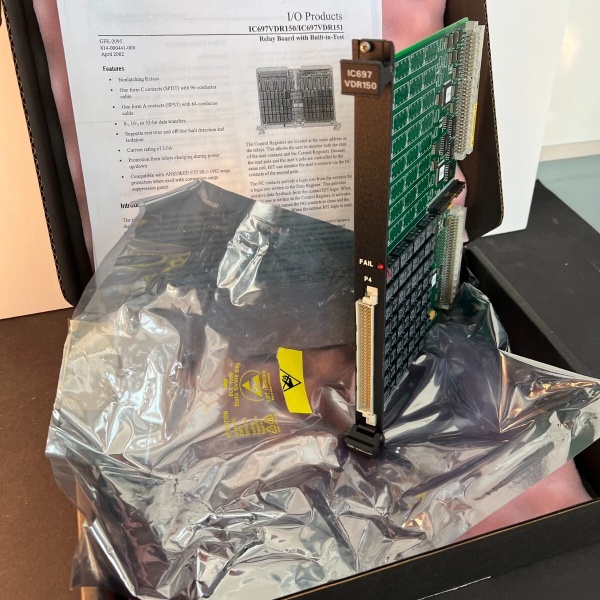
IC697VDR151
Conformal coat cracked—salt fog bridges the coil driver
The board is coated, but the 96-pin edge is masked. If the coat cracks, salt bridges 24 V to 5 V and you cook the driver IC. Scrape the salt, hit the edge with 2100-FTG, and re-coat—problem gone for another decade
The board is coated, but the 96-pin edge is masked. If the coat cracks, salt bridges 24 V to 5 V and you cook the driver IC. Scrape the salt, hit the edge with 2100-FTG, and re-coat—problem gone for another decade
.
Technical Deep Dive & Overview
IC697VDR150 is a 64-relay output slice frozen in 1990s VME silicon. A 5 V logic interface latches the CPU word, drives 32 miniature relays, and reports coil/status back over the VME bus. Because the module is group-isolated and non-latching you can swap it hot—just kill the 24 VDC coil supply first or you’ll arc-weld the 96-pin connectors. Treat the Form-C contacts like precision switches and the card will keep the contactors pulling for another thirty years.
IC697VDR150 is a 64-relay output slice frozen in 1990s VME silicon. A 5 V logic interface latches the CPU word, drives 32 miniature relays, and reports coil/status back over the VME bus. Because the module is group-isolated and non-latching you can swap it hot—just kill the 24 VDC coil supply first or you’ll arc-weld the 96-pin connectors. Treat the Form-C contacts like precision switches and the card will keep the contactors pulling for another thirty years.