Description
Key Technical Specifications
- Model Number: RM7890B1014/U
- Manufacturer: Honeywell Industrial Combustion Controls
- Supply Voltage: 120VAC, 50/60Hz (±10% tolerance)
- Power Consumption: 10VA (nominal); 15VA (peak during ignition)
- Flame Sensor Compatibility: UV cell (standard), cadmium sulfide (CdS), infrared (IR) (with adapter)
- Trial-for-Ignition (TFI) Time: 10 seconds (fixed; non-adjustable)
- Lockout Reset: Manual reset (local button) or remote reset (via external contact)
- Output Contacts: 1 SPDT (Form C) safety interlock contact (10A @ 120VAC resistive)
- Operating Temperature: -40°C to +70°C (-40°F to +158°F)
- Enclosure Rating: NEMA 1 (indoor; panel-mounted); IP20
- Safety Certifications: UL 795, CSA C22.2 No. 213-M1987, FM Approved
- Flame Signal Input: 10–30 microamps (UV cell); 0.5–10 milliamps (CdS/IR)
- Interlock Inputs: 1 dedicated safety interlock input (normally closed)

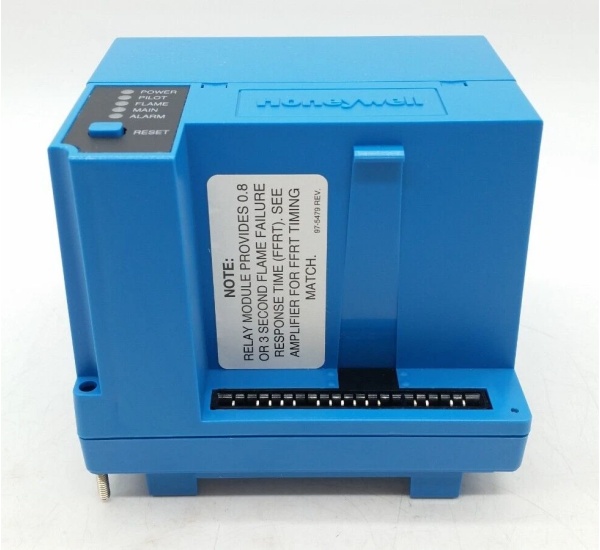
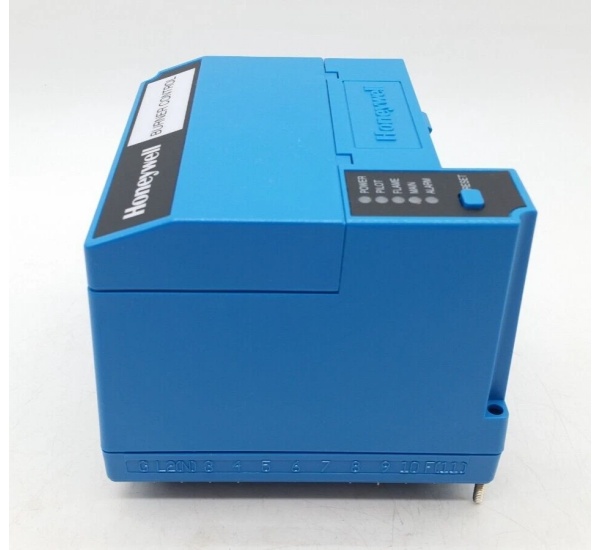
Honeywell RM7890B1014/U
Field Application & Problem Solved
In power plants, refineries, and paper mills, the single biggest risk with industrial burners is unignited fuel buildup—this leads to explosions or flash fires when the fuel finally ignites. Legacy flame controllers often fail to detect weak flames (common in low-NOx burners) or false-trigger lockouts from electrical noise, causing costly downtime. The RM7890B1014/U solves both problems with its robust flame signal processing and fixed safety timing.
You’ll find this controller on every type of single-burner system: package boilers in power plants, process furnaces in refineries, and waste-heat recovery heaters in chemical plants. Its core value is simplicity and reliability—no fancy programming, just hardwired safety logic that works every time. Unlike programmable controllers, it doesn’t require software updates or calibration, which is critical in remote locations where tech support is scarce.
Another critical problem it addresses is multi-fuel flexibility. Plants often switch between natural gas, fuel oil, or biogas depending on cost—this controller works with any flame sensor type, so you don’t need to replace the entire controller when fuel sources change. I’ve seen it installed on 50-year-old boilers and brand-new low-emission burners alike—its compatibility with legacy and modern systems is a huge plus for retrofits.
Installation & Maintenance Pitfalls (Expert Tips)
UV Cell Wiring Must Be Shielded—No Exceptions
Rookies often use unshielded wire for the UV cell connection, which picks up noise from ignition transformers or VFDs. This causes the controller to “see” a false flame (preventing ignition) or lose flame signal (triggering lockout). Use 18-gauge shielded twisted-pair wire, ground the shield at the controller end only, and keep the wire at least 12 inches away from high-voltage ignition wiring. I’ve fixed more “failed” controllers by re-wiring the UV cell than any other issue.
Don’t Bypass the Safety Interlock Input
The dedicated interlock input is for critical safety devices (high-temperature switches, low-fuel pressure switches, draft switches). Techs sometimes jump this input to get the burner running quickly during a shutdown—but this disables the controller’s primary safety layer. If the interlock device trips (e.g., high boiler temperature), the controller won’t shut down the fuel supply, leading to catastrophic overheating. Never bypass this input—fix the underlying interlock fault instead.
Trial-for-Ignition Time Is Non-Adjustable—Plan Accordingly
The 10-second TFI is fixed—you can’t extend it. This is a problem in burners with slow ignition (e.g., heavy fuel oil burners with preheated lines). If the burner doesn’t ignite within 10 seconds, the controller locks out. Rookies often try to “trick” the controller by holding the reset button—this damages the internal relay. Instead, adjust the burner’s ignition system (e.g., increase spark intensity, optimize fuel-air mix) to ensure ignition within 8 seconds (leave 2 seconds of buffer).
Clean the UV Cell Quarterly—Not Annually
UV cells get coated with soot and oil, which reduces their ability to detect flame. I’ve seen controllers lock out because the UV cell was dirty, even though the flame was present. Clean the cell with isopropyl alcohol and a soft brush every 3 months (more often in dirty environments like coal-fired boilers). Don’t use steel wool—this scratches the cell’s window and renders it useless. Always test the cell with a UV test light before reinstalling.
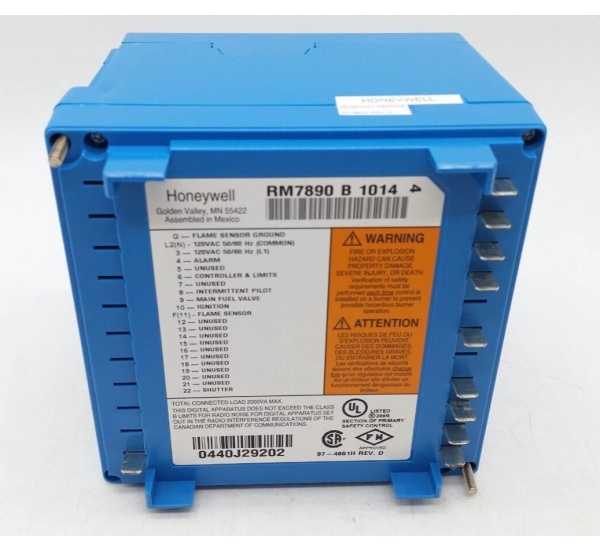
Honeywell RM7890B1014/U
Technical Deep Dive & Overview
The RM7890B1014/U is a hardwired, analog flame safeguard controller—no microprocessors, just discrete electronic components (relays, capacitors, rectifiers) that provide fail-safe operation. Its core function is simple: when the burner is commanded to start, it energizes the ignition system, monitors the flame sensor for a valid signal, and either allows fuel flow (if flame is detected within 10 seconds) or locks out (if not).
The controller’s flame signal processing is passive but effective: it filters out electrical noise using a dedicated noise-suppression circuit (the “/U” suffix denotes the unfiltered version—use only in low-noise environments). For UV cells, it detects the tiny electrical current generated when UV light hits the cell; for CdS/IR sensors, it measures changes in resistance caused by flame light. This multi-sensor compatibility is achieved via a switchable input circuit inside the controller (accessed by removing the front cover).
The safety interlock logic is hardwired: the controller will only initiate ignition if the interlock input is closed (indicating all safety conditions are met). If the flame is lost during operation, the controller immediately de-energizes the safety interlock contact, shutting off the fuel valve and locking out. The manual reset ensures a human acknowledges the fault before restarting—critical for preventing automatic restarts after a dangerous condition.
In the field, this controller’s strength is its lack of complexity. It doesn’t fail due to software glitches or firmware bugs—failures are almost always due to wiring errors, dirty sensors, or power surges. With proper installation and quarterly maintenance, it will run for a decade or more without issues.