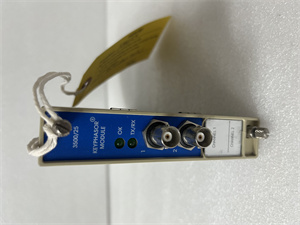
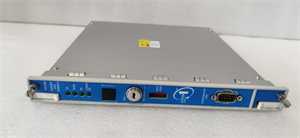
Description
Hard-Numbers: Technical Specifications
-
Processor Architecture: Dual processors with dual memory sets (not quad-core – “Quad” refers to 2oo4D voting in redundant configs)
-
Clock Speed: 1 GHz (PowerPC-based or x86 equivalent, depending on revision)
-
Memory: 1 GB DDR2 SDRAM per processor set; 256 MB Flash storage
-
Diagnostic Coverage: >99% via hardware data-comparators and continuous self-testing
-
Safety Integrity Level: SIL3 capable (single module, no time limitation)
-
Redundancy Architecture: 2oo4D (Two-out-of-Four with Diagnostics) when paired in redundant controller configuration
-
I/O Bus Interface: 4× bus drivers for driving I/O chassis (RMU/IO modules)
-
Communication: Dedicated redundant communication link between paired QPP modules in redundant setups
-
Watchdog Circuit: Hardware watchdog with cycle time verification and voltage monitoring (over/undervoltage detection)
-
Display Interface: Front-panel display showing time, date, system status, diagnostics (language-independent UNICODE support)
-
Operating Temperature: -40°C to +85°C (industrial range)
-
Protection Level: IP20 (standard), IP67 (enhanced variants with conformal coating)
-
Dimensions: 88 mm × 227 mm × 175 mm (3.46″ × 8.94″ × 6.89″)
-
Weight: 0.63 kg (1.39 lbs)
-
Power Requirements: 24V DC typical (derived from Safety Manager rack power)
-
MTBF: >100,000 hours
The Real-World Problem It Solves
Process industries—refineries, chemical plants, offshore platforms—cannot tolerate unplanned releases, explosions, or runaway reactions. Traditional PLCs lack the diagnostic coverage and fault tolerance for safety-critical loops. The FC-QPP-0001 provides a certified safety controller that continuously tests itself, compares dual-processor results in real-time, and forces outputs to a safe state if any internal fault is detected.
Where you’ll typically find it:
-
Emergency Shutdown Systems (ESD) for gas compressor stations and LNG trains
-
Fire and Gas (F&G) detection logic solvers on offshore oil platforms
-
Burner Management Systems (BMS) for boiler and furnace safety interlocks
This module eliminates the “single point of failure” in safety instrumented systems while maintaining the processing power to handle complex cause-and-effect matrices with millisecond response times.

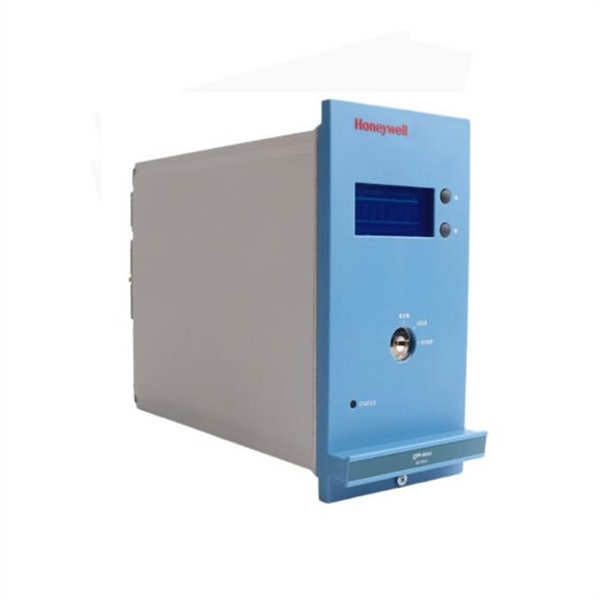
Honeywell FC-QPP-0001
Hardware Architecture & Under-the-Hood Logic
The FC-QPP-0001 functions as the safety brain of the Safety Manager system. Unlike standard PLCs that execute code on a single CPU, this module employs dual processors running in lockstep with hardware comparators verifying every memory read and write operation.
Signal flow and processing logic:
-
Dual-Core Execution: Two independent processors execute the same application logic simultaneously from separate memory sets. Each processor has its own 1 GB DDR2 SDRAM and 256 MB Flash storage.
-
Hardware Comparison: Dedicated data-comparators monitor every read/write action between the processors. If any bit differs between the two execution paths, the watchdog trips immediately.
-
Watchdog Supervision: A hardware watchdog circuit verifies that processors complete tasks within defined cycle times. It monitors data integrity checks on processor memory and validates power supply voltages (detecting both undervoltage and overvoltage conditions).
-
I/O Bus Control: Four independent bus drivers communicate with remote I/O chassis (RMU modules). The QPP reads safety inputs, executes Functional Logic Diagrams (FLDs) created in Safety Builder, and writes to safety outputs.
-
Redundant Synchronization: In 2oo4D configurations, two QPP modules synchronize via a dedicated high-speed link on the controller backplane. They vote on outputs while maintaining independent diagnostic paths.
-
Safe State Enforcement: Regardless of QPP internal state, the system can force safety-critical outputs to their de-energized/failsafe position via independent hardware paths. This ensures outputs go safe even if both processors fail simultaneously.
-
Continuous Self-Test: Additional test hardware achieves >99% diagnostic coverage by exercising memory, buses, and comparators during every scan cycle without impacting application execution.
Field Service Pitfalls: What Rookies Get Wrong
Assuming “Quad” Means Four Processors
The “QPP” designation stands for “Quad Processor Pack,” but this refers to the 2oo4D architecture in redundant configurations—not four cores on one board. A single QPP contains dual processors; a redundant pair creates the four-processor voting system.
-
Field Rule: Verify your safety architecture before ordering spares. A non-redundant Safety Manager needs one QPP. A redundant system needs two identical QPP modules (same firmware revision, same hardware version). Never mix V1.3 and V1.4 boards in the same redundant pair—the comparators will flag version mismatches as faults.
Ignoring the Conformal Coating
The “CC” suffix (FC-QPP-0001 CC) indicates conformal coating for harsh environments. In offshore platforms with salt air or chemical plants with corrosive atmospheres, uncoated boards suffer from dendritic growth between pins within 2-3 years.
-
Quick Fix: Specify FC-QPP-0001 CC V1.4 for marine or corrosive environments. Inspect coated boards under UV light—acrylic coatings fluoresce, revealing pinholes or wear. If you see green copper corrosion around the backplane connectors, replace the board immediately; the coating has failed and moisture has penetrated.
Mishandling the Redundant Link
In 2oo4D configurations, the synchronization link between QPP modules is a dedicated backplane connection—not Ethernet, not a jumper wire. If this link is loose or contaminated, the two QPPs lose synchronization and the system declares a redundancy fault.
-
Field Rule: When replacing a failed QPP in a redundant pair, power down the entire Safety Manager rack. Never “hot-swap” QPP modules—the redundant link initialization requires both units to boot simultaneously. After installation, verify the “SYNC” LED on both modules is solid green before declaring the repair complete. A blinking SYNC indicates the modules are arguing about who is primary; check the backplane connectors for bent pins or corrosion.