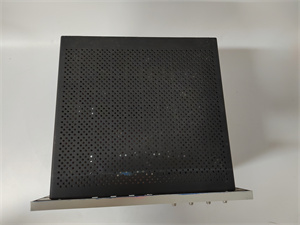
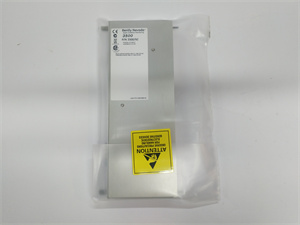
Description
Key Technical Specifications
- Model Number: 8C-TAOXB1 51307137-175
- Manufacturer: Honeywell Process Solutions
- Output Channels: 8 independent isolated 4-20mA current outputs
- Resolution: 16-bit (0.015% of full scale)
- Accuracy: ±0.1% of full scale (20°C operating temperature)
- Power Supply: 24VDC (18–32VDC range), 1.2A max current draw
- Isolation Rating: 2500V AC (channel-to-channel; 1-minute dielectric test); 1500V AC (channel-to-backplane)
- Load Capacity: Up to 600Ω per channel (compatible with most industrial actuators)
- Update Rate: 100ms per channel (scalable via HC900 controller configuration)
- Operating Temperature: -20°C to +60°C (-4°F to +140°F)
- Storage Temperature: -40°C to +85°C (-40°F to +185°F)
- Enclosure Rating: IP20 (panel-mounted for control cabinet installation)
- Certifications: UL 508, CSA C22.2 No. 142, CE, ATEX Zone 2 compliant
Field Application & Problem Solved
In refineries, chemical plants, and power generation facilities, the biggest pain point with analog output modules is cross-channel interference and signal drift—both of which cause actuators to misposition, leading to unstable process loops (e.g., fluctuating reactor temperatures, inconsistent flow rates). Legacy non-isolated AO modules suffer from this when exposed to high electromagnetic interference (EMI) from nearby VFDs or high-voltage equipment. The 8C-TAOXB1 solves this with its 2500V channel-to-channel isolation, which eliminates cross-talk entirely.
You’ll find this module in HC900 DCS installations: controlling control valves on crude distillation columns, adjusting damper positions on boiler air supply systems, and regulating flow meters on chemical injection skids. Its core value is precision and reliability—16-bit resolution ensures that even tiny changes in the controller’s setpoint translate to accurate actuator movements, which is critical for tight process control (e.g., maintaining ±0.5°C in a polymerization reactor). Unlike cheaper modules, it doesn’t drift with temperature changes, so you don’t have to recalibrate it every season.
Another critical problem it addresses is hot-swap capability. During planned maintenance or unplanned module failures, you can replace the 8C-TAOXB1 without shutting down the HC900 controller—this is a lifesaver for continuous processes like natural gas liquefaction, where even a 5-minute shutdown costs six-figure losses. Its redundant power compatibility also means you can hook it up to dual 24VDC supplies, eliminating power as a single point of failure.

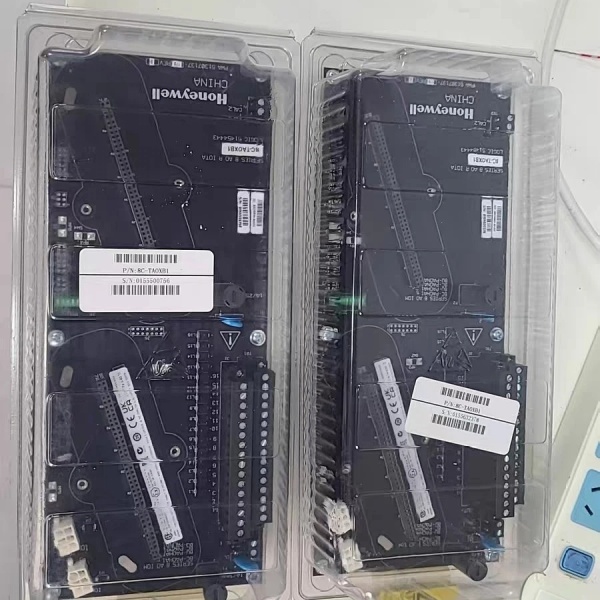
Honeywell 8C-TAOXB1 51307137-175
Installation & Maintenance Pitfalls (Expert Tips)
Load Resistance Limits Are Non-Negotiable
Rookies often connect actuators with loads exceeding 600Ω per channel, which causes the module’s output current to drop below the 4mA minimum. This makes the controller think the actuator is failed, triggering a process alarm. Always calculate the total load resistance (including cable resistance) before wiring—if it exceeds 600Ω, use a signal booster between the module and the actuator. I’ve fixed a failed boiler control loop where a 1000ft cable added 200Ω to a 500Ω actuator, pushing the total load to 700Ω—adding a booster solved the issue instantly.
Isolation Grounding Requires a Single Point
The module’s high isolation rating only works if you ground it correctly. A common mistake is grounding both the module’s chassis and the actuator’s ground—this creates a ground loop, which introduces noise into the 4-20mA signal (visible as a 1–2mA fluctuation on the controller’s HMI). Ground the module at the control cabinet only—leave the actuator’s ground disconnected unless required by local safety codes. Use a dedicated ground bus bar for the module, not the same bar as VFDs or motors.
Calibration Needs a Precision Current Source
Don’t use a multimeter to calibrate this module—multimeters aren’t accurate enough for 16-bit resolution. Invest in a precision current source (±0.01% accuracy) and calibrate each channel at 4mA, 12mA, and 20mA setpoints. Rookies often skip the 12mA midpoint check, which misses linearity errors that cause process instability. Calibrate every 12 months (or every 6 months in harsh environments with high humidity or vibration). Also, always save the calibration data to the HC900 controller’s memory—this makes replacement faster if the module fails.
Hot-Swap Requires Controller Configuration First
The module is hot-swappable, but only if you enable the “hot-swap” setting in the HC900 controller’s configuration software. If you don’t, pulling the module will cause the controller to fault the AO loop, triggering a process shutdown. Before replacing the module, go to the controller’s I/O configuration screen, mark the 8C-TAOXB1 as “hot-swappable,” and confirm the loop is set to “hold last value” during module replacement. I’ve seen a tech yank an unconfigured module during a refinery turnaround, causing a 2-hour shutdown of a gasoline blending unit—don’t repeat that mistake.
Technical Deep Dive & Overview
The 8C-TAOXB1 51307137-175 is an intelligent analog output module designed for the HC900 DCS, with a focus on precision and fault tolerance. At its core, it uses a 16-bit DAC (digital-to-analog converter) per channel, which converts the controller’s digital setpoint into a precise 4-20mA current signal. The 2500V channel-to-channel isolation is achieved via optocouplers and isolated power supplies for each channel—this means a fault in one channel (e.g., a shorted actuator) won’t affect the others, a critical feature for multi-loop process systems.
The module communicates with the HC900 controller via the backplane bus, with a 100ms update rate that ensures real-time control. It also has built-in diagnostic capabilities: it reports open circuits, short circuits, and overloaded channels to the controller’s HMI, so you can troubleshoot without opening the control cabinet. Its redundant power input design allows it to draw power from two separate 24VDC supplies—if one supply fails, the module switches to the other without missing a beat.
Unlike passive AO modules, the 8C-TAOXB1 has on-board firmware that handles signal linearization and temperature compensation—this is why it doesn’t drift with temperature changes. The IP20 rating means it’s meant for indoor control cabinet installation; if you need to mount it in a dusty or humid area, use a NEMA 4X enclosure with forced air cooling. In the field, this module’s reliability comes from its robust design—no moving parts, high isolation, and precise calibration. With proper installation and maintenance, it will run for 5–7 years without a single unplanned failure, making it a staple in critical process control loops.