Description
Key Technical Specifications
-
Model Number: VMIVME-M-485
-
Manufacturer: GE (legacy VMIC), later Abaco Systems
-
Function: Master half of a two-board long-line repeater pair
-
Protocols: RS-485, RS-422, Modbus RTU transparent
-
Propagation Delay: 400 ns @ 5 ft, +4 ns per additional foot
-
Nodes per Segment: 128 (with proper termination)
-
Isolation: 500 V channel-to-bus; differential signaling 1.5 kV surge withstand
-
Addressing: 16-/24-bit VME A16/A24, D08/D16 transfers
-
Interrupts: Supports all 7 VME IRQ levels
-
Connectors: Dual DIN 41612 (front), P2 rear I/O option
-
Form Factor: 6U double-Euro, single-slot VME slave
-
Power: +5 V 0.8 A, +12 V 50 mA from backplane
-
Temp Range: 0 – 55 °C operational, –20 – 85 °C storage

GE VMIVME-7700RC
Field Application & Problem Solved
Refineries stretch RS-485 like taffy. You start with a Modbus RTU flow computer in the DCS rack, then run 600 ft through cable trays shared with 4 kV VFD feeders to a remote analyzer house. By the time the signal reaches the last gas chromatograph the waveform looks like a sine wave and the CRC errors roll in at 3 %.
Refineries stretch RS-485 like taffy. You start with a Modbus RTU flow computer in the DCS rack, then run 600 ft through cable trays shared with 4 kV VFD feeders to a remote analyzer house. By the time the signal reaches the last gas chromatograph the waveform looks like a sine wave and the CRC errors roll in at 3 %.
Drop a VMIVME-M-485 pair in the middle and you just regenerated a clean differential signal. The master board lives in the main VME chassis; the slave board (VMIVME-Repeat-S-485) rides in the remote panel. Together they give you 100 m of new head-room, 128 more nodes, and the 400 ns baseline delay keeps your 38.4 kbaud Modbus timing budget intact. I’ve used this exact set to link a turbine governor rack to a 900 ft-away hydrogen dryer skid—zero retries, even when the 13.8 kV breaker slams shut and ground potential jumps 80 V.
Core value: signal integrity without protocol grief. The repeater is transparent—no address maps, no firmware—so your legacy DCS never knows it exists. You just bought yourself distance and noise immunity for the price of two VME slots.
Installation & Maintenance Pitfalls (Expert Tips)
Termination is still on you
The board regenerates the signal, it doesn’t terminate it. Leave the 120 Ω resistor pack out and the reflection comes right back through the repeater. Install termination at the far end of each segment, not at the repeater ports.
The board regenerates the signal, it doesn’t terminate it. Leave the 120 Ω resistor pack out and the reflection comes right back through the repeater. Install termination at the far end of each segment, not at the repeater ports.
Master/slave order is fixed
M-485 must be the upstream (master-side) board. If you flip the locations the link comes up but the delay asymmetry shifts your bit sample 1 µs—enough to corrupt 115 kbaud. Label the cables “M” and “S” before you pull them through the tray.
M-485 must be the upstream (master-side) board. If you flip the locations the link comes up but the delay asymmetry shifts your bit sample 1 µs—enough to corrupt 115 kbaud. Label the cables “M” and “S” before you pull them through the tray.
Ground loops kill the isolation
Both halves share the same VME ground reference. If you tie the remote chassis safety ground to a different earth stake, surge current will flow down the shield. Run a #12 AWG equipotential bond between cabinets or you’ll blow the 500 V isolation barrier on the first lightning hit.
Both halves share the same VME ground reference. If you tie the remote chassis safety ground to a different earth stake, surge current will flow down the shield. Run a #12 AWG equipotential bond between cabinets or you’ll blow the 500 V isolation barrier on the first lightning hit.
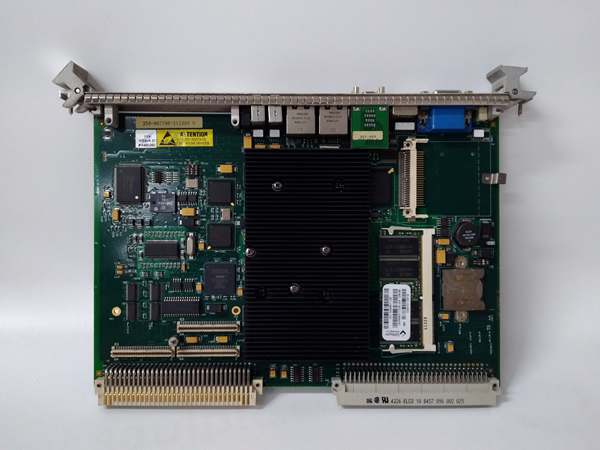
GE VMIVME-7700RC
Propagation math matters at 38.4 k
400 ns sounds tiny, but at 38.4 kbaud one bit is 26 µs. Stack three repeaters and you’ve eaten 1.2 µs—still safe, but budget your cable length so total round-trip delay stays under 40 % of a bit time.
400 ns sounds tiny, but at 38.4 kbaud one bit is 26 µs. Stack three repeaters and you’ve eaten 1.2 µs—still safe, but budget your cable length so total round-trip delay stays under 40 % of a bit time.
DIN jack-screws walk out
Mill vibration loosens the 96-pin connectors. Six months later you get “intermittent comm fail” every time the compressor starts. Hit the jack-screws with a 3 mm hex and Loctite 222 during commissioning—cheapest insurance you’ll ever buy.
Mill vibration loosens the 96-pin connectors. Six months later you get “intermittent comm fail” every time the compressor starts. Hit the jack-screws with a 3 mm hex and Loctite 222 during commissioning—cheapest insurance you’ll ever buy.
Technical Deep Dive & Overview
The VMIVME-M-485 is the master half of a two-board repeater set. Inside is nothing more than a differential line receiver, a clean re-driver, and a 22V10 PLD that qualifies VME access—no UARTs, no FIFO, no firmware to corrupt. The PLD simply latches a control register that enables the drivers and reports cable-fault status. Because the board is completely transparent to the serial bit-stream, it supports any async protocol up to 115.2 kbaud and handles burst traffic without introducing jitter.
The VMIVME-M-485 is the master half of a two-board repeater set. Inside is nothing more than a differential line receiver, a clean re-driver, and a 22V10 PLD that qualifies VME access—no UARTs, no FIFO, no firmware to corrupt. The PLD simply latches a control register that enables the drivers and reports cable-fault status. Because the board is completely transparent to the serial bit-stream, it supports any async protocol up to 115.2 kbaud and handles burst traffic without introducing jitter.