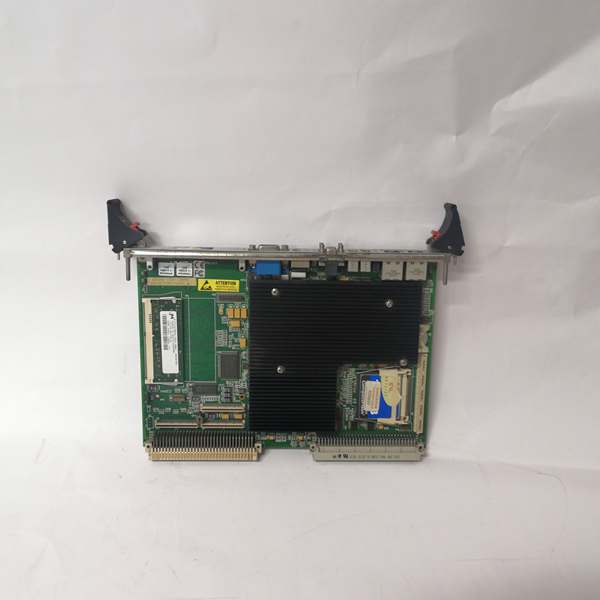
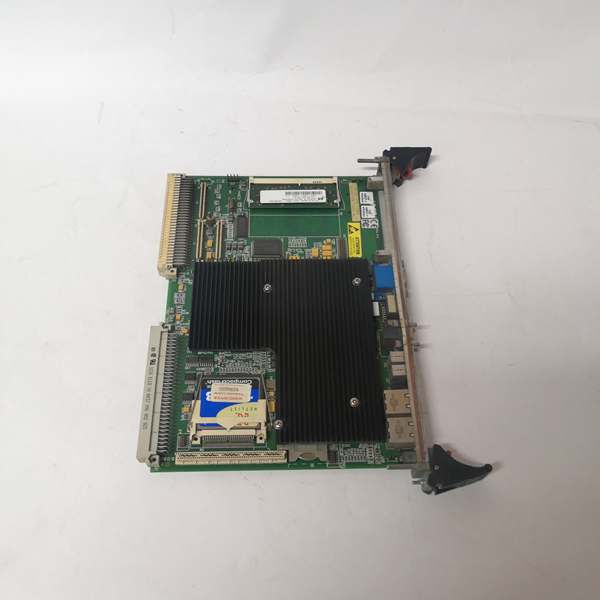
Description
Hard-Numbers: Technical Specifications
-
Processor: Intel Pentium III FC-PGA/PGA2, up to 1.26 GHz
-
L2 Cache: 512 KB Advanced Transfer Cache (on-die, full-speed)
-
System Bus: 133 MHz front-side bus via Intel 815E chipset
-
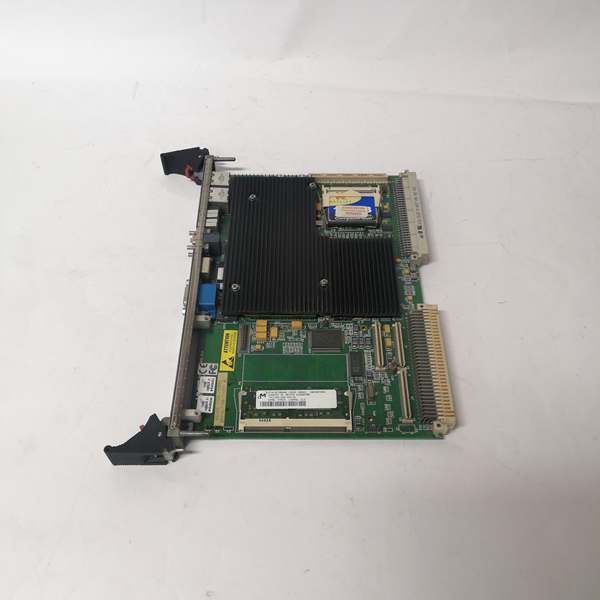
DRAM Memory: One 144-pin SODIMM socket, max 512 MB PC133 SDRAM (dual-ported to VMEbus)
-
Nonvolatile SRAM: 32 KB battery-backed
-
Storage: IDE CompactFlash support up to 1 GB (bootable, secondary IDE channel)
-
Graphics: Intel 815E AGP SVGA controller with 4 MB external synchronous DRAM cache, resolutions up to 1600×1200×256 colors
-
Ethernet: Dual controllers (Intel 82559 + ICH2 integrated), 10BaseT/100BaseTX, RJ45 front panel
-
Serial Ports: 2× RS-232 (16550-compatible, 16-byte FIFO, up to 115.2 kbaud)
-
USB: 2× USB 1.1 ports (front panel)
-
VMEbus Interface: VME64 compliant, supports A32/A24/D32/D16/D08(EO)/MBLT64/BLT32 transfer modes
-
Expansion: One PMC site (IEEE P1386, 5V signaling, front panel I/O)
-
Timers: Two 16-bit + two 32-bit programmable timers (software-accessible)
-
Watchdog: Software-selectable watchdog timer with reset/NMI/SYSFAIL options
-
Operating Temperature: 0°C to 55°C (standard), -20°C to +70°C (extended variants)
-
Power Requirements: +5V DC, +12V DC, -12V DC (VMEbus standard)
-
Form Factor: 6U Eurocard, single-slot, passive heatsink cooling
-
Dimensions: 233.4 mm × 160 mm (standard VME 6U)

GE VMIVME-7750-734
The Real-World Problem It Solves
Legacy industrial systems built in the late 1990s and early 2000s standardized on VMEbus architecture, but needed x86 processing power to run Windows-based HMI software, complex control algorithms, and TCP/IP networking. The VMIVME-7750-734 drops a full Pentium III computer onto a single VME slot, eliminating the need for external PCs while maintaining real-time VMEbus access to I/O modules.
Where you’ll typically find it:
-
Power plant turbine control systems running GE Mark VI or similar DCS platforms
-
Military test benches and simulation racks requiring deterministic VME backplane access
-
Semiconductor fabrication equipment (steppers, etchers) with legacy VME-based motion controllers
This board bridges the gap between desktop software ecosystems and rugged backplane-based I/O, keeping aging critical infrastructure running without full system replacement.
Hardware Architecture & Under-the-Hood Logic
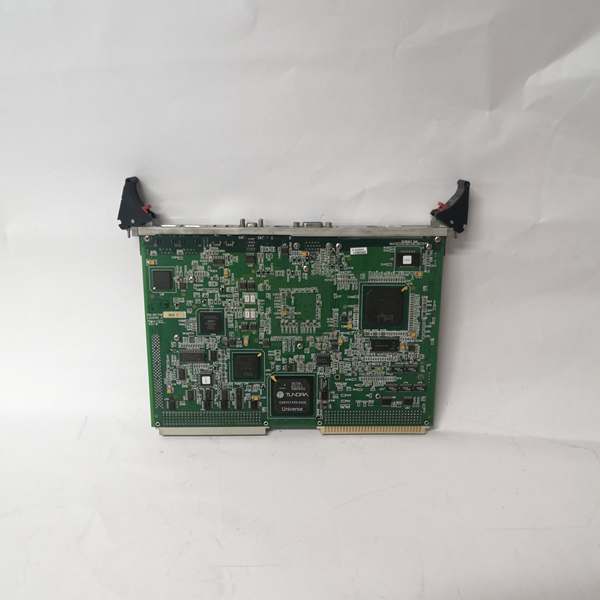
The VMIVME-7750-734 functions as a system controller or peripheral CPU on the VME64 backplane. It does not merely interface—it is the processing node, with the Intel 815E chipset handling memory/graphics while a Tundra Universe IIB PCI-to-VME bridge manages backplane transactions.
Signal flow and processing logic:
-
CPU Core: Pentium III executes instructions from SDRAM or on-board flash, with 32-bit addressing and 64-bit data bus width. The 512KB L2 cache runs at core speed, reducing main memory latency for real-time loops.
-
Memory Architecture: The 144-pin SODIMM connects to the 815E memory controller. Critically, this DRAM is dual-ported—the CPU accesses it normally, while the VME bridge can DMA data directly to/from memory without processor intervention.
-
VMEbus Bridge: The Universe IIB chip translates PCI cycles to VME64 protocols. It handles arbitration, interrupt handling (IACK daisy-chain), and block transfers (BLT32/MBLT64) for high-speed data acquisition.
-
Endian Conversion: Patent-protected hardware (US 6,032,212) performs real-time byte swapping between little-endian x86 and big-endian VME devices—no software overhead.
-
System Controller Mode: When jumpered as Slot 1, the board generates SYSCLK, arbitrates bus requests (round-robin or priority), and monitors bus timeouts (16µs or 256µs programmable).
-
I/O Subsystem: The 815E ICH2 southbridge provides IDE (CompactFlash), USB, and Ethernet MAC interfaces. Dual Intel PHYs give redundant network paths for remote booting or failover.
GE VMIVME-7750-734
Field Service Pitfalls: What Rookies Get Wrong
Forgetting the CMOS Battery
The 32KB NVSRAM and real-time clock rely on a lithium battery. After 10+ years in service, these fail. When the battery dies, BIOS settings reset to default and the board may fail to boot from CompactFlash.
-
Field Rule: Replace the battery before it fails. Document the BIOS settings (boot order, VME arbitration mode, endian configuration) and store backups. Use a hot-swappable battery holder if the chassis allows safe access.
Improper VME Termination
The VMIVME-7750-734 can act as system controller, but only one board per chassis should hold that role. Two controllers fighting for SYSCLK generation creates intermittent bus errors that look like software bugs.
-
Quick Fix: Check the SYSEN jumper. If this board is in Slot 1, enable system controller mode. If not, disable it. Verify with a scope that SYSCLK is clean (16MHz or 25MHz depending on chassis) before blaming the CPU.
PMC Module Power Draw
The PMC expansion site provides 5V at limited current. Many third-party PMC cards (especially those with FPGAs or additional processors) exceed the 15W-25W budget available through the VME P1/P2 connectors.
-
Field Rule: Calculate total 5V load before installing PMC modules. If the board randomly resets under load, measure the 5V rail at the PMC connector. If it sags below 4.75V during VME block transfers, the PMC is starving the CPU. Add external PMC power or choose a lower-draw card.