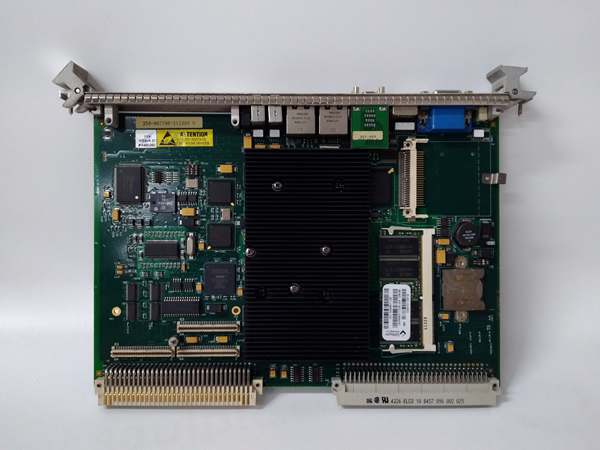
Description
Key Technical Specifications
-
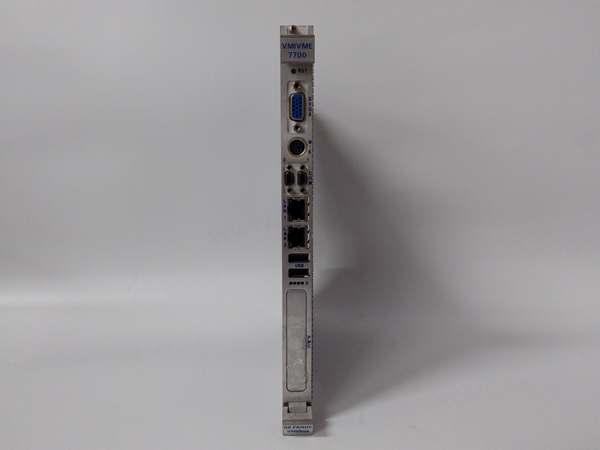
Model Number: VMIVME-7697
-
Manufacturer: GE (ex-VMIC)
-
CPU: Intel Pentium III 233–500 MHz (board rev dependent)
-
Memory: 128 KB battery-backed SRAM; 8–128 MB SDRAM DIMM
-
Flash Disk: On-board 8–32 MB IDE-compatible flash drive
-
Watchdog: 16-bit down-counter, 1 ms resolution
-
Alarm Routing: Jumper J18 selects Reset or NMI on timeout
-
Interrupts: VME IRQ 1-7, NMI mapped to IRQ2, maskable in BIOS
-
VME: A16/A24/A32, D08/D16/D32, VME64 slave & master
-
I/O: 1× RS-232, 1× LPT, USB 1.1, 10/100 Ethernet (late rev)
-
Power: +5 V @ 4 A, +12 V @ 200 mA typical

GE VMIVME-7700RC
Field Application & Problem Solved
Power-plant DCS racks hate mystery reboots. When a VME CPU locks, operators lose the HMI, the log file is empty, and you’re crawling through 19-inch cabinets at 2 a.m. looking for a smoking gun. The VMIVME-7697 gives you a built-in bloodhound: a hardware watchdog that either resets the CPU or fires an NMI so your crash handler can dump RAM to battery-backed SRAM before the box dies.
Power-plant DCS racks hate mystery reboots. When a VME CPU locks, operators lose the HMI, the log file is empty, and you’re crawling through 19-inch cabinets at 2 a.m. looking for a smoking gun. The VMIVME-7697 gives you a built-in bloodhound: a hardware watchdog that either resets the CPU or fires an NMI so your crash handler can dump RAM to battery-backed SRAM before the box dies.
I’ve used this exact board on a turbine lube-oil node. Watchdog timeout was set to 500 ms; when a task missed its deadline the board issued NMI, the ISR wrote 256 bytes of stack to battery SRAM, then forced a reset. We pulled the SRAM data on next boot and found the pointer corruption that caused the miss—fixed the bug and never lost the frame again.
Core value: deterministic fault capture. You get a logged alarm and a controlled restart instead of a silent freeze, so the control room keeps its view and you keep your sanity.
Installation & Maintenance Pitfalls (Expert Tips)
Watchdog timeout is power-on default disabled
BIOS leaves the counter stopped. If you expect protection, your boot code must write the timeout value and set WD_TE (timer enable) or the board will sit there forever while your tasks drift.
BIOS leaves the counter stopped. If you expect protection, your boot code must write the timeout value and set WD_TE (timer enable) or the board will sit there forever while your tasks drift.
J18 jumper chooses fatal vs diagnostic
Position 1-2 = reset CPU (quick recovery, no log).
Position 2-3 = route to NMI (lets firmware dump context).
Choose before you button up—changing it later means pulling the card.
Position 1-2 = reset CPU (quick recovery, no log).
Position 2-3 = route to NMI (lets firmware dump context).
Choose before you button up—changing it later means pulling the card.
NMI vector must be claimed early
VMIC routes NMI to IRQ2. If your OS doesn’t install a handler, the default BIOS handler just beeps and hangs. Install your dump routine in real mode before enabling protected mode or you’ll lose the crash signature.
VMIC routes NMI to IRQ2. If your OS doesn’t install a handler, the default BIOS handler just beeps and hangs. Install your dump routine in real mode before enabling protected mode or you’ll lose the crash signature.
Battery SRAM is not infinite
128 KB sounds big until you dump full registers + 4 MB RAM image. Limit the dump to 64 KB and checksum the rest; otherwise you’ll overwrite the battery-backed area and lose the last alarm on power-loss.
128 KB sounds big until you dump full registers + 4 MB RAM image. Limit the dump to 64 KB and checksum the rest; otherwise you’ll overwrite the battery-backed area and lose the last alarm on power-loss.
Flash disk wears after 100 k writes
The on-board IDE flash is handy for logs but it’s NOR flash with 100 k erase cycles. Rotate files or mount it read-only after boot; otherwise your alarm log will brick the chip in two years of cyclic writes.
The on-board IDE flash is handy for logs but it’s NOR flash with 100 k erase cycles. Rotate files or mount it read-only after boot; otherwise your alarm log will brick the chip in two years of cyclic writes.
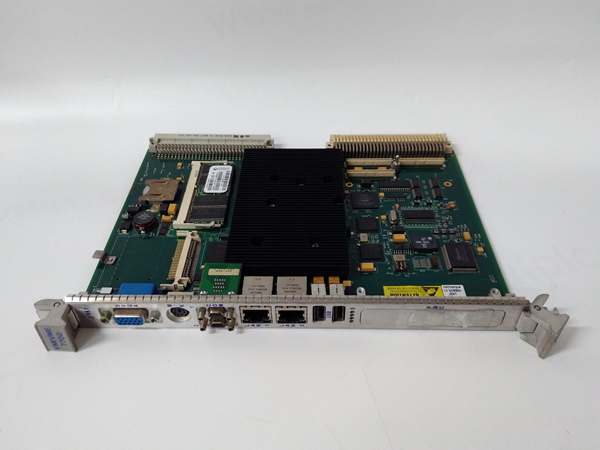
GE VMIVME-7700RC
Technical Deep Dive & Overview
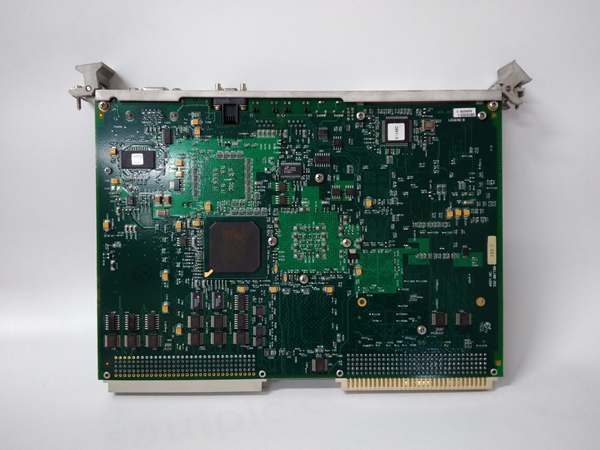
The 7697 is a Pentium III SBC with an on-board 16-bit watchdog timer. When the count expires, hardware can either pulse the reset line or drive NMI (jumper J18). An NMI ISR can copy critical data to 128 KB battery-backed SRAM before reset, giving you a black-box trace. Timer control registers live at PCI I/O offset +40; flags are cleared on read, so the ISR must snapshot WD_WAF (watchdog alarm flag) before re-arming. Because the timer runs off the 1 ms PCI clock, resolution is 1 ms with maximum timeout 65.5 s—plenty for 10 ms control loops yet long enough for debug builds.
The 7697 is a Pentium III SBC with an on-board 16-bit watchdog timer. When the count expires, hardware can either pulse the reset line or drive NMI (jumper J18). An NMI ISR can copy critical data to 128 KB battery-backed SRAM before reset, giving you a black-box trace. Timer control registers live at PCI I/O offset +40; flags are cleared on read, so the ISR must snapshot WD_WAF (watchdog alarm flag) before re-arming. Because the timer runs off the 1 ms PCI clock, resolution is 1 ms with maximum timeout 65.5 s—plenty for 10 ms control loops yet long enough for debug builds.