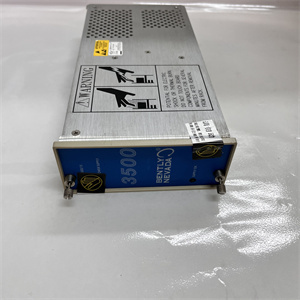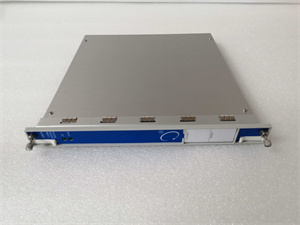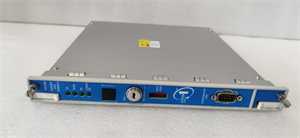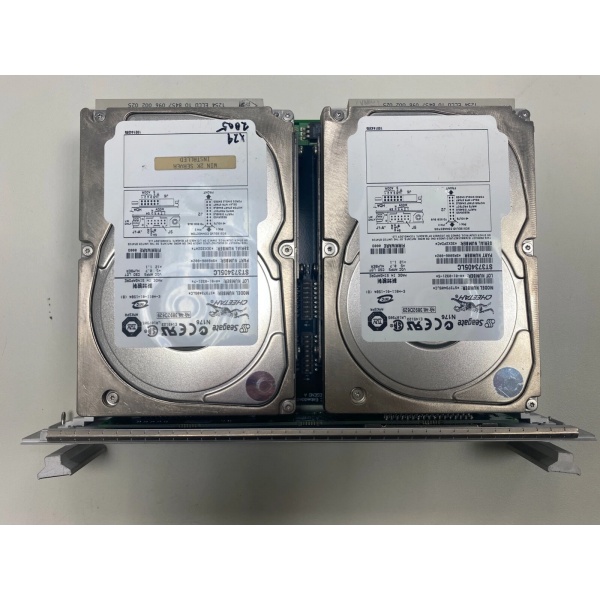
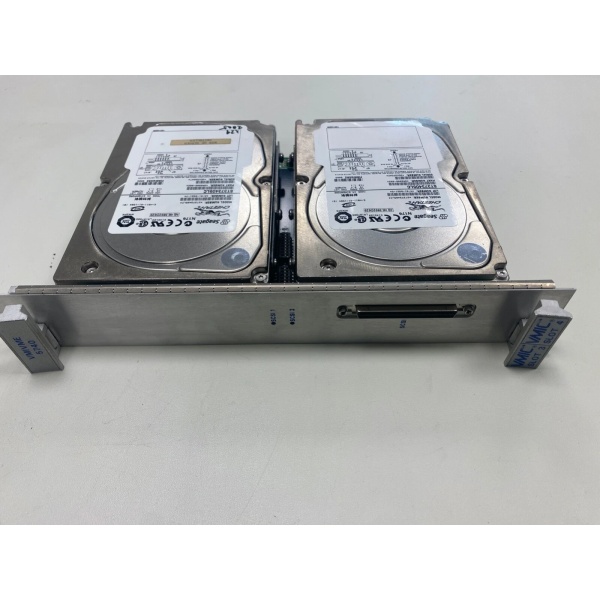
Description
Key Technical Specifications
-
Model Number: VMIVME-5740
-
Manufacturer: GE (legacy VMIC)
-
Serial Build: 12 independent ports, software-select RS-232/422/485, 2-wire/4-wire
-
Data Rate: 300 bps – 921.6 kbps
-
FIFO: 512 B TX / 512 B RX per port
-
Isolation: 2.5 kVrms port-to-bus; 100 m copper, 10 km with fiber media converter
-
-
SCSI Build: Dual SCA-2 80-pin internal, Ultra320 LVD
-
Transfer Rate: 320 MB/s synchronous
-
Capacity: Up to 147 GB (2 × 73.4 GB) 3.5″ drives
-
Front: HD68 SCSI connector, active termination, ID DIP switch
-
-
VME Bus: A32/A24/A16, D32/D16, interrupt & DMA, VME64 compliant
-
Power: ±5 V @ 180 mA (serial logic) +24 V @ 400 mA (serial isolation) or +5 V @ 2 A (SCSI)
-
Environment: -40 … +70 °C operating, 10 g vibration, 50 g shock
-
Form Factor: 6U single-slot VME64 slave

VMIVME-5740
Field Application & Problem Solved
Steel-mill visual-inspection lines need three things fast: image coordinates from 921 kbps RS-422 cameras, thickness data from RS-485 lasers, and a way to stuff it all into the existing VME rack without adding four different serial cards. Drop in a serial-flavor VMIVME-5740 and you just flattened the problem: 12 ports, software-switchable protocol, 2.5 kV isolation so the 480 V VFD ground shift doesn’t crawl into the CPU, and DMA to keep the 7750 CPU free for defect algorithms.
Steel-mill visual-inspection lines need three things fast: image coordinates from 921 kbps RS-422 cameras, thickness data from RS-485 lasers, and a way to stuff it all into the existing VME rack without adding four different serial cards. Drop in a serial-flavor VMIVME-5740 and you just flattened the problem: 12 ports, software-switchable protocol, 2.5 kV isolation so the 480 V VFD ground shift doesn’t crawl into the CPU, and DMA to keep the 7750 CPU free for defect algorithms.
On the storage side, nuclear DCS nodes hate external SCSI boxes—more fans, more failure points. The SCSI build of the 5740 bolts two 73 GB Ultra320 drives directly to the VME crate, 320 MB/s burst, active termination, and the front HD68 lets you plug a portable for quick log dumps. I’ve used the SCSI variant on a 7FA turbine black-box: no external chassis, no extra power supplies, and the vibration rating survived 8 g inside the skid.
Core value: one slot, two radically different jobs—either dense serial I/O or high-speed onboard storage—both with industrial-grade isolation and temperature specs.
Installation & Maintenance Pitfalls (Expert Tips)
Serial vs. SCSI is factory build
You order either personality; there is no field swap. If you need both functions buy two cards—don’t try to re-work the PCB or you’ll lose the isolation barrier and the warranty.
You order either personality; there is no field swap. If you need both functions buy two cards—don’t try to re-work the PCB or you’ll lose the isolation barrier and the warranty.
24 V supply is mandatory for serial
The ±5 V from VME only feeds the logic; port isolation runs from +24 V. Forget the 24 V feed and the ports simply won’t transmit—no error flag, just dead silence. Land 24 V on the front connector before you close the cabinet.
The ±5 V from VME only feeds the logic; port isolation runs from +24 V. Forget the 24 V feed and the ports simply won’t transmit—no error flag, just dead silence. Land 24 V on the front connector before you close the cabinet.
921 kbps needs short stubs
At 921.6 kbps RS-485 the reflection budget is razor-thin. Keep stub length < 30 cm or terminate the device on the spot; otherwise you’ll chase CRC errors that look like device flaws.
At 921.6 kbps RS-485 the reflection budget is razor-thin. Keep stub length < 30 cm or terminate the device on the spot; otherwise you’ll chase CRC errors that look like device flaws.
SCSI cable length is 1 m max internal
Ultra320 timing is tight—if you sub in longer ribbon to reach drives deeper in the crate you drop to Ultra160. Use the supplied 30 cm SCA-2 cable and mount the drives adjacent to the card.
Ultra320 timing is tight—if you sub in longer ribbon to reach drives deeper in the crate you drop to Ultra160. Use the supplied 30 cm SCA-2 cable and mount the drives adjacent to the card.
Front HD68 is hot-pluggable but not hot-swappable
You can plug a portable drive without shutting down VME, but you must quiesce the SCSI bus first (halt the CPU or issue a bus-free command). Blind-plug while the bus is active and you’ll wedge the whole chain.
You can plug a portable drive without shutting down VME, but you must quiesce the SCSI bus first (halt the CPU or issue a bus-free command). Blind-plug while the bus is active and you’ll wedge the whole chain.
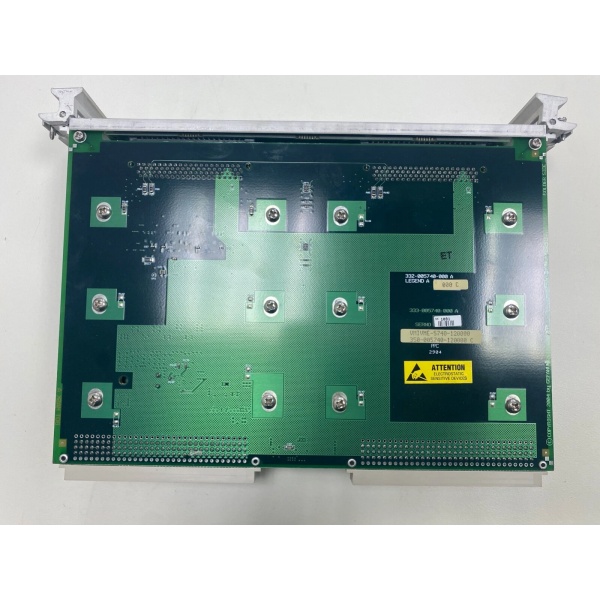
VMIVME-5740
Technical Deep Dive & Overview
The 5740 is two completely different boards sharing a PCB footprint and VME slave interface. Serial flavor: 12 UARTs behind 2.5 kV opto-isolators, 512-byte FIFOs, DMA engine, and a PLD that qualifies VME cycles. SCSI flavor: LVD SCSI controller, dual SCA-2 connectors, active termination, and a front HD68 for external access. Both use the same A32/A24/A16 decoder, so the CPU sees either a COM port array or a disk controller—no custom drivers, just standard VME peek/poke or off-the-shelf SCSI stack. Industrial temperature, 10 g vibration, and 50 g shock mean it lives where fans and external boxes die.
The 5740 is two completely different boards sharing a PCB footprint and VME slave interface. Serial flavor: 12 UARTs behind 2.5 kV opto-isolators, 512-byte FIFOs, DMA engine, and a PLD that qualifies VME cycles. SCSI flavor: LVD SCSI controller, dual SCA-2 connectors, active termination, and a front HD68 for external access. Both use the same A32/A24/A16 decoder, so the CPU sees either a COM port array or a disk controller—no custom drivers, just standard VME peek/poke or off-the-shelf SCSI stack. Industrial temperature, 10 g vibration, and 50 g shock mean it lives where fans and external boxes die.