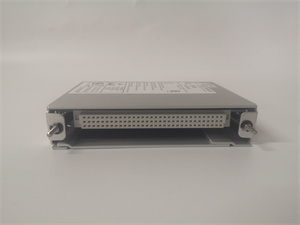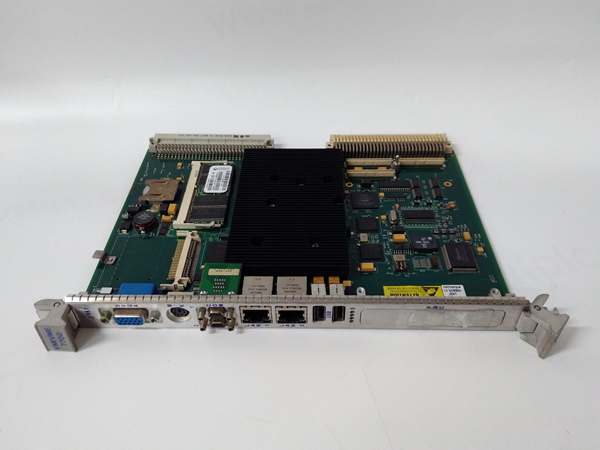
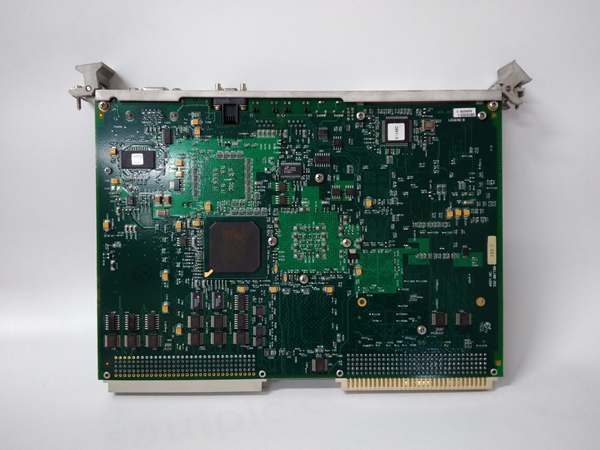
Description
Key Technical Specifications
-
Model Number: VMIVME-4140
-
Manufacturer: GE Fanuc / VMIC (General Electric)
-
Channels: 16 isolated differential inputs (RTD 3/4-wire, TC J/K/T/E, ±10 V, 0-25 mA)
-
Resolution: 16-bit (±0.015 % accuracy)
-
Sampling Rate: 200 kS/s per channel continuous; burst 1 MS/s
-
Isolation: 5 kVrms channel-to-bus; 500 V channel-to-channel
-
Excitation: 2/5/10 mA RTD; 2.5 V TC cold-junction compensation
-
Input Protection: ±30 V continuous, 60 V transient; MOV clamping
-
Built-in-Test: Auto-zero & self-test; BIT LED & status register
-
Communication: VME64x slave; DMA to dual-port RAM
-
Operating Temperature: –55 °C…+125 °C (MIL-STD-810G)
-
Form Factor: 6U single-slot VME64x
-
MTBF: 450 000 h
-
Status: Factory discontinued – new & tested spares available

GE VMIVME-7700RC
Field Application & Problem Solved
In combined-cycle plants the biggest headache is catching a 0.1 °C drift on a bearing RTD or a 0.05 mA shift on a governor servo without running external signal conditioners. The board solves that by living in the VME crate: it excites the RTD, cold-junction compensates the thermocouple, and dumps 16 samples into dual-port RAM every 5 µs. You’ll typically find one per EX2100 or test-cell rack where ±0.015 % accuracy on 690 V bus voltage and 4-20 mA servo pressure is required in the same scan. Core value: it collapses 16 isolated ADCs, anti-alias filters, surge clamps, and auto-zero logic into one card you can swap while the turbine is on turning gear
In combined-cycle plants the biggest headache is catching a 0.1 °C drift on a bearing RTD or a 0.05 mA shift on a governor servo without running external signal conditioners. The board solves that by living in the VME crate: it excites the RTD, cold-junction compensates the thermocouple, and dumps 16 samples into dual-port RAM every 5 µs. You’ll typically find one per EX2100 or test-cell rack where ±0.015 % accuracy on 690 V bus voltage and 4-20 mA servo pressure is required in the same scan. Core value: it collapses 16 isolated ADCs, anti-alias filters, surge clamps, and auto-zero logic into one card you can swap while the turbine is on turning gear
.
Installation & Maintenance Pitfalls (Expert Tips)
RTD Excitation Must Match Sensor—Don’t Guess
Factory default is 2 mA. If you land a 1 mA thin-film RTD the self-heating drifts 0.3 °C. Use ToolboxST to set 0.5 mA for thin-film or you’ll chase phantom overtemperature trips
Factory default is 2 mA. If you land a 1 mA thin-film RTD the self-heating drifts 0.3 °C. Use ToolboxST to set 0.5 mA for thin-film or you’ll chase phantom overtemperature trips
.
Burst Mode Heats the Card—Add Airflow Above 60 °C
At 1 MS/s the on-board regulators climb 15 °C. If your cabinet runs > 60 °C add a 24 VDC muffin fan or the thermal sensor throttles the ADC and you lose samples.
At 1 MS/s the on-board regulators climb 15 °C. If your cabinet runs > 60 °C add a 24 VDC muffin fan or the thermal sensor throttles the ADC and you lose samples.
P2 Connector Works Loose with Vibration
The 160-pin VME P2 connector is held by two screws; if you forget to tighten them the card creeps out and you lose half the channels on the next start-up. Torque screws to 0.4 Nm and tug-test the rear panel.
The 160-pin VME P2 connector is held by two screws; if you forget to tighten them the card creeps out and you lose half the channels on the next start-up. Torque screws to 0.4 Nm and tug-test the rear panel.
Spare Lead-Time Is 6-8 Weeks—Keep One on the Shelf
Factory stock is gone; new & tested spares are available but not overnight. If you crack a layer or burn the RJ-45 you’ll be down until the part arrives—keep one in stores or you’ll discover the weakness during the next grid event
Factory stock is gone; new & tested spares are available but not overnight. If you crack a layer or burn the RJ-45 you’ll be down until the part arrives—keep one in stores or you’ll discover the weakness during the next grid event
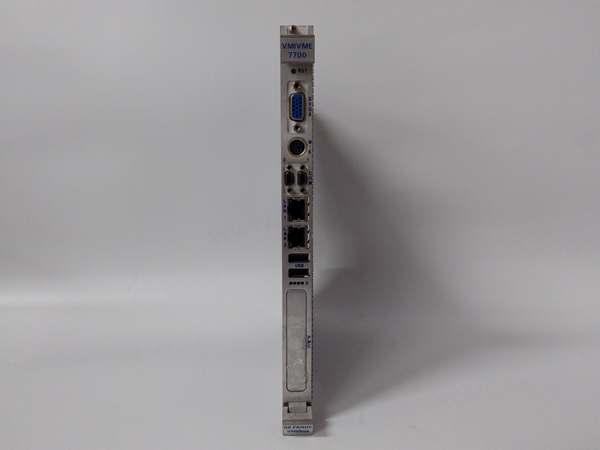
GE VMIVME-7700RC
.
Technical Deep Dive & Overview
Internally the card is a 16-bit SAR ADC bolted to a 16-channel multiplexer and a dual-port FIFO. The FPGA handles autoscan timing; the VME master reads 16 samples in one 64-bit cycle. Lose the 5 V rail and the card goes dark, the FIFO empties, and the CPU throws “ADC TIMEOUT” within 50 ms. Swap takes two minutes: pull the old card, slide the new one in until the ejectors latch, and the crate sees all channels again—no software reload required
Internally the card is a 16-bit SAR ADC bolted to a 16-channel multiplexer and a dual-port FIFO. The FPGA handles autoscan timing; the VME master reads 16 samples in one 64-bit cycle. Lose the 5 V rail and the card goes dark, the FIFO empties, and the CPU throws “ADC TIMEOUT” within 50 ms. Swap takes two minutes: pull the old card, slide the new one in until the ejectors latch, and the crate sees all channels again—no software reload required
.