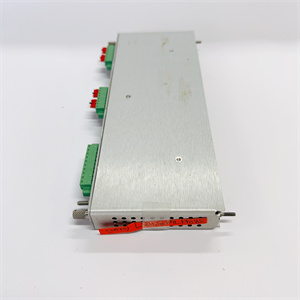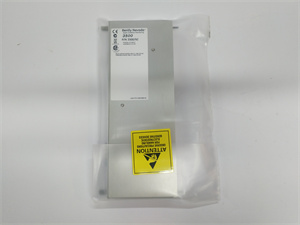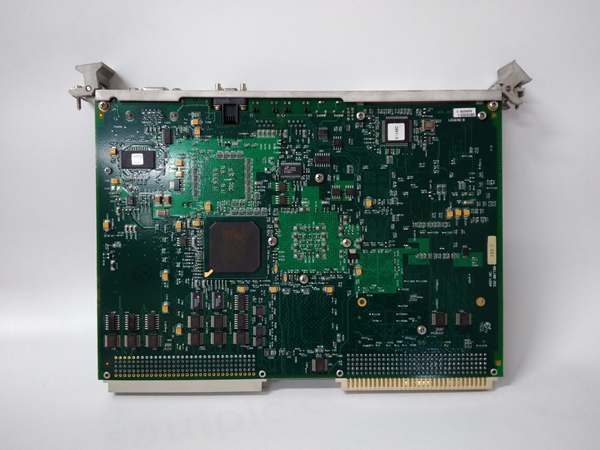
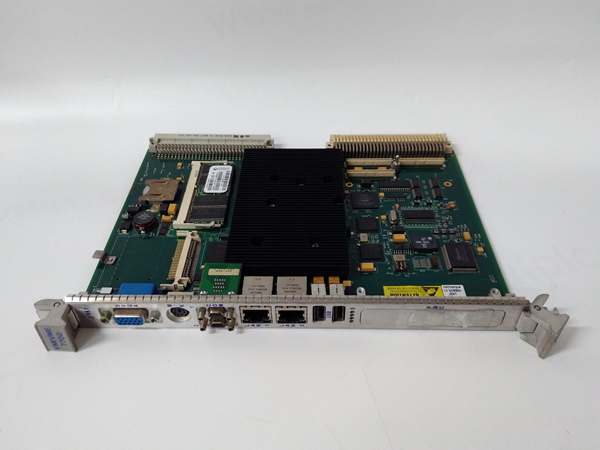
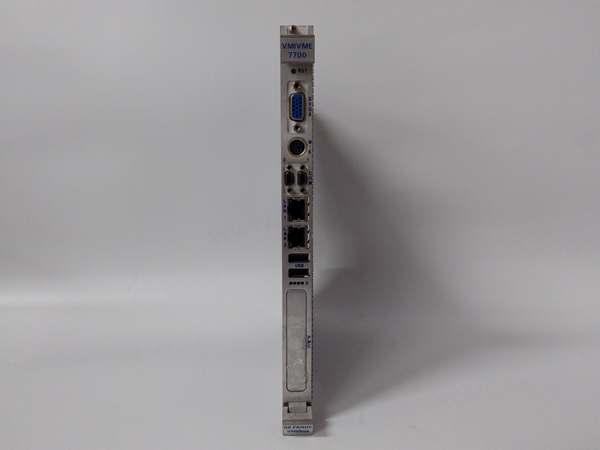
Description
Key Technical Specifications
-
Model Number: VMIVME-4132
-
Manufacturer: GE (legacy VMIC)
-
Resolution: 12-bit monotonic
-
Channels: 32 analog outputs, jumper-select 4-16-32 active
-
Output Range: 0-5 V, 0-10 V, ±2.5 V, ±5 V, ±10 V (jumper)
-
Drive Current: 10 mA source/sink over full range
-
Settling Time: 8 µs to 1 LSB
-
Accuracy: ±0.05 % FSR gain, ±0.025 % FSR offset
-
Output Impedance: 0.1 Ω
-
Protection: Short-circuit & transient protected; output switch per channel
-
BIT: On-board 12-bit ADC loops back any channel for self-test
-
Connectors: Front-panel 64-pin DIN; optional discrete-wire interface (-010)
-
Power: +5 V @ 2.5 A typ., 3.6 A max
-
Form Factor: 6U double-Euro, single-slot VME slave, A16 short I/O

GE VMIVME-7700RC
Field Application & Problem Solved
Steam-turbine inlet valves still want analog set-points: 0-10 V to the electro-hydraulic servo, ±10 V to the governor trim. Old racks solved it with four 4-channel DACs, each with its own trim-pot drift. Drop in one VMIVME-4132 and you just flattened the problem: up to 32 channels, double-buffered so you can load new values then hit a single strobe for glitch-free transfer. I’ve used this exact card on a 7FA gas-turbine inlet-guide-vane loop: 10 valves, one slot, simultaneous update, and the on-board ADC looped the signal back for closed-loop verification—no extra test cables, no calibration drift after five years.
Steam-turbine inlet valves still want analog set-points: 0-10 V to the electro-hydraulic servo, ±10 V to the governor trim. Old racks solved it with four 4-channel DACs, each with its own trim-pot drift. Drop in one VMIVME-4132 and you just flattened the problem: up to 32 channels, double-buffered so you can load new values then hit a single strobe for glitch-free transfer. I’ve used this exact card on a 7FA gas-turbine inlet-guide-vane loop: 10 valves, one slot, simultaneous update, and the on-board ADC looped the signal back for closed-loop verification—no extra test cables, no calibration drift after five years.
Core value: density plus accuracy. You get 12-bit resolution, 8 µs settling, and the BIT loop tells you if a channel drifts before the valve hunts.
Installation & Maintenance Pitfalls (Expert Tips)
Channel count is jumper-hard
Board ships 32-channel; move W1-W4 to 4, 8, 16 if you need fewer. Forget the jumper and unused channels float random—looks like a calibration error.
Board ships 32-channel; move W1-W4 to 4, 8, 16 if you need fewer. Forget the jumper and unused channels float random—looks like a calibration error.
Output switch is software-controlled
At power-up all output switches are open—field sees high-Z. If your servo amp wants a known zero on boot, write zeros then close switches in your init script or add external pull-downs.
At power-up all output switches are open—field sees high-Z. If your servo amp wants a known zero on boot, write zeros then close switches in your init script or add external pull-downs.
10 mA is max
Each output is short-circuit protected but folds back above 10 mA. A 1 kΩ servo input pulls 10 mA at 10 V—right at the limit. Check load impedance before you land wires.
Each output is short-circuit protected but folds back above 10 mA. A 1 kΩ servo input pulls 10 mA at 10 V—right at the limit. Check load impedance before you land wires.
BIT loop-back is not field wiring
The on-board ADC only tests the buffer output, not the field cable. For safety-critical loops, loop the front-panel pin back to an external ADC or prove the valve position with a second sensor.
The on-board ADC only tests the buffer output, not the field cable. For safety-critical loops, loop the front-panel pin back to an external ADC or prove the valve position with a second sensor.
Front-panel LEDs lie on over-current
LED stays green even if the channel is current-limited. If your calibration sheet shows 0.5 % low, scope the output under load—if it’s clipping at 10 mA the LED won’t tell you.
LED stays green even if the channel is current-limited. If your calibration sheet shows 0.5 % low, scope the output under load—if it’s clipping at 10 mA the LED won’t tell you.
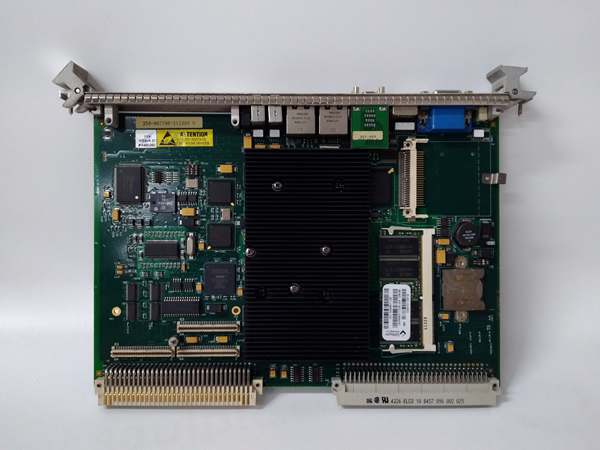
GE VMIVME-7700RC
Technical Deep Dive & Overview
The 4132 is a bank of 12-bit DACs feeding Burr-Brown 3582 output amplifiers. A 22V10 PLD decodes the short I/O address, latches data into double-buffered registers, and strobes simultaneous update. An on-board 12-bit ADC with multiplexers can loop any channel back for self-test—no external input card needed. Output switches disconnect the buffer from the field under software control, so you can hot-swap a servo without dragging down the rest of the loop. Simple, deterministic, and bullet-proof—exactly what you want when the turbine wants 32 analog commands yesterday.
The 4132 is a bank of 12-bit DACs feeding Burr-Brown 3582 output amplifiers. A 22V10 PLD decodes the short I/O address, latches data into double-buffered registers, and strobes simultaneous update. An on-board 12-bit ADC with multiplexers can loop any channel back for self-test—no external input card needed. Output switches disconnect the buffer from the field under software control, so you can hot-swap a servo without dragging down the rest of the loop. Simple, deterministic, and bullet-proof—exactly what you want when the turbine wants 32 analog commands yesterday.