Description
Key Technical Specifications
-
Model Number: VMIVME-2532A
-
Manufacturer: GE (ex-VMIC), later Abaco Systems
-
I/O Count: 32 bits, jumpered per 8-bit nibble as in or out
-
Voltage Range: 5 – 48 VDC field side
-
Current: 600 mA sink/source per bit
-
Clamp: 70 V transient clamp diodes on all outputs
-
Data Transfer: 8- or 16-bit VME D08/D16 slave cycles
-
Isolation: 500 V channel-to-bus (opto)
-
BIT: Off-line and real-time self-test, front-panel FAIL LED
-
Test Jumpers: Optional 100 % output-driver test points
-
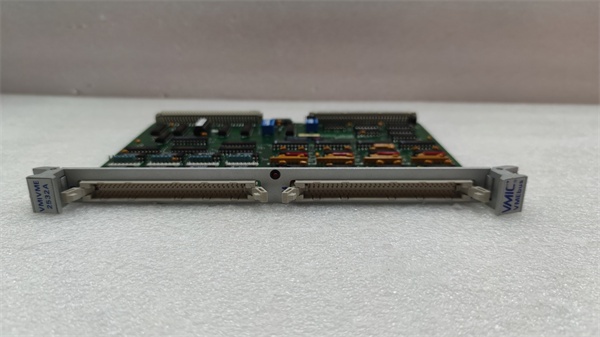
Connectors: Front-panel 96-pin DIN 41612; rear I/O via P2
-
Power: +5 V @ 1 A typical (all outputs on), +12 V 50 mA for BIT
-
Form Factor: 6U single-slot VME, A16/A24 address space

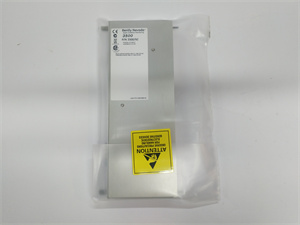
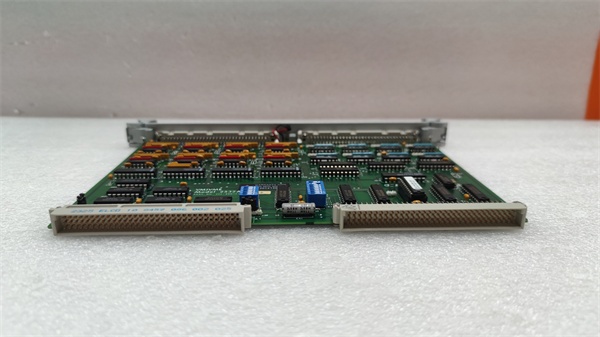
GE VMIVME-2532A
Field Application & Problem Solved
Co-gen turbine skids mix voltages like a junk drawer—12 V pilot lights, 24 V solenoids, 48 V battery trips—and the DCS needs to read them back for position feedback. Old panels solved it with three different cards and a fistful of interposing relays. Drop in one VMIVME-2532A, set nibbles as input or output with a jumper, and you just flattened the problem: 32 lines that can sink or source 600 mA, survive 70 V spikes, and report if a driver shorts or a wire opens.
Co-gen turbine skids mix voltages like a junk drawer—12 V pilot lights, 24 V solenoids, 48 V battery trips—and the DCS needs to read them back for position feedback. Old panels solved it with three different cards and a fistful of interposing relays. Drop in one VMIVME-2532A, set nibbles as input or output with a jumper, and you just flattened the problem: 32 lines that can sink or source 600 mA, survive 70 V spikes, and report if a driver shorts or a wire opens.
I’ve used this exact board on a black-start diesel package: 24 outputs to trip 48 V fuel valves, 8 inputs reading 12 V limit-switch status, all on the same card. The BIT word flagged a welded driver before we ever hit START—saved us from cranking a 2 MW engine with no fuel. Core value: one slot replaces thirty-two relays and tells you when it’s dying.
Installation & Maintenance Pitfalls (Expert Tips)
Direction jumpers are nibble-based
Channels 0-7, 8-15, 16-23, 24-31 each need a jumper block set to IN or OUT. Miss one and you’ll read back garbage or blow the driver. Label the silk-screen map on the panel door so the next guy doesn’t chase “bad inputs” for an hour.
Channels 0-7, 8-15, 16-23, 24-31 each need a jumper block set to IN or OUT. Miss one and you’ll read back garbage or blow the driver. Label the silk-screen map on the panel door so the next guy doesn’t chase “bad inputs” for an hour.
600 mA is total per channel
The darlington can handle 600 mA but the trace fuse is 750 mA. A 48 V solenoid that inrushes 1.2 A will open the foil trace in microseconds. Add an external interposing relay or size a contactor coil under 500 mA steady-state.
The darlington can handle 600 mA but the trace fuse is 750 mA. A 48 V solenoid that inrushes 1.2 A will open the foil trace in microseconds. Add an external interposing relay or size a contactor coil under 500 mA steady-state.
70 V clamp is not a MOV
The integrated clamp diode is good for 70 V transients, not lightning. If your field supply lives on the same tray as 4 kV VFDs, add external 150 V MOV across the coil or the diode will eventually short and take the driver with it.
The integrated clamp diode is good for 70 V transients, not lightning. If your field supply lives on the same tray as 4 kV VFDs, add external 150 V MOV across the coil or the diode will eventually short and take the driver with it.
BIT only tests the silicon
BIT flags open-collector or shorted-driver faults, not the field coil. For safety loops, loop the BIT sense into an input card and prove the coil actually dropped—don’t trust BIT alone.
BIT flags open-collector or shorted-driver faults, not the field coil. For safety loops, loop the BIT sense into an input card and prove the coil actually dropped—don’t trust BIT alone.
GE VMIVME-2532A
Front-panel FAIL LED is latched
FAIL LED stays on until you read the BIT register—handy for catching intermittent faults, but it also masks new faults if you never clear it. Read the register during every scan and log the nibble; otherwise you’ll miss the second failure.
FAIL LED stays on until you read the BIT register—handy for catching intermittent faults, but it also masks new faults if you never clear it. Read the register during every scan and log the nibble; otherwise you’ll miss the second failure.
Technical Deep Dive & Overview
The 2532A is a 32-bit VME register driving opto-isolated darlington arrays. A 22V10 PLD decodes the address, latches the data, and drives the darlingtons that switch the field voltage low-side. Because the direction is jumper-select per 8-bit nibble, you can mix inputs and outputs on the same connector—something pure-output cards can’t do. The 70 V clamp and 600 mA rating let you replace small relays without external snubbers, and the BIT circuit loops the collector voltage back to a read register so software can spot shorts or opens in real time. No firmware, no micro—just deterministic bits every scan.
The 2532A is a 32-bit VME register driving opto-isolated darlington arrays. A 22V10 PLD decodes the address, latches the data, and drives the darlingtons that switch the field voltage low-side. Because the direction is jumper-select per 8-bit nibble, you can mix inputs and outputs on the same connector—something pure-output cards can’t do. The 70 V clamp and 600 mA rating let you replace small relays without external snubbers, and the BIT circuit loops the collector voltage back to a read register so software can spot shorts or opens in real time. No firmware, no micro—just deterministic bits every scan.