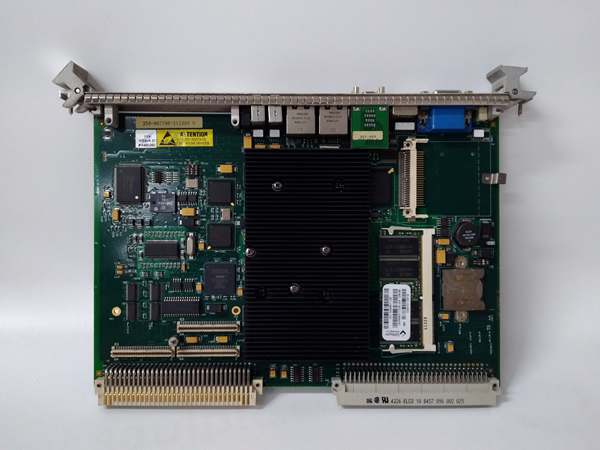
Description
Key Technical Specifications
-
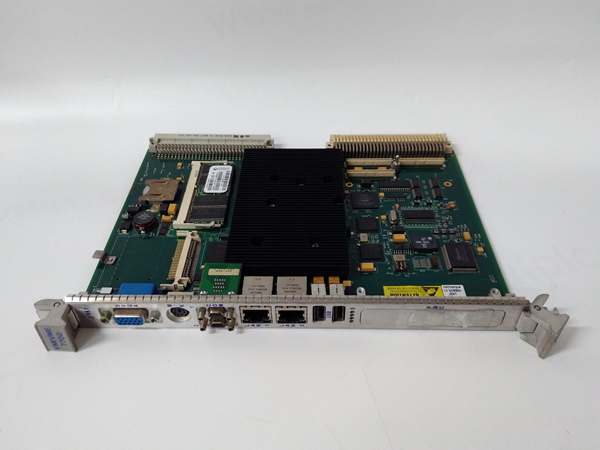
Model Number: VMIVME-2128
-
Manufacturer: GE (legacy VMIC)
-
Channels: 128, open-collector with optional pull-up
-
Output Voltage: 5 – 48 VDC external supply
-
Sink Current: 600 mA per channel continuous
-
Isolation: 1 500 Vrms channel-to-bus (opto)
-
BIT: On-board coil-open / contact-weld sense
-
Connectors: Front-panel 96-pin DIN 41612; P2 rear I/O option
-
Power: +5 V @ 1.5 A (all outputs on), +12 V 50 mA for BIT
-
Form Factor: 6U single-slot VME slave, A16/A24, D08/D16
-
Temp Range: 0 – 55 °C commercial, –40 – +85 °C rugged option

GE VMIVME-7700RC
Field Application & Problem Solved
Refinery skids still use rows of ice-cube relays to trip solenoid valves—128 of them eat a 19-inch panel and every lightning strike welds a contact shut. Replace the mess with one VMIVME-2128 and you just bought panel space, diagnostics, and immunity. Each output sinks 600 mA at 48 V, enough to drive a ¾-inch ASCO valve directly; the open-collector design lets you mix 12 V pilot lights and 48 V trip valves on the same board without rewiring.
Refinery skids still use rows of ice-cube relays to trip solenoid valves—128 of them eat a 19-inch panel and every lightning strike welds a contact shut. Replace the mess with one VMIVME-2128 and you just bought panel space, diagnostics, and immunity. Each output sinks 600 mA at 48 V, enough to drive a ¾-inch ASCO valve directly; the open-collector design lets you mix 12 V pilot lights and 48 V trip valves on the same board without rewiring.
I’ve dropped this card into a cat-cracker lube-oil trip rack: 128 valves, one slot, and the BIT word flagged two welded drivers before startup—saved us a false trip on day-one. Core value: relay replacement that talks back.
Installation & Maintenance Pitfalls (Expert Tips)
External pull-up sizing is non-negotiable
Leave the pull-up resistor pack out and inductive coils give you 200 V flyback—board survives, field supply doesn’t. Size RP per table in manual: 27 kΩ for 48 V, 6.8 kΩ for 24 V, 1.5 kΩ for 12 V. Anything else and the off-state leakage keeps the valve half-open.
Leave the pull-up resistor pack out and inductive coils give you 200 V flyback—board survives, field supply doesn’t. Size RP per table in manual: 27 kΩ for 48 V, 6.8 kΩ for 24 V, 1.5 kΩ for 12 V. Anything else and the off-state leakage keeps the valve half-open.
600 mA is sink only—no sourcing
Rookies try to drive a 24 V lamp across channel and supply; lamp floats high, board never turns off. Wire the load between supply and channel, let the 2128 pull down; if you need high-side switching, add an interposing relay.
Rookies try to drive a 24 V lamp across channel and supply; lamp floats high, board never turns off. Wire the load between supply and channel, let the 2128 pull down; if you need high-side switching, add an interposing relay.
BIT detects open-coil, not shorted load
BIT flag means the darlington is OK, not that the valve moved. For safety-critical trips, loop the BIT sense back to an input card and prove the valve actually dropped—don’t trust BIT alone.
BIT flag means the darlington is OK, not that the valve moved. For safety-critical trips, loop the BIT sense back to an input card and prove the valve actually dropped—don’t trust BIT alone.
Heat sinks are channel-grouped
Channels 0-31 share one copper plane; if you run 32 valves at 500 mA the foil hits 90 °C. Spread high-current loads across the connector or add external heat sink bars; otherwise the over-temp sensor trips the whole bank.
Channels 0-31 share one copper plane; if you run 32 valves at 500 mA the foil hits 90 °C. Spread high-current loads across the connector or add external heat sink bars; otherwise the over-temp sensor trips the whole bank.
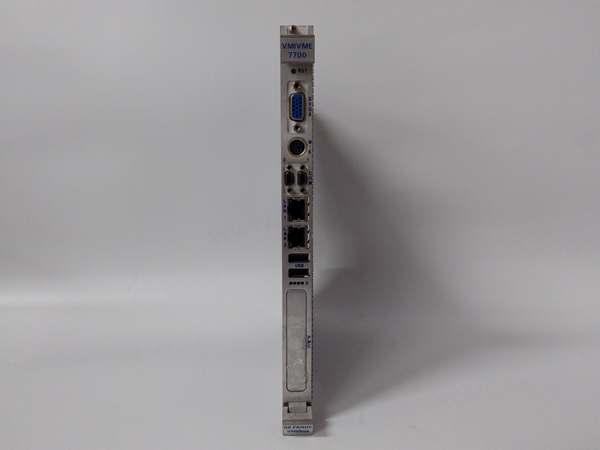
GE VMIVME-7700RC
DIN jack-screws walk out
Mill vibration loosens the 96-pin jack-screws. Six months later you get “random trip” every time the compressor starts. Hit them with 3 mm hex and Loctite 222 during commissioning—cheapest insurance you’ll ever buy.
Mill vibration loosens the 96-pin jack-screws. Six months later you get “random trip” every time the compressor starts. Hit them with 3 mm hex and Loctite 222 during commissioning—cheapest insurance you’ll ever buy.
Technical Deep Dive & Overview
The 2128 is a 128-bit latch driving open-collector MOSFETs, each rated 60 V and 600 mA. A 22V10 PLD decodes VME address, strobes the data, and asserts DTACK in <200 ns. Opto-couplers give 1.5 kV isolation between field supplies and the VME backplane; the BIT circuit loops back the drain voltage so software can flag a channel that never pulls low. Because the MOSFETs are low-side switches, you can mix supply voltages on the same card—run 12 V pilots and 48 V trips without isolation barriers. Simple, deterministic, and bullet-proof—exactly what you want when the trip solenoid has to drop in <50 ms.
The 2128 is a 128-bit latch driving open-collector MOSFETs, each rated 60 V and 600 mA. A 22V10 PLD decodes VME address, strobes the data, and asserts DTACK in <200 ns. Opto-couplers give 1.5 kV isolation between field supplies and the VME backplane; the BIT circuit loops back the drain voltage so software can flag a channel that never pulls low. Because the MOSFETs are low-side switches, you can mix supply voltages on the same card—run 12 V pilots and 48 V trips without isolation barriers. Simple, deterministic, and bullet-proof—exactly what you want when the trip solenoid has to drop in <50 ms.