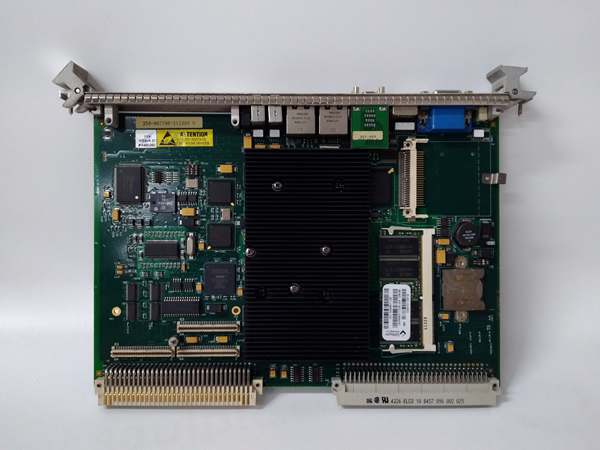
Description
Key Technical Specifications
-
Model Number: VMIVME-1150
-
Manufacturer: GE (legacy VMIC)
-
Bus Interface: VMEbus D08/D16 slave, A16/A24 address space
-
Input Voltage Range: 5 – 48 VDC (current-limited by 2.2 kΩ resistor)
-
Channels: 64, grouped in eight 8-bit ports
-
Isolation: 1 000 V working, 7 500 V transient (port-to-VME)
-
Access Time: ≤ 250 ns from DS0/DS1 to DTACK
-
Power Draw: +5 V @ 1.2 A typical (all LEDs on)
-
Connectors: Dual 64-pin DIN 41612, front-panel mounted
-
Filtering: Jumper-selectable 3 ms RC debounce per channel
-
Polarity: Jumper-select positive- or negative-true logic
-
MTBF: > 400 kh @ 40 °C (MIL-HDBK-217F, ground fixed)

GE VMIVME-7700RC
Field Application & Problem Solved
Paper mills are electrically nasty. You’ve got 4 kV drives on the same cable tray as 24 VDC limit-switch wiring, and every time the winder accelerates the ground potential jumps 30 V. Without isolation the DCS sees phantom valve-closed bits and the operator hits the panic stop—lost reel, lost grade, lost money.
Paper mills are electrically nasty. You’ve got 4 kV drives on the same cable tray as 24 VDC limit-switch wiring, and every time the winder accelerates the ground potential jumps 30 V. Without isolation the DCS sees phantom valve-closed bits and the operator hits the panic stop—lost reel, lost grade, lost money.
The VMIVME-1150 lives in the VME rack inside the control house, but its field contacts come straight from the machine deck. The 1 kV barrier lets you land those contacts without intermediate relays, saving panel space and eliminating the weakest link in the loop—the ice-cube relay that always welds shut on a ground fault. I’ve had this board swallow a 1.5 kV fast transient when a 480 V contactor coil shorted; the rack kept scanning and the paper machine never tripped.
Core value: density plus immunity. One slot gives you 64 bits of rock-solid status, polled in 600 ns total, so your 2 ms interrupt task still has headroom. That means you can run faster control loops on the stuff that actually makes money—pressure, flow, speed—while the 1150 quietly guards every limit switch and run-status contact in the mill.
Installation & Maintenance Pitfalls (Expert Tips)
DIP-switch math trips up first-timers
Switch 1 is the LSB, silk-screen is upside-down. If your hex editor shows 0x80 instead of 0x01 you’ve got it backward. Verify with a VME probe before you button up—saves the 2 a.m. “board not found” page.
Switch 1 is the LSB, silk-screen is upside-down. If your hex editor shows 0x80 instead of 0x01 you’ve got it backward. Verify with a VME probe before you button up—saves the 2 a.m. “board not found” page.
Field supply must float
The board doesn’t care if you source or sink, but tying the 24 V field bus to the same ground lug as the VME rack negates the isolation. Run a separate, fused field supply and star-ground it at the marshalling panel; noise drops by 20 dB.
The board doesn’t care if you source or sink, but tying the 24 V field bus to the same ground lug as the VME rack negates the isolation. Run a separate, fused field supply and star-ground it at the marshalling panel; noise drops by 20 dB.
Filter jumpers kill pulse counts
Default is 3 ms debounce—great for pushbuttons, lethal for turbine-meter pulses. If your daily total is short by a few hundred gallons, pull the W1-W8 jumpers on those channels; response time falls to <1 µs and accuracy comes back.
Default is 3 ms debounce—great for pushbuttons, lethal for turbine-meter pulses. If your daily total is short by a few hundred gallons, pull the W1-W8 jumpers on those channels; response time falls to <1 µs and accuracy comes back.
DIN jack-screws walk out
Mill vibration loosens the 64-pin connectors. Six months later you get random “VME bus error.” Hit the jack-screws with 5/64” hex and a dab of Loctite 222 during commissioning—simple insurance against a midnight call.
Mill vibration loosens the 64-pin connectors. Six months later you get random “VME bus error.” Hit the jack-screws with 5/64” hex and a dab of Loctite 222 during commissioning—simple insurance against a midnight call.
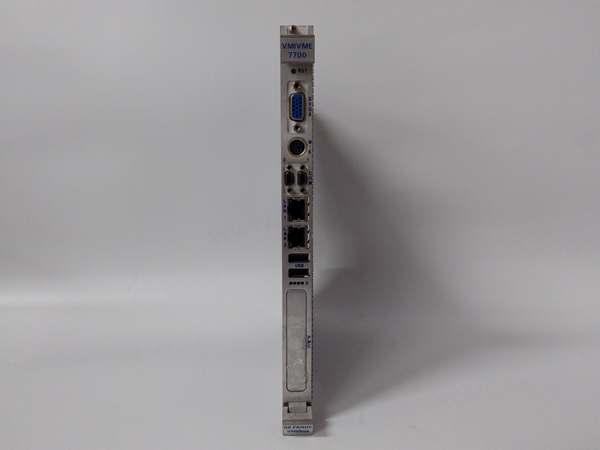
GE VMIVME-7700RC
Polarity mismatch wastes CPU cycles
Board ships positive-true. If your legacy program expects “0” when the contact closes, you’ll burn cycles inverting. Cut the polarity jumper per group and let hardware do it; scan time drops and the code documents itself.
Board ships positive-true. If your legacy program expects “0” when the contact closes, you’ll burn cycles inverting. Cut the polarity jumper per group and let hardware do it; scan time drops and the code documents itself.
Technical Deep Dive & Overview
The 1150 is basically eight octal opto-couplers glued to a VME slave interface—no micro, no firmware, nothing to corrupt. A 22V10 PLD decodes AM codes, asserts DTACK, and latches the photo-LED state into three 74ACT574 registers. Because the couplers are rated 5 kVrms and the board keeps working voltage at 1 kV, you stay inside the low-voltage safety class, so no extra barriers are needed in Class I Div 2 areas.
The 1150 is basically eight octal opto-couplers glued to a VME slave interface—no micro, no firmware, nothing to corrupt. A 22V10 PLD decodes AM codes, asserts DTACK, and latches the photo-LED state into three 74ACT574 registers. Because the couplers are rated 5 kVrms and the board keeps working voltage at 1 kV, you stay inside the low-voltage safety class, so no extra barriers are needed in Class I Div 2 areas.