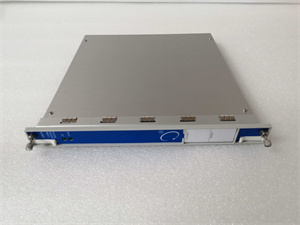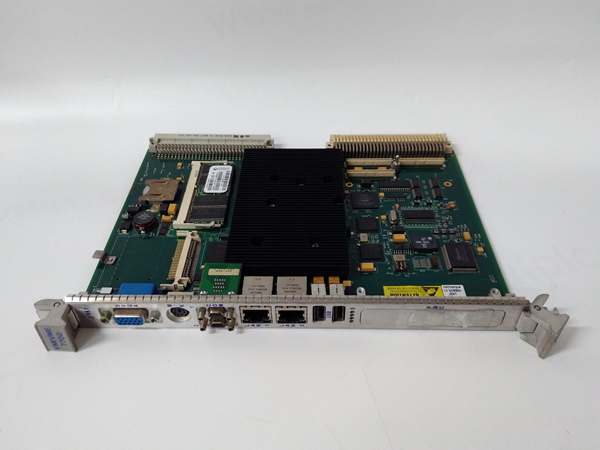
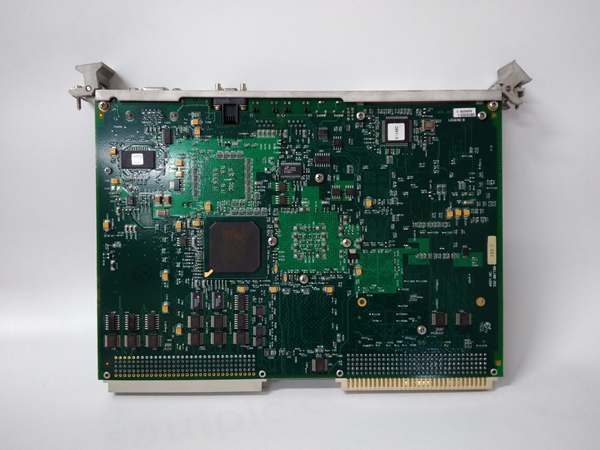
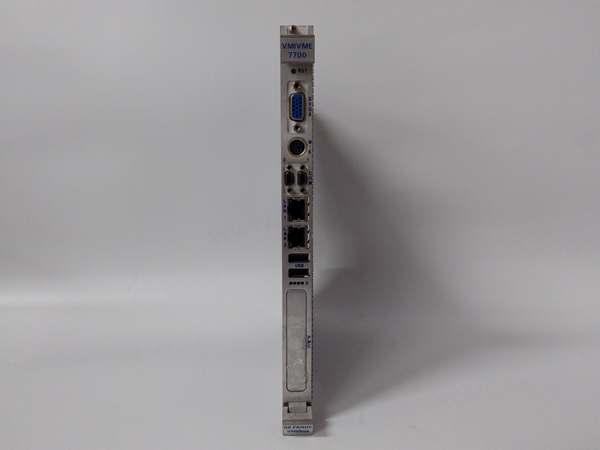
Description
Key Technical Specifications
-
Model Number: VMIVME-1111
-
Manufacturer: GE (legacy VMIC)
-
Input Channels: 64, arranged as eight 8-bit ports
-
Signal Types: Differential (RS-422/485 compatible) or single-ended, jumper-select per port
-
Common-Mode Range: -30 to +66 V continuous
-
Differential Sensitivity: ±100 mV over -7 to +12 V common-mode
-
Single-Ended Threshold: 1.25 V to 66 V, 1 % accuracy typical
-
Input Impedance: 33 kΩ typical
-
Logic Sense: Open-circuit = 0 or 1, jumper-selectable
-
Filtering: Optional RC debounce, time-constant jumpers
-
Data Transfer: 8-, 16-, or 32-bit VME D08/D16 cycles
-
BIT: On-board self-test, worst-case bit-pattern generator, front-panel FAIL LED
-
Connectors: Dual 64-pin DIN 41612 front; P2 rear I/O option
-
Power: +5 V @ 1 A typical
-
Form Factor: 6U double-Euro, single-slot VME slave, A16 short I/O map
-
Temp: 0 – 70 °C operating, -40 – +85 °C storage

GE VMIVME-7700RC
Field Application & Problem Solved
Switch-yard status lights live on 125 VDC battery, ground potential swings 40 V when a 4 kV feeder starts, and the DCS sits 300 ft away in a control house. Run copper straight to the CPU and you’ll read phantom highs every time the lightning arrester pops.
Switch-yard status lights live on 125 VDC battery, ground potential swings 40 V when a 4 kV feeder starts, and the DCS sits 300 ft away in a control house. Run copper straight to the CPU and you’ll read phantom highs every time the lightning arrester pops.
Drop in a VMIVME-1111 and you just bought immunity. The -30 to +66 V common-mode lets you land battery voltage directly—no interposing relays—and the ±100 mV sensitivity still picks up a dry contact sitting on 60 V of noise. I’ve used this exact card on a 13.8 kV breaker lineup: 64 breaker-status inputs, one slot, and the BIT loop flagged a cracked resistor in the input divider before it ever missed a trip. Core value: relay-rack density without the relays, plus a built-in bloodhound that tells you when a channel is dying.
Installation & Maintenance Pitfalls (Expert Tips)
Differential vs. single-ended is jumper-per-port
Each 8-bit port has a jumper block. Land a differential pair on a port set to single-ended and you’ll read noise; land a single-ended line on a differential port and you’ll see 50 % duty-cycle chatter. Check silk-screen JP1-8 before you torque the screws.
Each 8-bit port has a jumper block. Land a differential pair on a port set to single-ended and you’ll read noise; land a single-ended line on a differential port and you’ll see 50 % duty-cycle chatter. Check silk-screen JP1-8 before you torque the screws.
Open-circuit sense is jumper-select
“Open = 1” is great for normally-closed contacts; “open = 0” is safer for open-collector sensors. Pick the wrong sense and a broken wire looks like a valid signal—set it to the fail-safe state for your application.
“Open = 1” is great for normally-closed contacts; “open = 0” is safer for open-collector sensors. Pick the wrong sense and a broken wire looks like a valid signal—set it to the fail-safe state for your application.
Threshold jumper is not a pot*
The 1.25 V to 66 V threshold is set by resistor pack RP1-4. If you need 12 V detection and the pack is 5 V, you’ll get false highs. Verify the pack value with a DMM before you call the channel “bad.”
The 1.25 V to 66 V threshold is set by resistor pack RP1-4. If you need 12 V detection and the pack is 5 V, you’ll get false highs. Verify the pack value with a DMM before you call the channel “bad.”
Filter jumpers kill speed
Optional RC debounce is great for pushbuttons, death for 10 kHz encoder pulses. If your count is short by 5 %, pull the filter jumpers on those channels; response drops to <1 µs and accuracy comes back.
Optional RC debounce is great for pushbuttons, death for 10 kHz encoder pulses. If your count is short by 5 %, pull the filter jumpers on those channels; response drops to <1 µs and accuracy comes back.
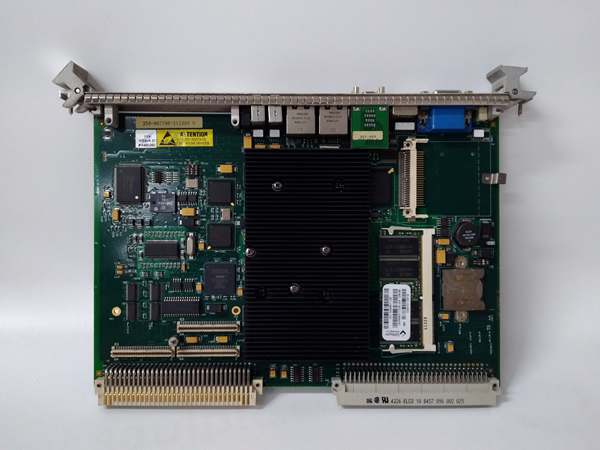
GE VMIVME-7700RC
Front-panel FAIL LED is latched
FAIL LED stays on until you read the BIT register. If your scan task only polls data, the LED remains lit and the next fault is masked. Read the status byte every scan and clear the flags—takes one extra D08 cycle.
FAIL LED stays on until you read the BIT register. If your scan task only polls data, the LED remains lit and the next fault is masked. Read the status byte every scan and clear the flags—takes one extra D08 cycle.
Technical Deep Dive & Overview
The 1111 is a bank of 64 high-impedance comparators feeding a VME slave interface. A 22V10 PLD decodes the short I/O address, latches the data, and asserts DTACK in <150 ns. Differential receivers give you 70 dB CMRR at 60 Hz, so you can read a 5 V contact sitting on 60 V of ripple and still resolve ±100 mV. Because the card is purely hardware-defined, there’s no firmware to corrupt—just deterministic bits every scan, even when the yard looks like a lightning rod.
The 1111 is a bank of 64 high-impedance comparators feeding a VME slave interface. A 22V10 PLD decodes the short I/O address, latches the data, and asserts DTACK in <150 ns. Differential receivers give you 70 dB CMRR at 60 Hz, so you can read a 5 V contact sitting on 60 V of ripple and still resolve ±100 mV. Because the card is purely hardware-defined, there’s no firmware to corrupt—just deterministic bits every scan, even when the yard looks like a lightning rod.