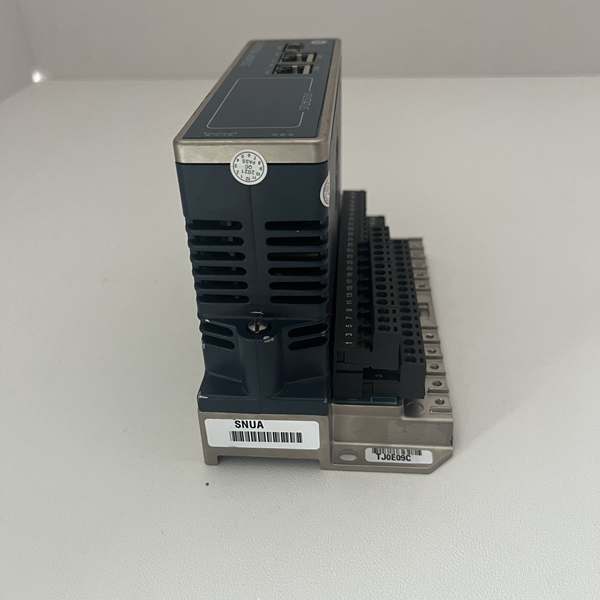
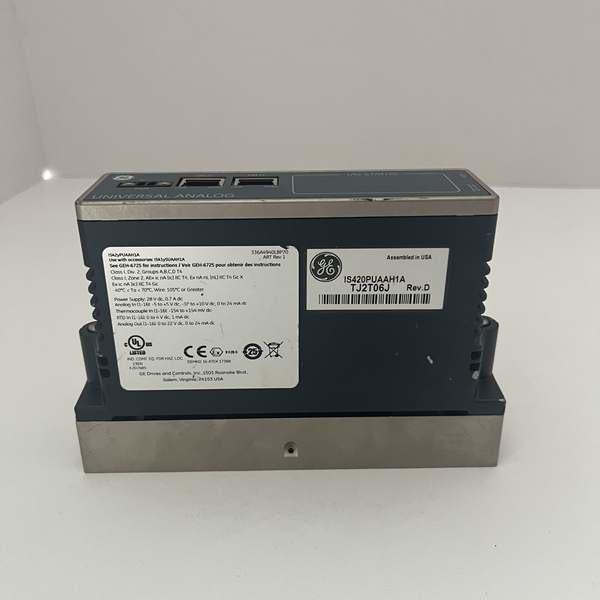
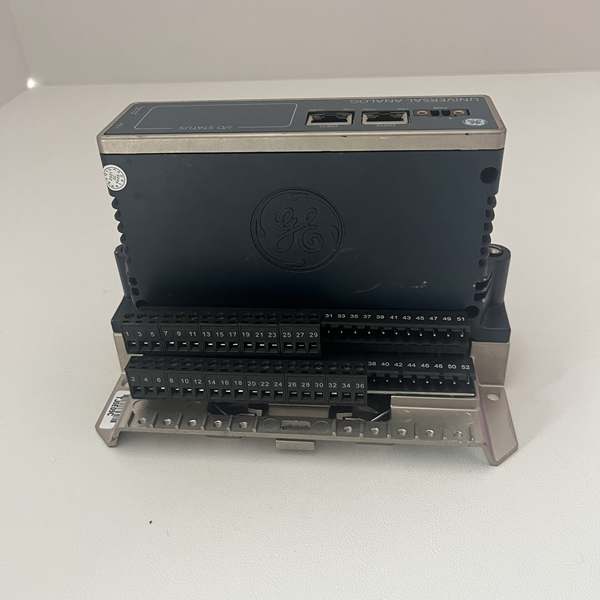
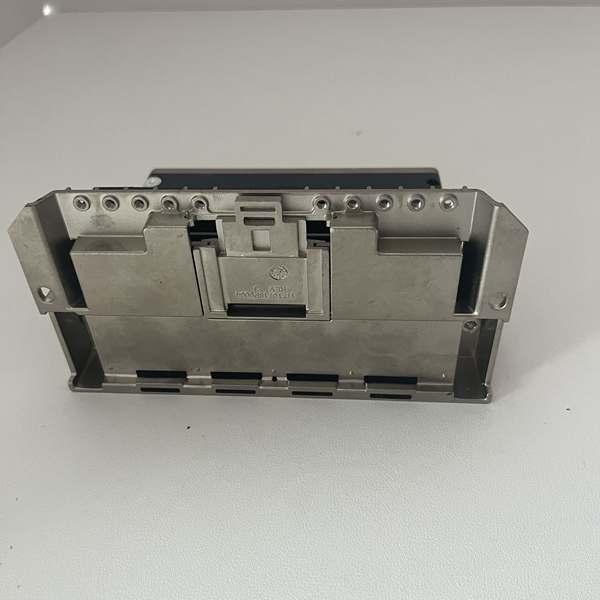
Description
Hard-Numbers: Technical Specifications
-
Channels: 16 simplex analog channels (individually configurable)
-
Supported Inputs: Thermocouple (types J, K, T, E, R, S, B), RTD (Pt100, Pt200, Cu10), 4-20 mA, ±5V/±10V, pulse accumulator, digital input
-
Supported Outputs: 0-20 mA with HART option, digital output
-
Scan Time: 5 ms (typical)
-
Update Rate: 10 ms frame rate
-
Accuracy: Better than 0.1% of span within specified temperature range
-
Resolution: 16-bit A/D conversion
-
Isolation: Channel-to-channel and channel-to-ground isolation
-
HART Support: Version 5/6/7 compatible on current inputs/outputs
-
Operating Temperature: -40°C to +70°C (-40°F to +158°F)
-
Humidity: 5% to 95% non-condensing
-
Power Consumption: 8.1W quiescent + 0.02W-0.68W per channel (depending on type)
-
Communication: Dual RJ45 Ethernet (IONet), auto-negotiating 10/100 Mbps
-
Configuration: ControlST V07.02.00C or later, auto-reconfiguration supported
-
Hot Swap: Supported (can replace under power without system shutdown)
-
Dimensions: 6.2″ × 4.3″ × 1.5″ (157mm × 109mm × 38mm)
-
Weight: Approximately 0.45 kg (1 lb)

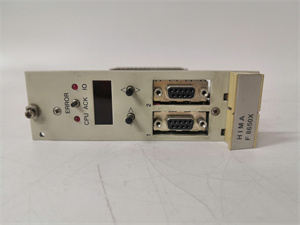
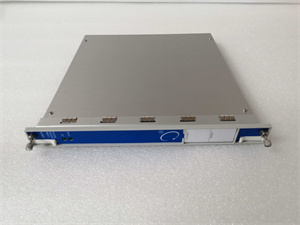
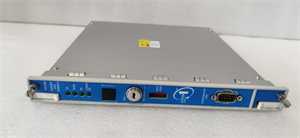
GE IS420PUAAH1A
The Real-World Problem It Solves
You know the headache: a turbine trip because a thermocouple failed and you didn’t have spare I/O channels to switch to backup sensors, or a compressor anti-surge valve that drifts because your 4-20mA loop resolution is only 12-bit. The IS420PUAAH1A eliminates these field problems with universal configurability—any channel can be any signal type, all 16-bit resolution, with HART diagnostics built in. No more stocking eight different I/O card types or rewiring terminals for loop changes.
Where you’ll typically find it:
-
Mark VIe control cabinets for Frame 7FA gas turbines (combustion temperature monitoring, valve position feedback)
-
Steam turbine lube oil and seal oil system monitoring (RTD temperature, pressure transmitters)
-
Balance of Plant (BOP) systems for combined-cycle plants (auxiliary boiler feed pumps, cooling water)
Bottom line: It reduces spare parts inventory from dozens of specialized I/O cards to one universal pack, while giving you HART device diagnostics and hot-swap capability to fix channels without taking the turbine offline.
Hardware Architecture & Under-the-Hood Logic
The IS420PUAAH1A mounts in a Mark VIe I/O pack carrier (typically alongside a YDOA discrete output pack). It’s not just an A/D converter—it’s a smart I/O processor with its own embedded firmware that handles signal conditioning, linearization, and HART communication protocol. The pack communicates with the UCS controller via dual redundant IONet Ethernet connections, not through a VME backplane like older Mark VI hardware.
Signal flow and processing logic:
-
Field Termination: Signals land on three-position terminal blocks per channel (positive, negative, shield) with independent wiring sections allowing channel-by-channel commissioning
-
Signal Conditioning: Each channel has dedicated circuitry for thermocouple cold junction compensation, RTD excitation current, or 24V loop power for transmitters—automatically selected based on software configuration
-
A/D Conversion: 16-bit sigma-delta converters sample each channel at 5ms intervals, with programmable filtering (0-10 seconds) to reject electrical noise from turbine generators
-
HART Processing: For 4-20mA channels, a separate HART modem communicates with smart transmitters at 1200 baud, extracting secondary variables (sensor temperature, diagnostics) without disturbing the analog loop
-
Ethernet Transmission: Processed data transmits via IONet to the UCS controller using GE’s proprietary protocol; dual Ethernet ports allow redundant network paths with automatic failover
GE IS420PUAAH1A
Field Service Pitfalls: What Rookies Get Wrong
Assuming All Channels Are Identical Rookies see “universal I/O” and think any channel handles any signal. While technically true, each channel requires specific terminal wiring—thermocouples need shielded compensation cable, RTDs need 3-wire or 4-wire connections, and HART loops need specific load resistance. Wiring a thermocouple to a channel configured for 4-20mA gives you garbage readings and possible cold junction errors.
Field Rule: Always verify the channel configuration in ControlST before landing wires. Check the terminal block labels—TC+, TC-, RTD A/B/C, or mA+/mA-. A miswired RTD will read 300°F high and trip your turbine on false overtemperature.
Forgetting HART Load Requirements HART communication requires 250-600 ohms loop resistance. Rookies connect a HART transmitter directly to the IS420PUAAH1A without checking if the internal load resistor is enabled, or they add an external resistor when it’s already built in. Result: no HART communication or erratic analog readings.
Quick Fix: In ControlST, verify the “HART Enabled” checkbox is ticked for the channel—this automatically switches in the internal 250-ohm resistor. If using an external barrier or isolator, disable the internal resistor to avoid double-loading the loop. Test HART communication with a handheld configurator before declaring the loop commissioned.
Hot-Swapping Without IONet Verification The pack supports hot-swap, but rookies pull the old pack before verifying the replacement is communicating on IONet. The controller faults the I/O section and the turbine control drops to manual or trips.
Field Rule: After installing the new IS420PUAAH1A, wait for the “OK” LED to go solid green and verify in ToolboxST that all 16 channels show “Healthy” status before removing the old pack from the configuration. The auto-reconfiguration feature takes 10-30 seconds—wait for it. If any channel shows “Fault,” check the terminal block seating before the controller declares the I/O failed.