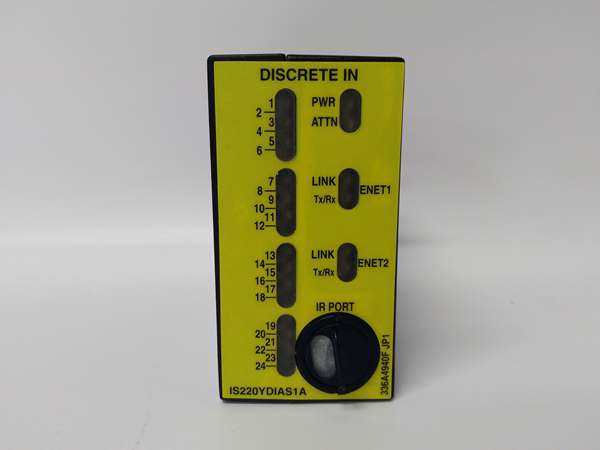
Description
Hard-Numbers: Technical Specifications
- Protocol Support: IONet 10/100Mbps Ethernet
- Input Channels: 32 discrete dry contact inputs
- Input Voltage: 18–32 VDC (nominal 28 VDC)
- Isolation Rating: 2500 VAC RMS field-to-backplane
- Power Draw: 8 W max @ 24 VDC
- Operating Temperature: -35°C to +65°C
- Relative Humidity: 5–95% non-condensing
- Certifications: UL, CE; Class I Div 2, Zone 2 hazardous locations
- Compatible Terminal Boards: IS200STCIS1A/2A, IS400STCIS1A/2A, IS400TBCIS2C
- Dimensions: 138 x 86 x 56 mm
- Weight: 0.9 kg (2 lbs)
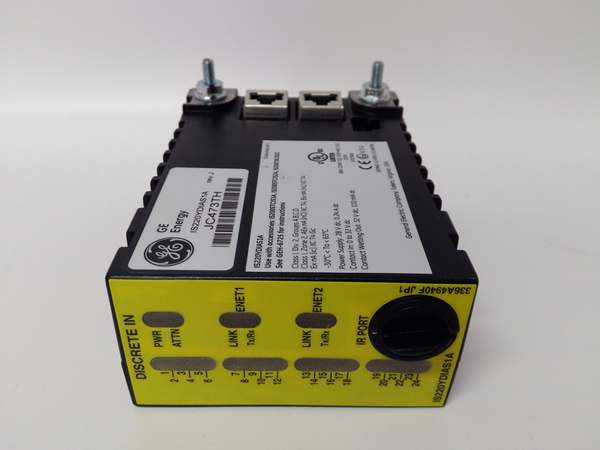
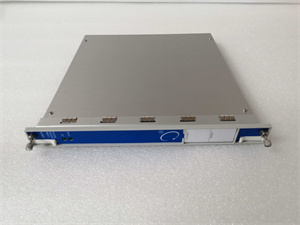
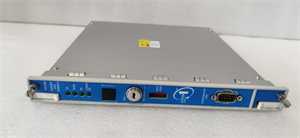
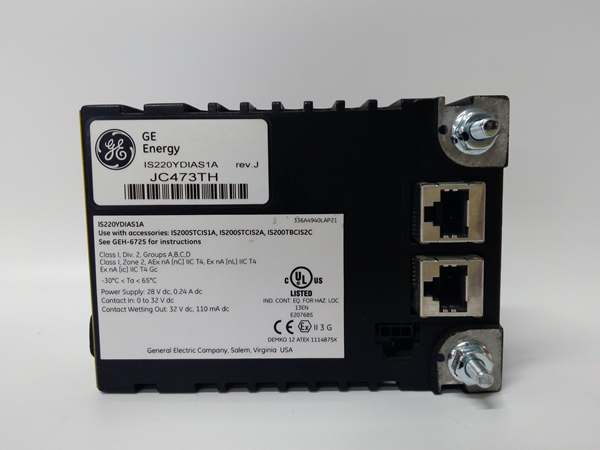
GE IS220YDIAS1A
The Real-World Problem It Solves
Control systems suffer from unreliable discrete input readings due to ground loops and electrical noise. Unfiltered signals cause false trips and missed interlock statuses. provides full channel-to-channel isolation to eliminate noise and ensure accurate contact state detection.Where you’ll typically find it:
- Turbine start/stop permissive interlock circuits
- Lube oil pressure and temperature switch monitoring
- Valve position limit switch feedbackBottom line: delivers stable, noise-free discrete signal acquisition for critical safety and control loops.
Hardware Architecture & Under-the-Hood Logic
features an on-board microcontroller running QNX Neutrino OS with 256MB DDR SDRAM. Each input channel has independent isolation and signal conditioning.
- Field contact signals connect to terminal block inputs.
- Signals pass through 2500V galvanic isolation barriers.
- On-board processor scans all 32 channels at 1ms intervals.
- Input states are debounced and verified against fault conditions.
- Processed data transmits over redundant IONet to controller.
- Self-diagnostics monitor for short circuits, open circuits, and power anomalies.
- Front-panel LEDs indicate channel activity and module health.
Field Service Pitfalls: What Rookies Get Wrong
Shared Ground ConnectionsRookies tie input grounds to system ground or other I/O grounds. Creates ground loops that induce noise and false input triggers.
- Field Rule: Use only isolated field grounds; never connect to cabinet or system grounds.Unscreened Wiring RunsRunning discrete input wires alongside high-voltage power cables induces electrical noise. Causes intermittent input state changes.
- Quick Fix: Route input wiring in dedicated grounded metal trays; maintain 30cm separation from power cables.Inadequate Contact WettingUsing high-resistance contacts without sufficient wetting current. Results in stuck-on states due to surface oxidation.
- Field Rule: Ensure minimum 5mA wetting current per input; clean or replace oxidized contacts.
Commercial Availability & Pricing Note
Please note: The listed price is for reference only and is not binding. Final pricing and terms are subject to negotiation based on current market conditions and availability.