Description
硬性数据:技术规格
- 处理器: BPPx 处理器板,带有高速逻辑、Flash 和 RAM,用于确定性以太网 I/O 扫描和内置自我诊断。
- 通信协议: 两个10/100Base-TX以太网端口用于冗余I/O网络(IONet)与Mark VIe控制器的集成。
- 供电电压: 28 V DC 标称值(典型范围 18-32 V DC)。
- 功耗:典型功耗为12瓦至18瓦(根据同时激活的输出通道数量增加)。
- 离散输出 (DO): 12个独立的C型(Form C)继电器驱动通道。能够吸合/源出,通常每个通道额定为24 VDC,1A。
- 反馈输入:15个监控/反馈输入用于验证继电器健康状况、线圈连续性以及端子板的正确就位。
- 输出使能控制: 专用硬件线路,在处理器复位、上电和自检程序期间,将所有输出强制置于开路(去激励)状态。
- 输入/输出保护: 现场侧电路与控制侧逻辑之间的光隔离(典型值为1500 VAC);输出驱动器的过载和短路保护。
- 工作温度: -30°C 到 +65°C(涡轮舱扩展工业等级)。
- 储存温度: -40°C 到 +85°C 。
- 湿度耐受性: 5%到95%不冷凝。
- 抗振动性: 为满足IEC标准,适用于恶劣的工业环境。
- 保护:工业级 conformal coating,通道到总线的隔离,以及 IP20 等级的外壳。认证用于 I 类 2 级和 ATEX 区域 2 的危险场所。
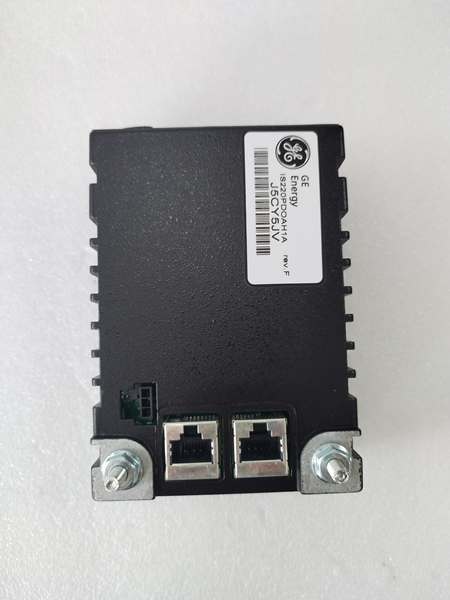
- 连接器: 双RJ-45以太网,一个DC-37针连接器用于直接终端板接口,以及一个3针电源连接器。
- 兼容的终端板: TRLY(H1B,H1C,H1D,H1F 用于固态继电器)和 SRLY(用于电磁继电器)。注意: 不兼容安装在 DIN 槽上的 DRLY 板。
- 响应时间:从以太网命令接收到来自主机物理输出状态变化大约6毫秒。
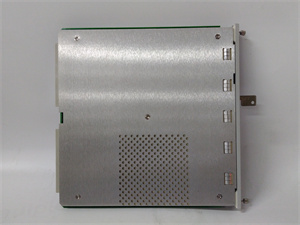
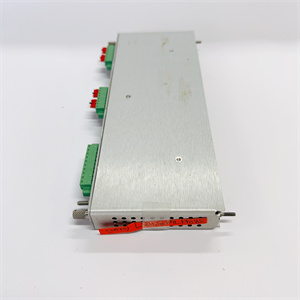
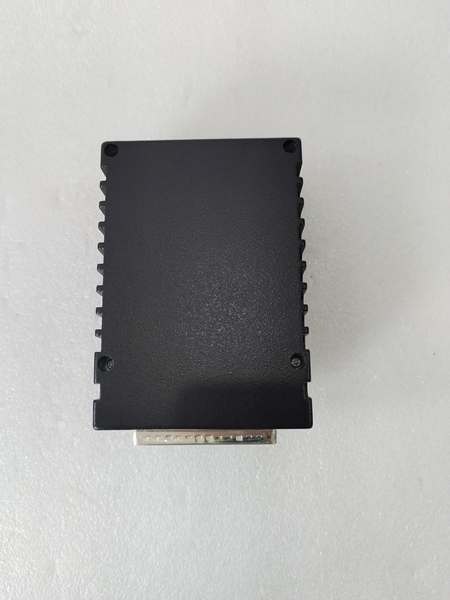
- 尺寸(约): 15.875 厘米 x 10.795 厘米 x 4.65 厘米 (6.25″ x 4.25″ x 1.83″) .
- 重量(约): 0.5 公斤(1.1 磅)。
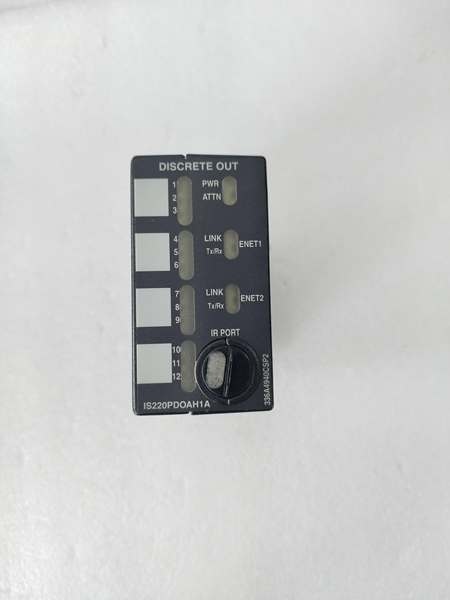
IS220PDOAH1A
它解决的实际问题
在发电厂或重型工业设施中,那些实际上驱动部件的设备——比如巨大的燃油切断电磁阀、润滑油泵启动线圈或紧急停车(ESD)阀门——会消耗大量的电力。你绝对不能将这些重型负载直接连接到精密的、价值10,000美元的涡轮控制器上。此外,当控制器失去电源或正在重启时,你绝对不希望一个偶然的电涌意外触发涡轮机的停车序列。
The solves the problem of safe, high-current actuation and electrical isolation. It acts as a robust gatekeeper. The Mark VIe controller sends a low-voltage 24V DC logical “Go” command via Ethernet; the PDOA receives it and “closes the gate,” allowing current to flow to an interposing relay or directly to a light-duty actuator . Crucially, its hardware-level “Output Enable” circuit ensures that during power-up or a processor crash, all 12 outputs are physically forced into a safe, de-energized state, preventing catastrophic nuisance tripping .
Where you’ll typically find it:
- Panel-mounted on TRLY or SRLY terminal boards within the Mark VIe turbine control cabinet .
- Directly controlling the starter coils for Auxiliary Lube Oil Pumps, Seal Gas Compressors, and Ventilation Fans.
- Driving the pilot stages of critical Emergency Shutdown Valves (ESD) and Burner Management System (BMS) alarms .
Bottom line: It is the heavy-lifting, short-circuit-protected muscle that safely translates the Mark VIe controller’s digital intentions into real-world physical actions.
Hardware Architecture & Under-the-Hood Logic
The PDOA is more than just a relay driver; it is a highly monitored, fail-safe execution node designed for mission-critical reliability .
- Command Reception & Processing: The onboard BPPx processor continuously listens to the redundant IONet Ethernet ports. When a command packet arrives (e.g., “Energize Output 1”), the processor validates the instruction and triggers the corresponding output driver circuit .
- Hardware-Level Output Enable (OE): This is the PDOA’s most critical safety feature. A dedicated hardware circuit monitors the processor’s “health” pin. If the processor resets, crashes, or loses power, the OE line physically drops, instantly disconnecting all 12 output transistors regardless of the software state. This guarantees a known safe state during reboots .
- Driven Output & Load Monitoring: When enabled, the output transistor saturates, sinking current through the field device (e.g., a relay coil). Simultaneously, an analog monitor circuit measures the actual current flowing through the transistor. If the processor commands the output ON, but the current monitor reads 0 Amps, it flags an immediate “Open Circuit/Wire Break” fault to the controller .
- Deterministic Feedback: The processor continuously scans the 15 monitor/feedback lines (which check terminal board presence, fuse integrity, and relay status), packages this diagnostic data, and transmits it back to the Mark VIe controller at the configured task frame rate (as fast as 10ms) .
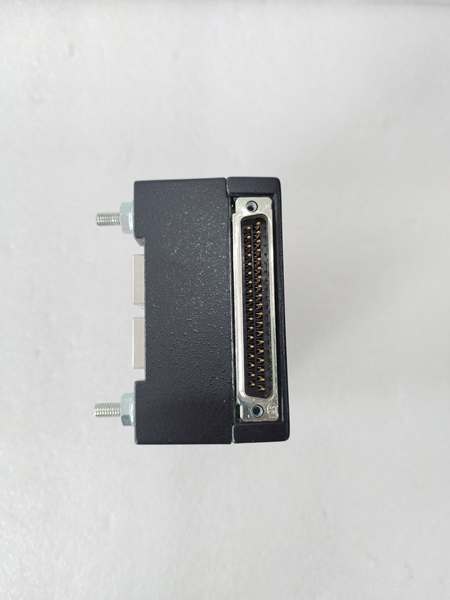
IS220PDOAH1A
Field Service Pitfalls: What Rookies Get Wrong
The “Ghost Trip” (Ignoring the Output Enable)
Rookies often assume that because an output isn’t programmed to turn on in the logic, it will stay off during a controller download or power cycle.
- The Symptom: An operator downloads a minor logic change to the Mark VIe. The moment the controller transitions from Program to Run mode, the turbine trips on an unexpected “Lube Oil Pump Off” signal, even though the pump was running fine.
- Field Rule: The PDOA’s hardware “Output Enable” is absolute. During the millisecond it takes for the controller to boot and establish Ethernet communication, the PDOA forces all outputs to the de-energized state. If your turbine protection logic treats a “Loss of Output Signal” as a trip condition, you must incorporate a “First Scan” delay or a permissive timer in your ToolboxST logic to ride through the 6ms to 100ms hardware reset window .
The Silent Killer (Improper Suppression on Inductive Loads)
The PDOA has robust internal protection, but it isn’t indestructible. Rookies often connect 120VAC or 240VAC solenoid valves directly to the interposing relay outputs without thinking about the aftermath.
- The Symptom: The module works fine for a few months, then suddenly a whole bank of outputs dies. Upon inspection, the tiny surface-mount transistors on the PDOA board are charred black. The inductive voltage spike from a disconnecting solenoid blew right past the internal clamping diodes.
- Field Rule: Never, ever drive an inductive AC load directly from a PDOA channel without external suppression. Always install an RC snubber network or a Metal Oxide Varistor (MOV) across the coil terminals of the load. The PDOA is designed for 24VDC control loops; treat it like a sensitive sensor, not a welding machine.
The TMR Blind Spot (Mismatched Terminal Boards)
In a Triple Modular Redundant (TMR) setup, three PDOA packs work together to vote on an output state.
- The Symptom: The Mark VIe system throws a “Hardware Mismatch” fault and refuses to transition to “Triple” mode, even though all three PDOA units are identical.
- Field Rule: In a TMR architecture, the voting happens on the Terminal Board, not just inside the I/O pack. You cannot mix and match. If you are building a TMR output, you must use three PDOAs AND a TMR-compatible terminal board (like the TRLY series). Using a standard SRLY (Simplex Relay) board with three PDOAs will result in a configuration mismatch error. Always verify the physical jumper settings and ID chip on the terminal board match the controller’s expectation .
⚠️ Buyer Beware: The “Clone Trap”
Because the Mark VIe architecture allows for simplex, dual, and TMR configurations, the market is flooded with used and refurbished PDOA modules. Unscrupulous sellers often flash older hardware revisions with newer firmware to make them “compatible.”
- The Reality: The has gone through several hardware revisions (H1A, H1B, etc.). While a seller might list a module as “H1A compatible,” the internal BPP processor board could be an obsolete revision that lacks the necessary hardware bug fixes .
- The Fix: When buying spares, demand the full 100-character GE serial number (e.g.,
336A4940CSP2). Cross-reference this not just with the Mark VIe manual, but specifically with your plant’s current ToolboxST project file (*.tproj) I/O configuration. If the hardware revision in your software doesn’t match the physical spare, the controller will flag a “Mismatch” and potentially force the I/O node into a failsafe (output-disabled) state .
Commercial Availability & Pricing Note
Please note: The listed price is for reference only and is not binding. Final pricing and terms are subject to negotiation based determined on current market conditions and availability.