Description
Hard-Numbers: Technical Specifications
- Processor: BPPx processor board for real-time I/O scanning, debounce logic, deterministic communication, and built-in self-diagnostics .
- Communication Protocol: Dual 10/100Base-TX Ethernet ports for redundant I/O network (IONet) integration with the Mark VIe controller .
- Supply Voltage: 24 V DC Nominal (Supports 18-32 V DC industrial range) .
- Power Consumption: ~12-15 W (Dependent on communication activity and relay coil energization) .
- Discrete Inputs (DI): 24 independent channels, optimized for dry contact sensing (voltage-free contacts) with integrated current limiting and noise filtering .
- Discrete Outputs (DO): 12 independent C-type (Form C) relay driver channels. Capable of sinking or sourcing 24 VDC at 1A per channel .
- Input Filter: Hardware-based 4 ms filter to eliminate contact bounce and high-frequency electrical noise .
- Voltage Suppression: 60 V RMS AC voltage suppression (at 50/60 Hz) to protect against inductive kickback and transient spikes .
- Input/Output Protection: Optical isolation (1500 VAC) between field-side circuits and control-side logic; overload and short-circuit protection on output drivers .
- Operating Temperature: 0°C to +60°C (Standard control room rating) .
- Humidity Tolerance: 5% to 95% non-condensing .
- Vibration Resistance: Engineered to meet IEC standards for rugged industrial environments .
- Protection: Industrial-grade conformal coating, channel-to-bus isolation, and IP20-rated enclosure. Certified for Class I Division 2 and ATEX Zone 2 hazardous locations .
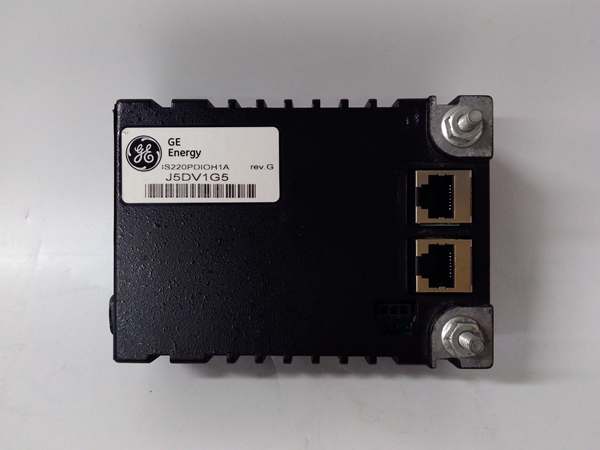
- Connectors: Dual RJ-45 Ethernet, one DC-37 pin connector for direct terminal board interface, one 3-pin power connector, and dedicated screw-terminal blocks for field wiring .
- Compatible Terminal Boards: TDBS (Simplex Discrete I/O) and TDBT (TMR Discrete I/O) .
- Incompatible Terminal Boards: Standard single-function boards like TBCI, TICI, or SRLY (The PDIO integratestheir functions internally) .
- Dimensions (Approx.): 15.875 cm x 10.795 cm x 4.65 cm (6.25″ x 4.25″ x 1.83″) .
- Weight (Approx.): 0.5 kg (1.1 lbs) .
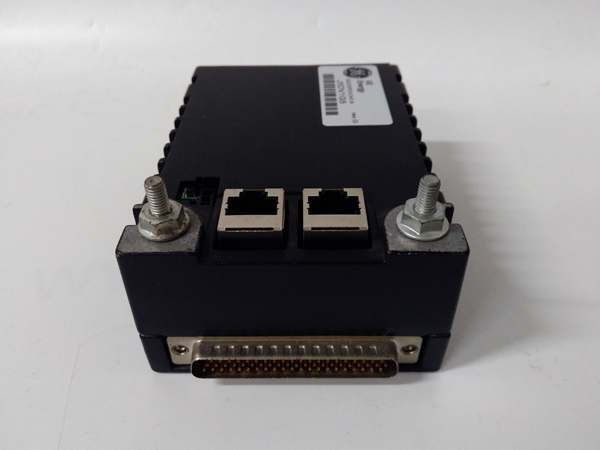
IS220PDIOH1A
The Real-World Problem It Solves
In turbine control cabinets, panel space is expensive real estate. Traditionally, reading a limit switch (Input) and turning on a cooling fan (Output) required two separate I/O packs (a PDIA and a PDOA), consuming two slots and doubling the wiring effort.
The solves the problem of I/O density and architectural complexity. By seamlessly merging 24 dry contact inputs and 12 relay driver outputs into a single, firmware-driven package, it frees up critical rack space and reduces component count . Furthermore, it bridges the electrical gap between fragile controller logic and the harsh industrial world using 1500V optical isolation and hardware debouncing, ensuring that a noisy 24V relay coil switching on doesn’t trick the system into thinking a proximity switch has triggered .
Where you’ll typically find it:
- Mounted on TDBS (Simplex) or TDBT (Triple Modular Redundant) terminal boards in Mark VIe turbine control panels .
- Wired to mixed signal clusters, such as auxiliary motor starters (Output) and their corresponding thermal overload feedback contacts (Input) .
- Deployed in both Gas and Steam turbine packages where conserving I/O rack space without sacrificing TMR (Triple Modular Redundancy) capabilities is a priority .
Bottom line: It is the space-saving, noise-immune, all-in-one field interface that consolidates your turbine’s eyes and hands into a single rugged package.
Hardware Architecture & Under-the-Hood Logic
Unlike standard single-function modules, the PDIOH1A houses a more complex acquisition board tailored for mixed signal conditioning, all governed by the standard BPPx processor .
- Mixed-Signal Conditioning: The 24 DI channels pass through precision current-limiting resistors and optical isolators for dry contact sensing. Simultaneously, the 12 DO channels are driven by robust C-type relay drivers capable of handling 1A loads, with integrated flyback diode protection to absorb inductive voltage spikes from external relays .
- Hardware Debouncing: A 4 ms hardware filter on the DI channels acts as the first line of defense against mechanical switch bounce and high-frequency EMI, physically preventing false triggering before the signal reaches the processor .
- Deterministic Communication: The onboard BPPx processor continuously scans the mixed input states and output statuses. It packages this data into Ethernet frames and transmits them to the Mark VIe controller via dual redundant IONet ports at configured frame rates (as fast as 10ms), ensuring minimal latency .
- Fault Management & Diagnostics: The processor continuously monitors its own health, communication link status, and power supply quality. If a critical fault is detected (e.g., loss of communication with the controller), it triggers hardware-level alarms. The front-panel LEDs provide at-a-glance diagnostics for system health, Ethernet activity, and individual channel energy .
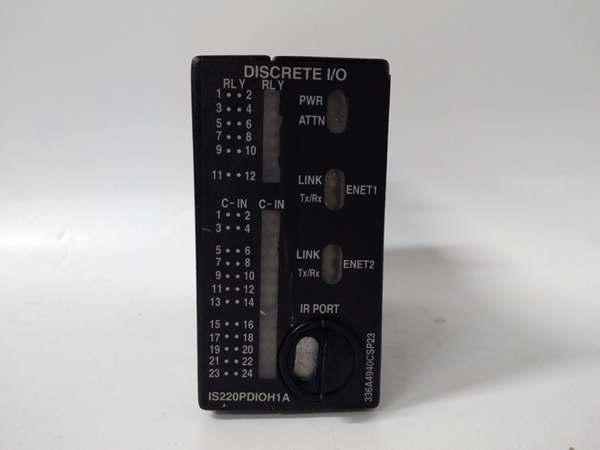
IS220PDIOH1A
Field Service Pitfalls: What Rookies Get Wrong
The “Mixed-Up Terminals” (Wiring a DO like a DI)
Because the PDIOH1A combines 24 Inputs and 12 Outputs, rookies often lose track of which physical pins correspond to sinking current versus sourcing it.
- The Symptom: A technician connects a 24V field supply to what they think is an Input channel, only to watch the voltage collapse to 0V because they accidentally landed it on an active Output driver. Conversely, connecting a dry contact to an Output channel results in absolutely nothing happening.
- Field Rule: Always tape the manufacturer’s pinout diagram to the inside of the panel door. Inputs (DI 1-24) typically rely on externally sourced or internally pulled-up wetting currents, while Outputs (DO 1-12) actively sink or source current to drive loads. Double-check your terminal board documentation (TDBS/TDBT); an experienced tech once said, “On a PDIO, if you assume it’s an input, it’s probably an output. Read the damn label.”
Ignoring the 4ms Hardware Filter on Fast Counters
The PDIOH1A, like other discrete input modules, incorporates a non-negotiable 4-millisecond hardware filter on its DI channels to prevent noise-induced false triggers .
- The Symptom: You have the PDIOH1A reading a flow meter that pulses 200 times a second (200Hz). The Mark VIe controller is completely ignoring the flow rate, showing 0 pulses.
- Field Rule: The 4ms filter means the module physically cannot recognize an input pulse shorter than 4 milliseconds. 200Hz equates to a 5ms period—fast enough that the hardware filter will start clipping or entirely missing the pulses. If your application requires capturing pulses faster than 4ms (higher than 125Hz), the PDIOH1A is the wrong module for the job. You will need to use a dedicated high-speed counter module (like a PCCA) or a different I/O pack specifically designed for pulse train inputs .
The “Midnight Swap” Firmware Mismatch
Replacing a failed at 2:00 AM seems straightforward—until you power it up.
- The Symptom: The controller throws a “Hardware Mismatch” or “Firmware Incompatible” fault. The new module has a different hardware revision or DSP firmware version than what the ToolboxST project file expects.
- Field Rule: Before swapping modules in a live TMR (Triple Modular Redundant) rack, always perform a “Soft Load” of the I/O pack firmware via ToolboxST first. Better yet, standardize your spare inventory. Nothing kills turbine availability like a 4-hour unplanned downtime because a tech grabbed a Rev-B spare when the running controllers are expecting a Rev-A.
⚠️ Buyer Beware: The “Datasheet Scam”
If you are searching for this module online, you might encounter third-party reseller listings with wildly conflicting specs—claiming the is a “32-Channel Configurable I/O” card or an “Analog Input Module” .
- The Reality: In the GE Mark VIe ecosystem,
PDIOstrictly stands for Process Discrete Input / Output assembly (24 DI / 12 DO). Third-party brokers often use “Black Hat” SEO tactics, scraping random specifications from other modules into their listings to game search engine algorithms . - The Fix: Never order critical spares based solely on a reseller’s webpage. Always cross-reference the 100-character GE part number (found on the physical label, e.g.,
336A4940CSP1) with the official GE Mark VIe I/O pack compatibility charts (GEH-6721) before purchasing .
Commercial Availability & Pricing Note
Please note: The listed price is for reference only and is not binding. Final pricing and terms are subject to negotiation based on current market conditions and availability.