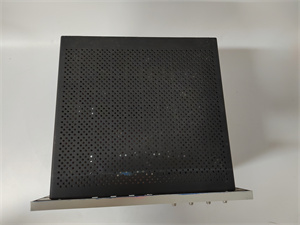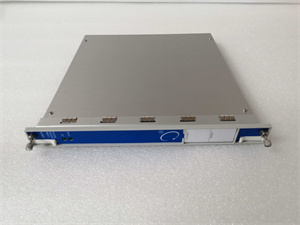
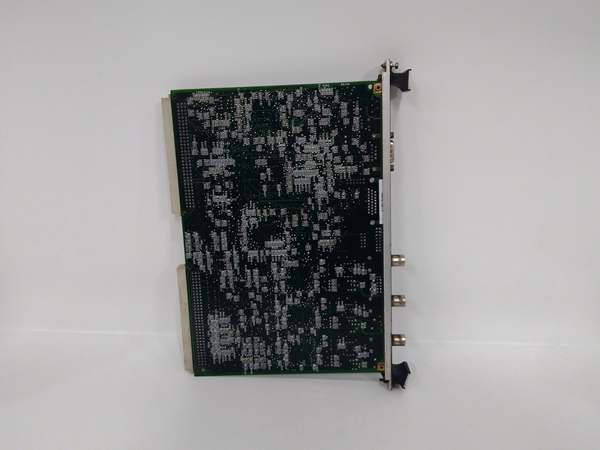
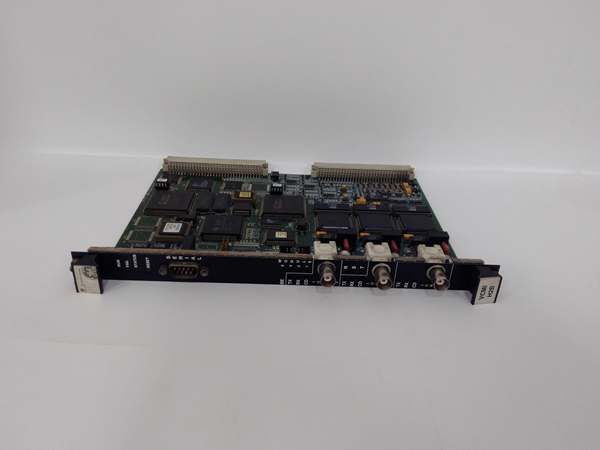
Description
Hard-Numbers: Technical Specifications
-
Processor: Texas Instruments TMS320C32 32-bit floating-point digital signal processor
-
Memory Architecture:
-
Dual-port memory: 32 KB (32-bit transfer configuration)
-
SRAM: 64K × 32
-
Flash memory: 128K × 8
-
-
Communication Interfaces:
-
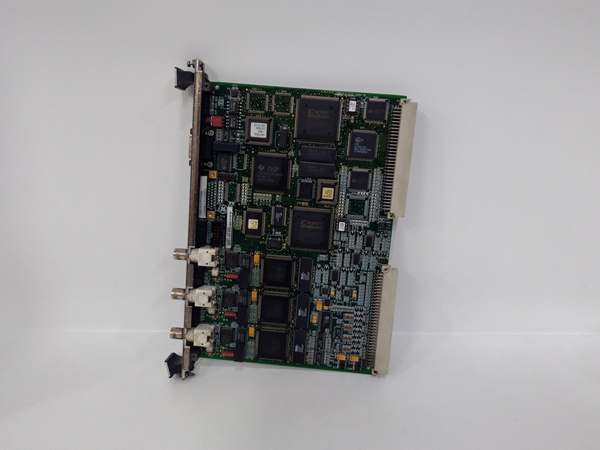
3× IONet 10Base2 Ethernet ports (BNC connectors, 10 Mbps)
-
VME64 bus block transfers
-
1× RS-232C serial port (DB9, 9600-38400 baud)
-
1× Parallel port (8-bit bi-directional, EPP 1.7 mode)
-
-
Redundancy: Triple Modular Redundancy (TMR) with SIFT (Software Implemented Fault Tolerance) voting
-
Frame Rate: 10 ms (100 Hz) for simplex, 40 ms (25 Hz) for TMR
-
Operating Temperature: -30°C to +65°C (-22°F to 149°F)
-
Board Type: 6U high VME board, 0.787″ (20mm) wide
-
Dimensions: 7 cm × 13.2 cm × 13.7 cm (approximate)
-
Weight: 0.3 kg (300g)
to 0.44 kg
-
Power Supply: Derived from VME backplane (+5V, ±12V)
-
Front Panel: 3× IONet BNC ports, 1× serial port, reset button, 4× LED indicator sets (3/6/8/3 configuration)

The Real-World Problem It Solves
You know the nightmare: a single communication fault in a non-redundant turbine control system causes the entire I/O rack to drop offline, tripping the turbine on loss of signal. The IS200VCMIH2BEE eliminates this vulnerability with triple IONet ports and SIFT voting—three independent communication paths (R, S, T) that vote on data integrity. If one IONet cable gets damaged or one port fails, the other two maintain communication without interruption. It’s not just a network card; it’s the backbone of your TMR architecture, ensuring that critical turbine data (speed, vibration, temperature) reaches the control processors reliably even during partial network failures.
Where you’ll typically find it:
-
Mark VI TMR control racks in Frame 7/9 gas turbines where communication integrity is safety-critical
-
Unit Data Highway (UDH) nodes connecting remote I/O racks to central controllers in combined-cycle plants
-
Emergency shutdown systems (ESD) requiring SIL-rated communication redundancy
Bottom line: It keeps your turbine control network alive during cable faults, port failures, or electromagnetic interference by voting data across three independent IONet channels.
Hardware Architecture & Under-the-Hood Logic
The IS200VCMIH2BEE mounts in a VME slot and acts as the bridge between the VME backplane (local I/O) and the fiber optic IONet (remote controllers/racks). It’s not a general-purpose computer—it’s a specialized communication processor with the TMS320C32 DSP handling protocol conversion, data voting, and fault detection in real-time.
Signal flow and processing logic:
-
VME Interface: The board monitors the VME backplane for I/O data from local boards (analog inputs, discrete outputs), buffering this data in dual-port memory accessible by both the DSP and VME masters
-
IONet Transmission: The TMS320C32 assembles data packets and broadcasts them simultaneously out all three IONet ports (R, S, T channels) to remote VCMI boards or control processors
-
SIFT Voting: On receive, the DSP compares data from all three IONet ports byte-by-byte; if one port disagrees (corrupted packet), the majority vote determines the valid data, flagging the discrepancy for maintenance
-
Fault Isolation: If an IONet port fails completely (cable cut, transceiver fault), the board automatically continues operation on the remaining two ports, maintaining TMR integrity without process interruption
-
Synchronization: The 40ms TMR frame rate ensures all three channels remain time-synchronized; the VCMI coordinates with redundant VCMI boards in other racks to maintain system-wide data consistency
GE IS200VCMIH2BEE
Field Service Pitfalls: What Rookies Get Wrong
Treating IONet Like Standard Ethernet Rookies see “Ethernet” and plug the BNC connectors into a Cisco switch with RJ45 adapters. IONet is 10Base2 (thinnet) with BNC connectors and proprietary GE protocols—not TCP/IP. The VCMI won’t link to standard Ethernet equipment, and you’ll get “IONet Fault” alarms that clear when you remove your patch cable.
Field Rule: IONet requires dedicated GE-approved fiber optic or coaxial cable (RG-58A/U for 10Base2). Use only BNC T-connectors and 50-ohm terminators. Never connect IONet to plant LAN switches—it’s a separate control network. Verify the “IONET” LEDs on the front panel show solid green for all three ports; flashing indicates packet errors or voting mismatches.
Ignoring SIFT Voting Diagnostics The VCMI performs SIFT voting continuously, but rookies don’t check the diagnostic registers. A single IONet port with intermittent errors won’t fail the system (TMR continues on 2-out-of-3), but it indicates impending cable or transceiver failure.
Quick Fix: Access the VCMI diagnostics via the RS-232 port (9600 baud) or through the Mark VI ToolboxST software. Check the SIFT error counters—if one channel shows accumulated errors while others are clean, swap the IONet cable and BNC connector for that channel. Don’t wait for complete failure; replace the cable during the next maintenance window.
Confusing Simplex and TMR Versions The “H2” in VCMIH2 indicates TMR (three IONet ports). Simplex versions (VCMIH1) have only one IONet port. Rookies install a simplex VCMI in a TMR rack and wonder why redundancy alarms won’t clear—the board physically lacks the S and T channel hardware.
Field Rule: Verify the part number suffix before installation. IS200VCMIH2BEE = TMR (3 ports). IS200VCMIH1BEE = Simplex (1 port). The front panel visually confirms this—TMR boards have three BNC connectors in a row; simplex has one. Installing the wrong version breaks your TMR architecture and defeats the safety design.