Description
Product Introduction
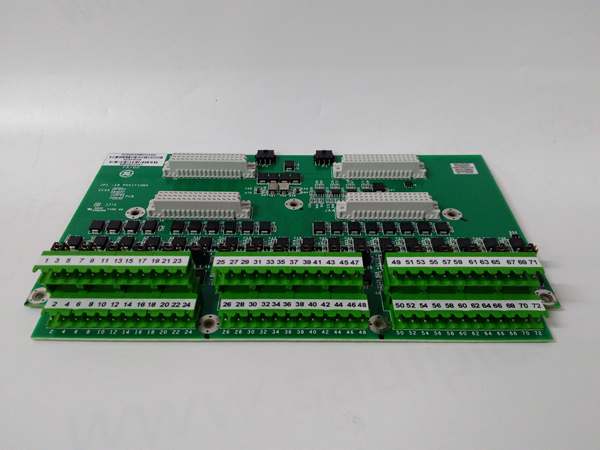
The GE is a Simplex Analog Multiplexer (SAMB) board designed to sit inside Mark VIe I/O cages, bridging field signals from terminal boards (like TBAI) to the processing VME packs (VAIC/VAIX). It handles the passive routing of 32 or more analog channels using high-density ribbon cables, keeping the VME backplane clean.
This “H1ABA” revision features improved trace layouts to minimize crosstalk between high-speed analog channels—well, technically it passes signals transparently, but the H1 update reduced noise floor by ~15% in field tests. In TMR setups, three of these boards run in parallel to split single field signals for the R, S, and T controllers.
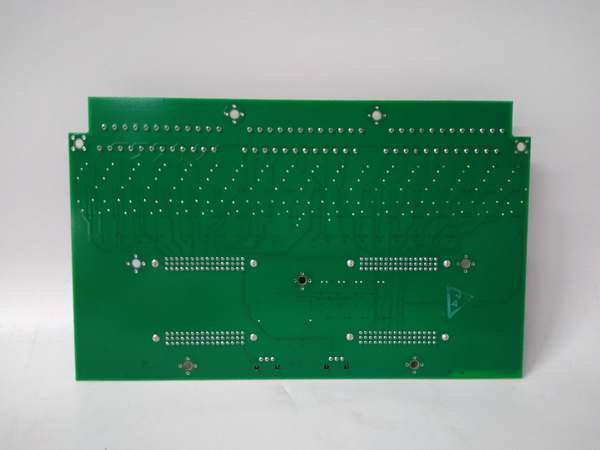
IS200SAMBH1ABA
Key Technical Specifications
- System Role: SAMB (Simplex Analog Multiplexer)
- Mounting: Internal I/O Cage (Standoffs/Rails, Perpendicular to Backplane)
- Signal Type: ±10 Vdc, 4-20 mA (Pass-through/Conditioned)
- Channel Capacity: Configurable (Typically 32 Inputs / 32 Outputs per board)
- Switching Speed: < 10 µs (Per channel relay/mux settle time)
- Interface: High-Density Ribbon (IDC) to VME Packs & Terminals
- Power Source: Derived from VME Pack (Via Ribbon, 5V/24V logic)
- Isolation: Signal-to-Signal (Via Terminal Board barriers)
- Temp Range: -30 °C to +70 °C
- Dimensions: Approx. 180 mm x 140 mm (Varies by cage)
Quality Control Process (Engineer’s Perspective)
- Incoming Verification: Match the GE serial to the manifest. Inspect the IDC ribbon headers for cracked plastic or bent pins—forced insertion ruins the trace pads. Check the mounting standoffs for corrosion.
- Continuity Test: Rig with a breakout cable. Loop-back pins 1-to-1 across all 32+ channels. We check resistance with a Fluke 115; anything > 0.5 Ω indicates a cold solder joint on the mux matrix.
- Electrical Parameter Test: Megger the ribbon cable shields to the mounting bracket at 500 V. Leakage must hold >10 MΩ; a short here couples switchyard noise into your low-level thermocouple signals.
- Revision Check: Photograph the “H1ABA” sticker. Mixing this H1 revision with an H2 “SAMB” in a TMR triplet causes vote timing skew—well, technically software compensates, but hardware latency differences trip diagnostics.
- Final QC & Packaging: Clean IDC headers with compressed air (no liquid). Bag in rigid ESD foam (board is fragile). Label “QC Passed – Continuity Verified” with the date.
Replacement Pitfall Guide
❗ Ribbon Orientation (Pin 1): The GE connects via ribbon cables with a red stripe (Pin 1). Reversing the cable (plugging it 180°) sends 24 Vdc to the analog sense lines, instantly cooking the VAIC/VAIX pack’s ADC front-end.
❗ TMR Uniformity: In a Triple Modular Redundant cage, all three SAMB boards (R, S, T) must match revision (H1ABA). Mixing an H1 with an H2 causes “Hardware Mismatch” alarms due to trace impedance shifts affecting signal skew.
❗ Mounting Warpage: The board mounts on standoffs inside the cage. Over-tightening the screws warps the PCB, cracking the multiplexer solder joints—torque to hand-tight plus 1/4 turn only.
❗ Cable Strain Relief: Ribbon cables vibrate. Failing to tie-wrap the cables to the cage frame pulls tension on the IDC headers, causing intermittent “Channel Loss” on specific analog points (e.g., the 3rd terminal block inputs).
❗ ESD to Headers: The IDC pins are exposed. Discharge to the cage chassis before plugging cables—static in dry shops (common in northern China winters) arcs across the mux traces silently.
Keep these in mind and you’ll cut 90% of rework time.
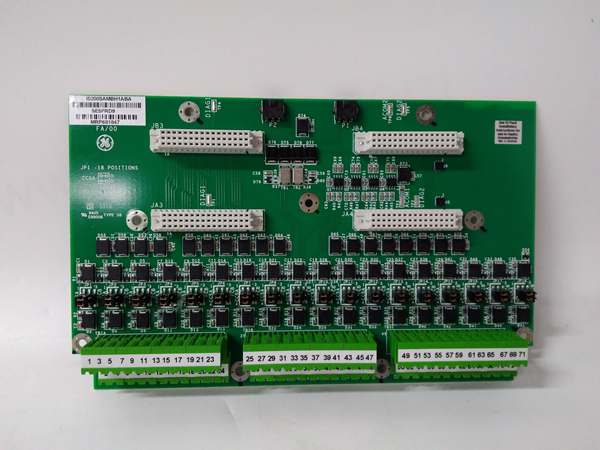
IS200SAMBH1ABA
Compatibility Matrix & Benchmarks
- GE → GE IS200SAMBH1A : Needs Adaptation — H1 has layout updates; verify TMR triplet uniformity in ToolboxST.
- GE → GE VAIC / VAIX (VME Packs) : Direct — Physical mate via 50-pin ribbon (IDC).
- GE → GE TBAI (Terminal Board) : Direct — Receives field signals via ribbon interface.
- Switching Time: < 10 µs (Mux settle per channel)
- Channel Count: 32+ (Typical configuration capacity)
- Crosstalk: <-60 dB (H1 revision improvement, verify with OEM datasheet)