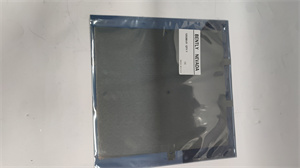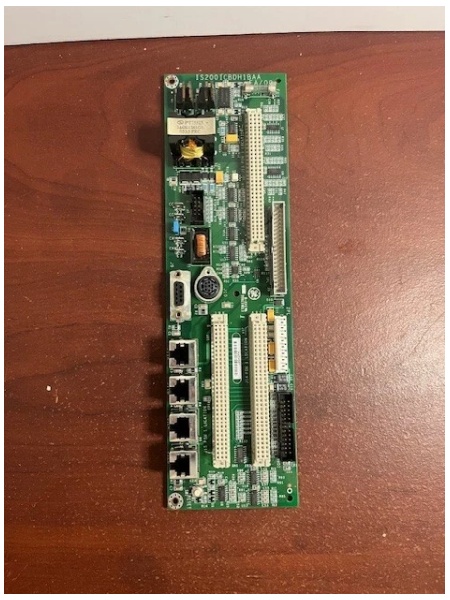
Description
Key Technical Specifications
-
Model Number: IS200ICBDH1BAA
-
Manufacturer: General Electric
-
Logic Voltage: +5 V @ 1 A, ±12 V @ 150 mA from VME back-plane
-
Analog Inputs: 12 differential, ±10 V or 4-20 mA jumper-select, 12-bit resolution, 5 kHz BW
-
Analog Outputs: 4 isolated, ±10 V, 5 mA drive, short-circuit protected
-
Signal Types: LVDT, servo current, 4-20 mA fuel/pressure, TC mV, vibration (Velomitor/Accel), gen/line volts
-
Connectors: 96-pin DIN VME, two 20-position pluggable (JE, 3PL) for field cables
-
Isolation: 1500 Vrms channel-to-logic, 500 V channel-to-channel
-
Diagnostics: Green “BOARD OK,” red “FAULT” LEDs visible through bezel
-
Operating Temperature: –20 °C to +70 °C (conformal-coated)
-
Dimensions / Weight: 22 × 16 × 9 cm, 2.3 kg

IS200ICBDH1BAA
Field Application & Problem Solved
A 1995 frame-7 peaker still expects clean, isolated ±10 V signals that represent servo current, LVDT position, fuel pressure, and exhaust temperature. The IS200ICBDH1BAA is the card that does the scaling. It sits in the Mark V VME rack, reads raw mV from thermocouples, 4-20 mA from fuel-flow transmitters, and ±10 V from dual LVDTs, then dumps the data onto the VME bus every 10 ms. When the card drifts—usually a precision divider resistor opens—you see 3 % low servo current and the unit trips on “SERVO FAULT DIFF”; swap the board, re-torque the JE and 3PL plugs, and the numbers snap back to the original calibration. You’ll find this PCB in any Mark V that still uses the RST I/O scheme: paper-mill back-pressure sets, refineries, and every frame-7 that never upgraded to Mark VI. Its value is repeatability: the divider network is laser-trimmed, so you get the same servo gain the turbine was commissioned with—critical for keeping old electromechanical overspeed bolts happy.
A 1995 frame-7 peaker still expects clean, isolated ±10 V signals that represent servo current, LVDT position, fuel pressure, and exhaust temperature. The IS200ICBDH1BAA is the card that does the scaling. It sits in the Mark V VME rack, reads raw mV from thermocouples, 4-20 mA from fuel-flow transmitters, and ±10 V from dual LVDTs, then dumps the data onto the VME bus every 10 ms. When the card drifts—usually a precision divider resistor opens—you see 3 % low servo current and the unit trips on “SERVO FAULT DIFF”; swap the board, re-torque the JE and 3PL plugs, and the numbers snap back to the original calibration. You’ll find this PCB in any Mark V that still uses the RST I/O scheme: paper-mill back-pressure sets, refineries, and every frame-7 that never upgraded to Mark VI. Its value is repeatability: the divider network is laser-trimmed, so you get the same servo gain the turbine was commissioned with—critical for keeping old electromechanical overspeed bolts happy.
Installation & Maintenance Pitfalls (Expert Tips)
LVDT common-mode blow-up—differential only, never ground
The LVDT inputs are true differential; land the shield on the wrong pin and you stuff 120 VAC into a 10 V amplifier—op-amp blows, card smells like fish. Always tie shield drain at the junction box only, float it at the card.
The LVDT inputs are true differential; land the shield on the wrong pin and you stuff 120 VAC into a 10 V amplifier—op-amp blows, card smells like fish. Always tie shield drain at the junction box only, float it at the card.
JE vs 3PL reversal—+24 V on mV input cooks the amp
The JE and 3PL headers are keyed alike but pin-outs differ. Land a 24 VDC contact on the thermocouple header and you stuff +24 V into a 100 mV input—trace burns open. Match the white wire-stripe to the silk-screen arrow before you push the plug home.
The JE and 3PL headers are keyed alike but pin-outs differ. Land a 24 VDC contact on the thermocouple header and you stuff +24 V into a 100 mV input—trace burns open. Match the white wire-stripe to the silk-screen arrow before you push the plug home.
Conformal coat cracked—salt fog kills the 2.5 V reference
The board is coated, but the 20-pin edge is masked. If the coat cracks, salt bridges the precision reference and you see 5 % offset on every channel. Scrape the salt, hit the edge with 2100-FTG, and re-coat—problem gone for another decade.
The board is coated, but the 20-pin edge is masked. If the coat cracks, salt bridges the precision reference and you see 5 % offset on every channel. Scrape the salt, hit the edge with 2100-FTG, and re-coat—problem gone for another decade.
Missing shoulder washers—card arcs to rack
The four corner holes are through-plated. Forget the fiber washers and the card edge sits 0.5 mm proud; 125 V generator voltage finds the rack paint, arcs, and blows a hole in the ground plane. Use the original GE shoulder washers—torque to 8 in-lb, no more.
The four corner holes are through-plated. Forget the fiber washers and the card edge sits 0.5 mm proud; 125 V generator voltage finds the rack paint, arcs, and blows a hole in the ground plane. Use the original GE shoulder washers—torque to 8 in-lb, no more.
Technical Deep Dive & Overview
IS200ICBDH1BAA is a 12-channel analog front-end frozen in 1995 silicon. A quad 741 op-amp array scales LVDT and servo signals; a 12-bit ADC converts them; an FPGA latches the data onto the VME bus every 10 ms. Because everything is hardware-scaled, you can swap the card hot and the controller never knows—just kill the 24 VDC field power first or you’ll arc-weld the 20-pin plugs. Think of it as a ruggedized signal conditioner that lives in a coal-dust cabinet; treat the differential inputs like instrumentation jewels and the servo loop will stay rock-solid for another thirty years .
IS200ICBDH1BAA is a 12-channel analog front-end frozen in 1995 silicon. A quad 741 op-amp array scales LVDT and servo signals; a 12-bit ADC converts them; an FPGA latches the data onto the VME bus every 10 ms. Because everything is hardware-scaled, you can swap the card hot and the controller never knows—just kill the 24 VDC field power first or you’ll arc-weld the 20-pin plugs. Think of it as a ruggedized signal conditioner that lives in a coal-dust cabinet; treat the differential inputs like instrumentation jewels and the servo loop will stay rock-solid for another thirty years .